Get a quick blog summary with:

Key Takeaways
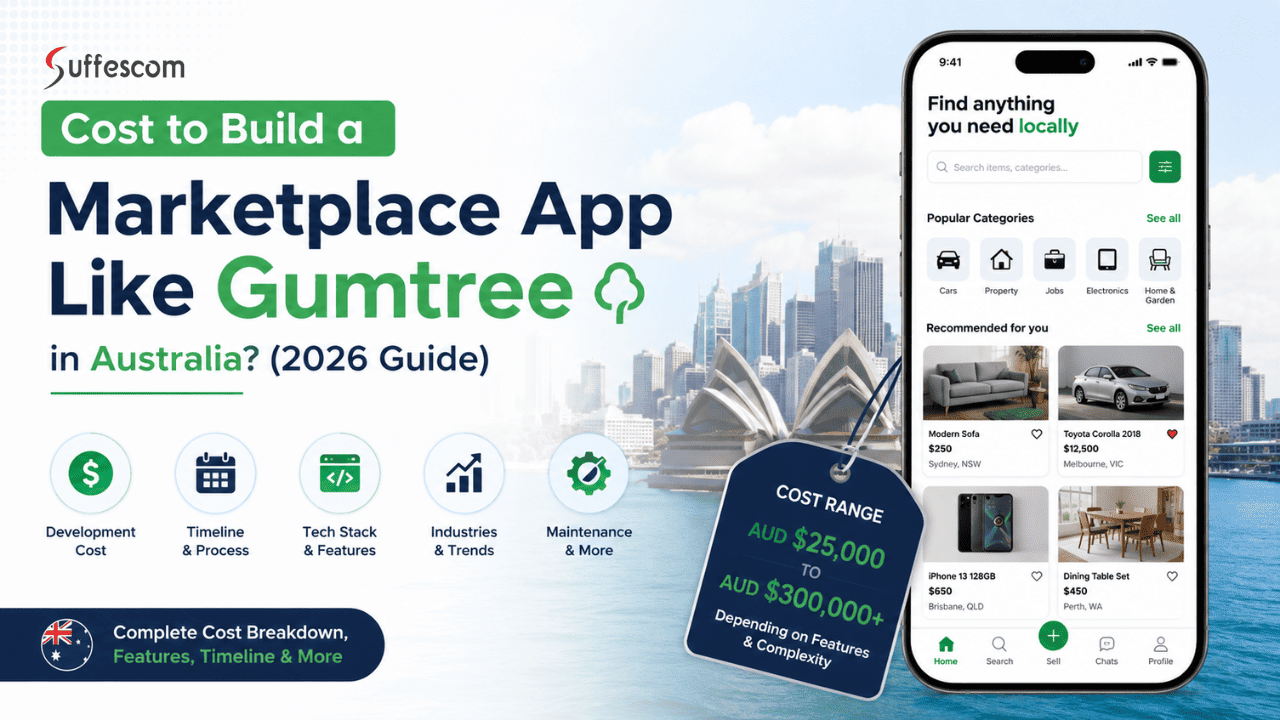
- Building a marketplace app like Gumtree in Australia can cost between AUD $25,000 and $300,000+ based on features and scalability.
- MVP marketplace apps are the best option for startups because they reduce risk and allow faster market testing.
- Essential marketplace features include product listings, search filters, and admin dashboards.
- Marketplace apps can make money from revenue strategies like commissions, featured listings, and seller promotions.
- AI features like smart recommendations, fraud detection, AI search, and chatbots are becoming important for modern marketplace apps in 2026.
Introduction
Marketplace application development in Australia is growing rapidly as customers are increasingly moving away from traditional retail methods and utilizing mobile-first purchases via their smartphones. One of, if not Australia’s most popular marketplace apps, Gumtree, has completely changed the way Australians shop for second-hand items and find local services or connect to buyers/sellers in their area (for example, they can view multiple furniture, car, real estate and freelance services available for sale locally).
According to the most recent statistics regarding eCommerce trends (particularly in Australia), online marketplace sales continue to increase annually due to the demand for convenience, sustainability, and the growing popularity of the circular economy. Since so many Australian’s are making the choice to use second-hand marketplaces to save money and be environmentally responsible, there are many opportunities for Australian-based and international-based startups who wish to invest their time/efforts in developing classified apps or developing mobile apps related to marketplace solutions (classified apps vs marketplace apps is largely a matter of degree).
Additionally, this trend has led companies to look to develop their own customized marketplace applications designed for specific industry segments, including automotive, real estate, trade service providers, rental properties, fashion resale, and various types of local service providers, to increase interest in developing custom marketplaces. Therefore, companies have multiple motivations for developing mobile apps, which provide them with a recurrent revenue stream through items sold via commission-based sales from customers, subscription fees, promoted listings, and in-app advertising.
Developing an app such as Gumtree will have a wide range of development cost estimations in Australia, dependent on the following: features of the app, complexity, scalability, and technology stack that will be used. Based on an example, the minimum development cost of an MVP for a simple marketplace application will be in the range of AUD $25,000 – $60,000, while the maximum possible cost to develop a high-end marketplace platform (Enterprise level) with AI functionalities and high complexity would exceed AUD $300,000.
This guide is about how much it costs to build a marketplace application in Australia. We will look at the prices, for a version and a full version. The marketplace application has some features that it needs to have. We will also talk about how to make money from the application. It is also important to think about how it will take to build the application. We will look at what technology to use to build the marketplace application. Sometimes a marketplace application project does not work out. We want to help people who are just starting out and people who already have a business. They are thinking about building an application to make a marketplace. We want to give them the information they need to decide if they should invest in building a marketplace application.
What Is a Marketplace App Like Gumtree?
A marketplace application, such as Gumtree, is a digital platform that connects buyers and sellers in one mobile or web-based application. Users of marketplace applications are able to list products and services, communicate with prospective purchasers directly, negotiate pricing with prospective purchasers, and make payments in person or online. Marketplace apps in Australia are rapidly growing as they become part of the larger ecommerce and start-up lifecycle as the demand continues to grow for quick solutions on how to buy and sell using a mobile platform.
Classified marketplace applications are very different from traditional ecommerce marketplaces, where the business sells directly to the customer. They function as intermediaries. That means that the owner of the application generates income from Publisher Ads. The owner of the app generates some of that income by receiving commission, selling advertising on the app, selling featured listings or subscriptions, or promoting sellers. The users of the application are necessarily third-party users as their actions are transactions between the buyer and seller.
How Classified Marketplace Apps Work
Classified marketplace apps are designed to simplify the buying and selling of goods by providing options for both parties (the buyer and the seller) when completing their respective transactions, including: Listing Items; Creating Messaging; Conducting Transactions Through a Payment/Transaction Processor; and Providing Location-Based Discovery of Items for Sale (Using GPS).
Buyer-Seller Interaction
The interaction between a buyer and seller is one of the key components of building a successful classified app. Once a buyer has found something they like, they can use the classified ads system to locate and compare products and contact a seller directly through messaging (for example, a seller from Sydney could post their iPhone to Gumtree and then communicate instantly with potential buyers within that same area using the app).
Because the marketplace app allows buyers and sellers to communicate with each other directly, they’re able to complete their transactions faster and with a more personal touch as opposed to using traditional ecommerce websites to complete their transactions.
Product Listing and Messaging
Product listing networks enable vendors to enter photographs, write descriptions, select category assignments, and set price structures. Advanced market application systems also have the ability to upload video, generate descriptions using artificial intelligence (AI), and automate category assignment suggestions; these tools enhance the overall quality of submitted listings.
An integrated messaging system is just as necessary for effective operation. A messaging application that has real-time chat ability allows users to ask questions, negotiate prices, and establish trust with sellers before completing their purchases. Applications where users are able to communicate smoothly generally have higher levels of user engagement as well as conversion rates.
Payments and Location-Based Discovery
In addition to an effective product listing and messaging system, the vast majority of modern marketplace mobile applications have included secure payment systems such as Stripe or PayPal to allow for easy processing of payments associated with purchases. Other marketplace applications have also included features such as seller verification systems and escrow payment solutions to reduce the likelihood of purchase fraud.
Another key feature of successful modern marketplace mobile applications is location-based discovery. Local users can quickly search for products and/or services that are being offered for sale in their nearby suburbs, thus providing the user with the ability to quickly and easily purchase from a local seller. This hyper-localised approach has greatly contributed to the overall success of classified application systems in Australia.
Popular Marketplace Apps in Australia
As evidenced by the significant number of popular applications in Australia that service various industries and meet various customers’ needs, Australia has a thriving marketplace-based economy.
Gumtree
Gumtree is one of the most recognised classified applications in Australia and allows users to purchase and sell automobiles, electronics, household items, rental property and local services.
Facebook Marketplace
Facebook Marketplace has quickly become a very popular place to buy and sell goods, by providing a way for people to find each other through their friends and community groups and feel comfortable buying and selling to each other.
eBay
eBay continues to be one of the largest online marketplaces and is characterised by its auction-style selling, nationwide delivery options, and large variety of products in numerous product categories.
Airtasker
Airtasker is an example of how creating a marketplace app is not limited to selling physical products but can also be used to connect people with local service providers who can perform tasks like cleaning, moving, fixing things and providing freelance services.
Why Marketplace Apps Are Growing in 2026
Marketplace app development is growing rapidly in Australia due to changes in consumer habits and the growth of mobile commerce.
Circular Economy Trend
Australians are more frequently buying used goods to reduce waste and save money. There is increasing interest in sustainability and therefore an increased demand for resale and classified ads sites.
Local Buying Behaviour
There has been a shift toward hyperlocal buying, giving consumers an advantage in terms of shorter wait times, lower shipping costs and a direct means of communicating with sellers who are nearby.
Mobile-First Commerce
With most online shopping activity taking place through mobile devices, entrepreneurs and businesses focused on today’s consumer should be prioritizing the creation of a mobile app to reach consumers through a marketplace.
AI-Powered Recommendations
Improvements in user interaction and higher conversion rates within marketplaces can be achieved through the use of AI-driven search, product recommendations personalized to each user, automated moderation of listed products, and smart pricing tools.
How Much Does Marketplace App Development Cost in Australia?
The most commonly asked question for those looking to build a marketplace app like Gumtree is what will it cost? The answer to this question is reliant on many factors—including app complexity, number of features, scalability of the application, third party integrations for the application, and expertise of the development team.
Building a marketplace mobile application is typically more complex than building a standard ecommerce application due to the need for multi-user architecture, real-time communication systems, payment integrations, administrator dashboards, and various methods of establishing trust, including reviews and verification systems.
In Australia, the rates associated with app development are generally higher than those found in offshore markets due to the higher cost associated with supporting local talent and supporting compliance requirements and higher levels of support for product strategy. However, by partnering with experienced Australian developers of marketplace applications, you will generally see improvements in scalability of your app, improved user experience design, and lower long-term costs associated with re-developing your app.
For start up companies, the best strategy is always to launch their product in the form of an MVP marketplace application. An MVP will allow them to determine whether there is sufficient demand for their product and also allow them to reduce the costs of their initial investment. Once the marketplace app has established itself in terms of usage and popularity, additional features like AI based suggestions, analytical dashboards, subscriptions and automation tools can be added over time.
To provide prospective clients with a better understanding of common marketplace app development costs within Australia within the year 2026, we have compiled a useful cost breakdown.
Average Cost to Build an App Like Gumtree
| App Version | Estimated Cost (AUD) | Ideal For | Typical Features Included | Estimated Development Timeline | Scalability Level |
| Basic MVP Marketplace App | $25,000 – $60,000 | Startups validating an idea | User registration, product listings, search filters, messaging, admin panel | 2–4 Months | Low to Medium |
| Mid-Level Marketplace App | $60,000 – $120,000 | Growing businesses scaling operations | Payment gateways, ratings & reviews, push notifications, analytics, seller dashboards | 4–7 Months | Medium to High |
| Enterprise Marketplace Platform | $120,000 – $300,000+ | Large-scale marketplaces and funded startups | AI recommendations, advanced moderation, subscriptions, real-time infrastructure, multi-region support | 8–12+ Months | High / Enterprise Grade |
Marketplace App Development Cost Breakdown
The costs of developing a marketplace app in Australia are often divided into several categories of both technical and operational expense types. By gaining a better understanding into where their investments are made, clients may better prepare their budgets for their business, as well as reduce any chance of unexpected expenses arising as they develop their app. Whether they are creating a startup MVP or developing an enterprise level marketplace platform such as Gumtree, all stages of development are critical to the scalability, user experience and overall success of their app.
UI/UX Design Cost
The cost for designing a user interface/user experience ranges on average between $5,000 and $20,000 Aus, depending on the complexity of the design, how many screens are being designed, and if there are any specific brand requirements. When developing a marketplace mobile application user experience plays a significant role in not only engaging buyers but also helping sellers retain their users. When the interface has poor design elements it can lead to decreased conversions and a higher rate of abandonment from the app.
Facebook Marketplace is known for its intuitive browsing experience, allowing sellers to upload products quickly and providing messaging systems that allow for seamless communication, all in an effort to create better user engagement.
iOS and Android App Development Cost
The average cost to develop native iPhone and Android applications is typically between $15,000 and $50,000 Aus per platform. The average cost will vary based on the complexity of features, the use of third-party integrations, and the methodology used to build the application.
In general, businesses that choose to develop two separate applications using native technology will perform better on their respective platforms due to better optimisation of device performance between platforms. However, due to the costs associated with developing two native apps many start-up businesses in Australia are now choosing to use technologies such as Flutter or React Native for building cross-platform applications in order to reduce the cost of developing the application and speed up the time to market.
Backend Development Cost
Back-end development is generally considered the most costly portion of developing a marketplace application, with costs typically ranging between $20,000 and $80,000 Aus. The back-end of an application powers user authentication, provides a listing management solution, facilitates messaging, payment processing, provides notifications and analytics, as well as provides the cloud infrastructure.
As an example, if a marketplace application goes from having 5,000 active users to having 500,000 active users, then the need for scalable back-end architecture to provide speed and reliability is critical.
Admin Dashboard Development
Admin dashboards typically range in price from $5,000–$20,000 AUD. Admin dashboards are designed to allow each marketplace owner the ability to monitor users, moderate listings, track transactions and revenue, as well as provide reports of some potential fraudulent activity.
API Integration Costs
Cost of third party API integration can vary greatly and range from $3,000–$15,000 AUD for most. Some of the most common third party integrations could include: PayPal and Stripe for payment processing, Google Maps, Firebase for API notifications, Twilio for Messaging service, and Analytics tools. All of the above will provide enhancement to overall functionality of a platform and ultimately an organization through increased efficiency.
QA Testing and Maintenance Costs
The QA testing of an app will vary from $5,000–$25,000 AUD based on the complexity of the application as it relates to how well it will perform on devices, operating systems and through various network conditions. After your app has launched, you will want to budget for maintenance and support on an ongoing basis (15%–20% of your original development budget) to cover bug fixes, server support and management, routine system/applications security updates, enhancements to features and overall scalability of the platform to remain competitive within Australia’s ever-changing digital marketplace sector.
| Development Component | Estimated Cost Range |
| UI/UX Design | $5,000 – $20,000 |
| iOS App Development | $15,000 – $50,000 |
| Android App Development | $15,000 – $50,000 |
| Backend Development | $20,000 – $80,000 |
| Admin Dashboard | $5,000 – $20,000 |
| API Integrations | $3,000 – $15,000 |
| QA & Testing | $5,000 – $25,000 |
| Maintenance & Support | 15–20% annually |
Factors Affecting Marketplace App Development Cost
Numerous variables influence the price of creating a market app in Australia, including how complicated of an app it is, how scalable the app has to be, as well as having a desired software architecture. A simple MVP market app could start at $25k AUD, while an enterprise-level marketplace platform that has advanced functionality would exceed $300k AUD. Having knowledge about these factors that drive costs will help a company set its budget appropriately and avoid a great deal of cost to redevelop an application at a later time.
Number of Features
Typically, the number of features or the type of features that are included within a marketplace application will directly correlate to the cost of developing the solution. A simple classified marketplace with user registration, product listings, messaging, and filtering can be relatively inexpensive. However, if you want to include features related to artificial intelligence recommendations, subscriptions, seller analytics, and real-time tracking, your application’s development time and backend application complexity will greatly increase, therefore increasing your costs.
For example, a startup that builds a niche furniture resale marketplace would probably only need basic product listings and chat functionality for its MVP. On the contrary, a national marketplace like Gumtree would require thousands of product listings, advanced category management, advanced moderation systems, and a scalable cloud infrastructure.
Native vs Cross-Platform Development
Native mobile application development costs are generally much greater than cross-platform (web-based) mobile application development due to having to develop two different platforms (iOS and Android) with two different code bases. However, there are a great deal of speed, performance and integration advantages when utilizing a native mobile application over a non-native mobile application.
Performance of enterprise marketplace apps that anticipate high volumes of user traffic could lead to the decision to develop the iOS application in Swift and the Android app in Kotlin as a means to maximize their level of performance; whereas, many startups are taking advantage of using Flutter or React Native in order to save between 30 and 40 percent on their overall marketplace mobile app development costs.
AI Integrations and Real-Time Chat
AI enabled marketplace app features are becoming increasingly prevalent amongst today’s marketplace applications, including, but not limited to: smart recommendations, automated fraud detection and AI Based search. By implementing features powered by Artificial Intelligence, user engagement is improved; however, additional machine learning and additional backend or infrastructure must be established.
One example is the use of “Personalised Recommendations” by Facebook Marketplace which utilizes user activity and your browsing history to increase conversion rates for users.
Furthermore, implementing Real-time Messaging systems requires significant investment in creating a stable infrastructure to support the thousands of users that would send Real-time Messages simultaneously (and possibly a notification).
Payment Gateway Complexity
Development costs are significantly impacted by the way that a marketplace application implements its Payments system. For example, setting up a simple direct payment option is usually cost efficient, however Escrow Payment systems, Commission Splitting; Refunds, and Seller Payouts require an intricate level of Payment architecture that adds to the complexity of the app being developed.
Scalability Requirements
When a business is going to grow fast it needs to plan for scalability. If a lot of people are going to use an app at the time it needs a strong backend to work properly. This means it needs good cloud hosting, a database that runs well and a content delivery network that is set up correctly.
If an app does not have a plan for scalability it can be really slow. Even stop working when a lot of people try to use it at the same time. Scalability planning is important, for apps that need to handle a lot of users. Scalability planning helps businesses make sure their apps keep working when they get really busy.
Security and Compliance
In the development of a day-to-day Australian marketplace app security is a key investment area when creating an app where you’re collecting users’ information and processing user online payments. Companies should use encrypted transactions for processing of payments, secure user authentication, catch potential fraud and ensure they are compliant with privacy regulations when processing user data.
An example of this would be for a marketplace that processes financial transactions by integrating multi-factor authentication into the marketplace app and using a secure payment gateway such as Stripe or PayPal.
MVP vs Full-Scale Marketplace App Development
One of the most important decisions when developing a marketplace application is determining if your company will launch with an MVP (minimum viable product) or invest in a Full Scale marketplace platform from the beginning. Many start-ups in Australia successfully launch their marketplace application with an MVP to validate their concept and obtain users prior to making significant investment in developing their marketplace.
The Minimum Viable Product (MVP) Marketplaces just include some of the maximum things to allow buyers and sellers to interact and connect effectively. Instead of this type of new application creating every possible high-end feature at once, the idea behind an MVP type of app is to create a viable application, get it to market quickly, receive feedback from users, and add/modify new features from what is experienced in real life when the product is being utilized for its intended purpose.
What Is an MVP Marketplace App?
The MVP Marketplace is the most basic version of a Marketplace concept with the look and functionality that you would expect from searching and buying a product on any similar type of website of this kind. An MVP Marketplace can be developed by the business consumer and enter into the space as quickly as possible with minimal costs associated with development.
For example, if a business in Sydney wants to launch a second-hand furniture marketplace like Gumtree, the MVP has to focus only on product listings, messaging, and search functionality. Features such as AI recommendations, subscriptions, advanced analytics, and automated moderation can be added later once the business gains traction.
Lean development methods are popular and valuable in the startup ecosystem. Lean methods allow new businesses to test the market with a minimal investment while allowing the business owners to understand the potential for scaling their business in the future.
Core MVP Features
Essential features within an MVP Marketplace that allow the Marketplace to function efficiently from the point of launch.
User Registration
To allow both buyers and sellers to register and log into their respective accounts with the use of email address, telephone number or social login credentials.
Product Listing
Sellers can upload product images, descriptions, categories and pricing associated with the product directly through the app.
Search and Filters
Users can search through the application to locate listings efficiently by way of keyword searches, category filters, price filters (where applicable), as well as by location-based searches.
In-App Messaging
It allows buyers and sellers to communicate in real-time. This functionality will allow buyers and sellers to communicate, negotiate prices and arrange pick-up or delivery in a secure manner.
Push Notifications
Push notifications will provide improved user engagement by providing notifications upon new messages, offers, listing approvals and/or pricing changes.
Admin Panel
A marketplace owner will have access to and be able to utilize an Admin Dashboard to manage the listings available on the marketplace platform, monitoring the users of the platform, moderating any content posted on the platform, and tracking the activity of users on the marketplace platform.
Typically for Australian start-ups, developing an MVP marketplace application can cost in the range of AUD $25,000 – $60,000 and can generally be launched within an 8 to 14 week period. This type of go-to-market strategy facilitates early user behavior testing and reduces risks associated with the development of the application.
Cost of MVP Marketplace App Development
| MVP Scope | Estimated Cost |
| Basic MVP | $25,000 – $40,000 |
| Advanced MVP | $40,000 – $60,000 |
The cost of developing an MVP marketplace application in Australia can vary greatly depending on the complexity of the application and the features that are included, as well as whether it will need to be scalable. Most startups in Australia will start off by creating a marketplace using an MVP because it allows them to create a minimal investment upfront while at the same time enabling them to determine whether there is any demand for their project.
The cost of creating a basic MVP marketplace application is usually between AUD $25,000 to AUD $40,000. The application will generally contain the minimum features necessary for an MVP. Some of the minimum features that will be included in this type of marketplace app are user registration, product listings, search filters, messaging capabilities, and a simple administration panel. Therefore, this would be a good choice for any business who is trying to check if they have a viable idea in a niche market, or if they are just starting to launch their product within a local area.
High level advanced MVP marketplace apps typically cost between AUD $40,000 to AUD $60,000. This type of MVP marketplace application will usually include many more features. For example, advanced payment gateways, push notifications, a reviews section, and analytics, as well as cloud storage and enhanced security.
For example, if a startup is developing a local (Brisbane) trade marketplace, the first stage of development may only have basic job posting and messaging functionality. Once users begin engaging with the platform and providing feedback, the company can then add the additional functionality such as real-time tracking, subscription features, and AI suggestions. This type of staged development approach enables businesses to avoid incurring excessive costs prior to determining whether a marketplace exists for their product line.
Full-Scale Marketplace App Features
Merchants are beginning to market their products through full-scale marketplace application development after gaining traction within the marketplace space. The benefits of this trend include increasing user engagement, improving monetisation opportunities, and providing a wider audience and structure for scalability.
AI Recommendations
AI algorithms are used to develop personalized products for consumers by analysing consumers’ past behaviour and product browsing history. Facebook Marketplace is one of many platforms that operate an AI recommendation engine, which is designed to improve customer engagement and conversion rates for sellers.
Multi-Language Support
Multilingual capabilities allow merchants to reach customers who speak different languages or to penetrate an international or multicultural market. This is particularly important for Australian-based marketplaces looking to service international customers or tap into migrant communities.
Video Listings
Video-based product listings provide a more engaging and trustworthy environment for consumers by allowing sellers to clearly demonstrate their products to customers. This format is increasingly used within the automotive, real estate, and fashion vocational marketplaces.
Subscription System
Marketplace retailers generate a monthly income via subscription structural revenue models. For example, retailers may be charged for premium listing services, subscription-based advanced analytics, or, as in the case of marketplace riders, paid to have an enhanced presence within the marketplace.
Live Location Tracking
Real-time location tracking allows consumers to quickly find nearby products and services through hyper-localised marketplaces. This feature is common across marketplace retailers who provide goods and services by way of delivery, rental, or on-demand service.
Fraud Detection
Marketplace platforms frequently incur a financial cost to develop fraud prevention systems to protect consumers’ trust in the marketplace and ensure they are safe and secure. Fraud detection systems are designed to be modulated and verified via an artificial intelligence (AI)-based performance measuring process to identify and reduce the amount of false activity that is true or genuine.
Analytics Dashboard
Advanced analytics dashboards allow companies to see how users behave in their applications, identify sales patterns, determine how their listings are performing, and track their overall platform growth. These insights enable startups to optimise dollar revenue generation and make better decisions.
Should Startups Build MVP or Full Marketplace Apps First?
MVPs are the preferred method of launching a marketplace app for most startup companies because typically this is the lowest risk option and creates the shortest timeframe to develop a complete marketplace. Building an entire marketplace from scratch will generally result in increased costs and timeframes to develop your marketplace.
Faster Market Validation
By developing an MVP, startups can quickly validate user demand before making a large investment in full marketplace capabilities.
Lower Investment Risk
Building an MVP will allow startups to validate their concept for $15,000 rather than the $150,000+ that most would otherwise have to spend upfront.
Easier Scaling
Startups launching an MVP with core functionality will do so before identifying which feature sets are needed for users within their marketplace.
Investor Attraction Benefits
Investors are more attracted to marketplace businesses that have already demonstrated usage and revenue potential through an MVP launch than those that haven’t yet launched a fully developed marketplace.
As an example, many of the large-scale successful Australian marketplace businesses started out with simpler versions of their current businesses before building the larger scale marketplace types of ecosystems that they have today with revenue generation capabilities and artificial intelligence technology.
Essential Features Required to Build an App Like Gumtree
Creating a thriving marketplace app like Gumtree requires more than just creating a basic platform for individuals to buy and sell. Today’s users want to be provided with fast, secure transactions, personalised experiences and an intuitive user interface, whether they are using a mobile device or accessing the web from a computer. A feature’s quality has a direct impact on user engagement, trust, retention and overall revenue generation within Australia’s digital marketplace where the competition is fierce.
Developing Marketplace mobile apps is typically focused on 4 areas – buyer features, seller features, administrator control and artificial intelligence (AI) / automation capabilities. Each of these four sections is crucial in performing well within the marketplace model, as well as for maintaining anonymity of the users utilising the marketplace over time.
Buyer Panel Features
The Buyer experience is one of the most critical factors in the success of developing a marketplace application. If buyers cannot find products quickly or easily, or they do not have a relationship with sellers, the conversion rate of the buyer will be greatly reduced.
User Profiles
User profiles enable buyers to manage their personal information, items they have saved, completed sales, and their preferred ways of communicating with sellers. Buyers are able to manage their profiles more effectively if they are verified – this way, all parties involved in the transactions can build better trust between themselves and each other and have a better experience when buying/selling within the marketplace.
Advanced Search Filters
Intelligent search and filter systems are designed to allow users to determine how fast or slow they would like to view results of their search for specific categories, locations, pricing, conditions, or keywords etc. An example would be a buyer searching for 2nd hand furniture in Sydney; the buyer will be able to filter results according to suburb, price range, and delivery methods.
Saved Listings
By using the saved listing feature, customers can save items to their account so they can come back later and re-check them. This increases customer engagement and encourages repeat visits.
Secure Payments
The payment api like Stripe or PayPal, allow customers to make secure and quick payments while reducing the risk of fraud.
Wishlist
Wishlists help to keep users engaged with the app by allowing them to track products they would like to buy in the future.
Ratings and Reviews
Review systems build trust between buyers and sellers. Platforms like eBay rely heavily on ratings to improve marketplace credibility.
Seller Panel Features
Seller-centered functions include the ability to administer listings, communicate with customers, and improve sales performance through features that enable sellers to optimally manage their businesses and other selling characteristics.
Product Uploads
Sellers should be allowed to upload multiple images, videos, prices and descriptions of their products quickly using their mobile phones.
Inventory Management
Provides an organized way for sellers to keep track of stock levels, accurately represent pricing changes, and update the status of a product in a timely manner.
Chat System
Real-time messaging improves buyer-seller communication and increases conversion opportunities.
Boost and Promoted Listings
Promoted listings let sellers pay to make their items more visible which gives the marketplace another way to make money.
Order Management
Order tracking and transaction management tools help sellers keep an eye on completed sales orders that are still pending and refunds.
Admin Panel Features
The admin panel is like the control room of the marketplace platform.
User Management
Admins can manage user accounts, deal with disputes and check users’ identities to keep the platform quality.
Content Moderation
Moderation tools help find listings, spam content and unsuitable material.
Fraud Monitoring
Fraud detection systems help reduce scams, suspicious transactions and misuse of accounts.
Revenue Tracking
Marketplace owners can track their commissions income from subscriptions, advertising revenue and payments from sellers.
Analytics Dashboard
Analytics dashboards give insights into how users there are, how well listings are performing, how customers behave and how engaged people are with the platform.
AI Features for Modern Marketplace Apps
AI functionality has become an essential part of differentiating between competitive marketplace applications during application development.
AI-Powered Search
Using artificial intelligence algorithms and models, you can understand users’ intentions when they search for items on your platform and how they behave.
Smart Recommendations
Scalable systems like Facebook Marketplace utilize recommendation engines to offer personalized recommendations for discovering new products and driving usage.
Automated Moderation
Modest artificial intelligence-based moderation platforms can automatically identify duplicate product listings, prohibited items, and/or potentially fraudulent behaviour within user-created listings.
AI Chatbot Support
The use of artificial intelligence chatbots enables companies to offer real-time customer service while reducing customer service workload (and subsequent employee cost), thus enabling businesses to respond more quickly to their customers’ requests.
Dynamic Pricing Suggestions
AI-based dynamic pricing applications analyze market demand and competitive data and suggest optimal pricing strategies to sellers to improve sales revenue.
Marketplace App Monetization Models
There are many opportunities to generate revenue for businesses that build marketplace apps; one of the major reasons why businesses build marketplaces is due to their potential for generating significant long-term (recurring) revenue. Examples of successful marketplaces include Gumtree, eBay and Airtasker, which all have scalable marketplace business models able to provide multiple recurring revenue streams through their many different monetisation options.
Whereas traditional eCommerce businesses make revenue by selling products directly, marketplace apps generate revenue by facilitating transactions between buyers and sellers (and thus increasing the potential for monetisation opportunities as users continue using the app). In addition, once a marketplace app has proven successful and a strong user base, there will likely be even more opportunities to generate recurring revenue through various monetisation strategies by both investors and start-ups interested in developing scalable digital businesses.
How Apps Like Gumtree Make Money
Successful marketplace applications employ multiple monetisation strategies instead of relying on only one source.
Featured Listings
Sellers who want their product listed at the top of search results or category pages will pay for this feature. This type of monetization (featured listings) is one of the most effective ways to generate revenue from your classified marketplace app, as it provides sellers with increased visibility to potential buyers and increases conversion rates for listings.
For example, if a car dealership sells cars on a marketplace platform, they may choose to pay to keep their listings above their competitors to increase the visibility of their inventory.
Commission Fees
Many marketplace applications use commission-based monetization models because they scale in direct proportion to the number of transactions that take place. Therefore, the marketplace nka receives a percentage of each successful transaction (sale or booking) that occurs through the app.
Airtasker, a type of marketplace application, makes a considerable amount of revenue by charging commissions on the completion of service transactions. This revenue model is extremely efficient, as it builds revenue with each completed and posted transaction.
Subscription Plans
Subscription plans generate recurring revenue for marketplace applications on a monthly or yearly basis. Sellers have the option to subscribe to a premium plan, which can include advanced analytics, unlimited listings, lower commission rates, and increased visibility.
For example, most real estate and automotive marketplaces provide subscription packages to agencies and professional sellers.
Banner Advertising
Businesses can purchase advertising space on marketplace application platforms in order to display sponsored advertising banners and product promotions. While the average revenue generated by advertising is generally lower than commission fees, revenue can be substantial once the app reaches a level of high user traffic.
Seller Verification Fees
There are several marketplace apps which charge sellers a verification badge to verify their identity. The purpose of these badges is to build trust with buyers and also to discourage fraudulent activities.
In-App Promotions
Marketplace platform apps include in-app promotional tools that allow sellers to increase their exposure for a short period of time by promoting listings during times of high demand.
Best Revenue Model for Startup Marketplace Apps
Most Australian startups find that using a mixed monetisation approach in conjunction with their current method tends to be the best option for early growth.
Freemium Strategy
With the freemium monetisation model, users will have access to the basic functions of the marketplace, free of charge. However, there will be a fee to upgrade to the enhanced (paid) version of the marketplace and to purchase enhanced seller support features.
Commission-Based Scaling
Because the commission model only requires that there is an increase in transaction volume for marketplace revenue to increase, it does not create pressure on new users to join the marketplace until it has begun to gain traction in the market.
Paid Boosts for Sellers
Paid promotions, known in the industry as seller boosts, can be one of the most straightforward types of monetisation to implement when creating a minimum viable product (MVP) for a marketplace app. Markets with minimal amounts of traffic can create early revenue from selling seller boosts to promote listings within the results of a search.
As an example of how this type of monetisation can work, consider a new furniture marketplace startup located in Melbourne, Australia. During the first six months of its existence, the marketplace will offer free seller listings. During the same timeframe, the marketplace will charge its sellers (at the rate of $50) to secure a homepage listing as well as a seller boost, which will be displayed in the search results. This monetisation model creates an immediate revenue stream for the sellers without discouraging new sellers from joining the marketplace.
| Monetization Method | Revenue Potential |
| Featured Listings | High |
| Commission Fees | Very High |
| Subscription Plans | High |
| Banner Advertising | Medium |
| Seller Verification Fees | Medium |
| In-App Promotions | High |
Best Tech Stack for Marketplace Mobile App Development
Choosing the right technology stack is a very important decision for developing a marketplace mobile app because it will have direct consequences on your ability to scale, the performance of your app, the security of your app, your costs of maintaining your app, and on any future growth of your application. In Australia, the technologies that businesses use to build their applications will differ depending on their budget, how fast they expect to grow as a business, and how complex they would like the feature set of their application to be.
Frontend Technologies
Frontend technology creates the way in which the user of the marketplace mobile application interacts with the application. To build the marketplace mobile application for both iOS and android platforms at the same time at the same cost, many companies use cross-platform software applications such as Flutter and React Native. The company will build one codebase that can be used to produce both iOS and Android marketplace mobile applications, and thus save on development costs and time to market.
When building native applications, the most preferred technology platforms are Swift and Kotlin. For native iOS applications, they will typically use Swift and when creating native Android apps, they will typically use Kotlin. As such, many of the marketplace companies that have the highest level of performance will generally choose to develop their applications using the native programming tools in order to provide faster application performance and better optimizations for the device capabilities of the respective platforms.
Backend Technologies
An infrastructure that allows back-end functionality and runs various aspects of a marketplace (i.e., listing items, messaging between users, processing a payment, sending out notifications, and managing real-time data) is required to take the back end of the application and provide users with a seamless experience. Node.js is a common back-end technology that can be used to build a scalable real-time marketplace; also, Laravel and Django can be used to build secure web-based applications. Firebase becomes a good choice among MVP marketplace apps due to its quick ability to create an MVP application compared to other backend technology solutions (such as Node.js or Laravel) and, because it has capabilities like authentication, cloud databases, and real-time chat capabilities.
Cloud & Infrastructure
The cloud and the infrastructure utilization of a marketplace app most often utilize either AWS, Google Cloud, or Microsoft Azure to host, store, and provide security.
Marketplace App Integrations
Integrations typically are required to complete a marketplace application and include payment processing services (e.g., Stripe and PayPal), mapping services (e.g. Google Maps), messaging services (e.g. Firebase Chat or Twilio), and content delivery (e.g., AWS CDN).
Marketplace App Development Timeline
The time it takes to develop a marketplace app can be around two to four months.. If the marketplace app has a lot of features and needs to work with other systems the marketplace app development will take a lot longer usually around six to twelve months to get everything done and tested.
Businesses that plan development stages carefully generally reduce costs, avoid delays and achieve a launch. Australian startups start with a simple approach because it helps them launch quickly, get user feedback and improve the platform bit by bit. They do this to get their product fast.
How Long Does It Take to Build an App Like Gumtree?
The development process has stages. Each stage helps make the platform better able to handle users and work smoothly.
| Development Stage | Estimated Timeline | What Happens During This Stage |
| Discovery & Planning | 1–2 Weeks | Market research, feature planning, competitor analysis, technical architecture planning |
| UI/UX Design | 2–4 Weeks | Wireframes, app interface design, user journey optimisation, prototype creation |
| MVP Development | 8–14 Weeks | Core feature development including listings, messaging, authentication, and admin panel |
| Testing & QA | 2–4 Weeks | Bug fixing, security testing, device compatibility checks, performance optimisation |
| Deployment | 1 Week | App Store and Google Play launch, cloud deployment, final configuration |
| Full Marketplace Development | 4–9 Months | Advanced features, AI integrations, scalability infrastructure, analytics, automation |
For example a startup that launches a fashion resale marketplace in Melbourne can build a version within 10 to 12 weeks using Flutter and Firebase. But if they wish to add features like AI recommendations, live tracking and fraud prevention tools it will take much longer.
Factors That Increase Development Time
Several technical and business factors can increase marketplace app development timelines.
Custom Features
The development and testing of features unique to a particular business including auction systems; payment systems that use escrows; providing an ability to list video content; and providing detailed analytics will require additional development and testing and may add several weeks or months to the time it takes to launch an app in a marketplace.
AI Integrations
To include an AI enabled search feature, provide smart recommendations, enable chatbot assistance, and provide automated moderation will require that additional back-end infrastructure be in place for proper machine learning processes to allow for any of these features to function as intended. All of these will add another layer of complexity to the app development project.
Complex Payment Systems
To provide multi-vendor payments, commission splitting payments, refund payments, and subscription / membership payments, and payment for escrow requirements, additional complexity of payment architecture and an increased number of compliance checks may be necessary.
Third-Party APIs
The vast majority of marketplace apps will require the use of integration to third-party API’s for mapping, messaging, analytics, cloud storage, payment processing, and notifications. Each API integration will take longer than anticipated and will require additional testing and compatibility verification.
Multi-Platform Support
Building separate marketplace platforms (iOS, Android, and web) will require significant increases in both development effort and quality assurance process.
For most Australian businesses that are developing a marketplace app, teaming/sourcing experienced marketplace app development companies will significantly shorten development timelines while decreasing the risk of delayed development timeframes, scalability challenges, and incurring significant expenses after the app is launched.
Why Marketplace App Projects Fail
Many marketplace app projects fail not because the idea’s bad. They fail because businesses launch without planning. They also fail because of lack of validation and scalable technology. In Australia’s growing marketplace industry users expect secure platforms. They also expect user-friendly platforms from day one. If the experience is poor users quickly move to established platforms like Gumtree or Facebook Marketplace.
Common Reasons Marketplace Apps Fail
There are business mistakes that can stop a marketplace app from growing successfully.
Overbuilding Before Validation
Many startups spend budgets on building advanced features. They do this before testing whether users actually want the product. This often leads to wasted development costs on marketplace app projects.
Poor UX/UI Design
If buyers or sellers find the app confusing they will not continue using it. They may also find it slow or difficult to navigate.
Weak Monetisation Strategy
Some marketplace apps gain users. However they fail to generate revenue. This is because monetisation was not planned properly from the beginning, for the marketplace app.
Lack of Scalability
Apps built without infrastructure often experience crashes. They also experience performance when user traffic increases for the marketplace app.
No Buyer-Seller Trust System
People will not use a platform if they do not trust it. They need to see reviews and verification badges. They need to know that their payments are secure. They also need to know that the platform is moderated. If these things are not in place users will not trust the platform enough to complete transactions. They will be afraid of getting cheated.
Choosing the Wrong Development Company
If you choose a company with developers they may build an app that is not stable. The app may have an architecture. This can cause a lot of problems. You will have to spend a lot of money to fix these problems.
Technical Mistakes in Marketplace App Development
Issues can cause a marketplace platform to fail. These issues can be very serious. They can make the platform unusable.
Poor Backend Architecture
A weak backend system can not manage things efficiently. It can not handle listings, messaging and payments. It can not handle a lot of user activity. This can cause a lot of problems.
No Cloud Scalability Planning
If you do not have a cloud infrastructure your app may become unstable. This can happen when there is a lot of traffic. The app may not be able to handle it.
Weak Security Implementation
If your security system is poor you are at risk of fraud and payment breaches. Your users’ data may also be leaked. This can be very bad for your platform.
Slow App Performance
If your app is slow people will not use it. They will get frustrated and leave. This will also affect your app store ratings. People will not give you ratings if your app is slow.
How to Successfully Launch a Marketplace App
To launch a perfect marketplace app, steps you need follow-
Start With MVP
When you launch a marketplace app with a version it helps you check if people really want to use it before spending a lot of money.
Focus on One Niche Market
If you target an area at first it helps new businesses build a stronger community of users and reduces competition.
Build Trust Mechanisms
Features like ratings, reviews, safe payments and checked profiles make people trust your platform more.
Invest in SEO and ASO
Search Engine Optimisation and App Store Optimisation helps in increasing visits to your website and downloads of your app.
Use Analytics From Day One
Use analytics tools, from the start to see how users behave improve features and make decisions about growing your app over time.
Cost to Maintain a Marketplace App in Australia
The cost to maintain a marketplace app in Australia is a deal. So you have launched a marketplace app in Australia. That is the start. You have to keep working on it to make sure the marketplace app is safe and can handle a lot of users in Australia. You also want the marketplace app to stay competitive in Australia. A lot of companies in Australia spend around 15 to 20 percent of what they paid to build the marketplace app each year to keep it running and fix problems with the marketplace app.
Ongoing Marketplace App Maintenance Costs
| Maintenance Area | Estimated Annual Cost (AUD) | Purpose |
| Server Hosting | $2,000 – $20,000 | Cloud hosting, storage, scalability |
| Security Updates | $2,000 – $10,000 | Data protection and fraud prevention |
| Feature Improvements | $5,000 – $50,000 | New features and UX enhancements |
| Bug Fixes | $2,000 – $15,000 | Performance optimisation and stability |
| Customer Support Systems | $3,000 – $20,000 | Chat support, CRM, ticket systems |
Regular maintenance of the app helps platforms deliver better performance, stronger security, and improved user experiences while supporting long-term business smoothness.
Should You Build a Marketplace App Like Gumtree in 2026?
Marketplace apps have been gaining popularity in Australia and all around the world. More and more individuals are now preferring to purchase and sell their products through mobile applications since they can do it much faster and conveniently. It has become evident that applications like Gumtree and Facebook Marketplace prove that people love to make local purchases and sales via the most basic platform on the go.
Marketplace app development for startups and businesses is beneficial since these applications can generate revenue through advertisements, commissions, subscriptions, and promoted listings.
Industries Benefiting from Marketplace Apps
Below is a list of industries that utilize marketplace apps.
Automotive
Used vehicles, bicycles, and car accessories are being purchased or sold in marketplace applications.
Real Estate
A variety of property-related marketplace apps allows users to find a house, flat, rental, commercial space, etc.
Local Services
Marketplace applications like Airtasker allow one to look for a cleaner, an electrician, a mover, etc., near the location.
Fashion Resale
Users resell their second-hand clothes, shoes, or accessories in order to save money and reduce the waste of resources.
Electronics
Used smartphones, laptops, video games, and other devices are sold via marketplace apps.
Furniture
The sale of second-hand furniture in the local vicinity through marketplace applications is common due to the ease of delivery and collection.
B2B Marketplaces
Businesses also use such apps for buying and selling goods in large quantities from suppliers and wholesalers.
Future Trends in Marketplace App Development
Marketplace applications are evolving rapidly owing to technological developments and consumer behavior.
AI-Powered Personalisation
AI assists applications in recommending products on the basis of consumer interests and previous searches.
Voice Search
Consumers can perform searches using voice input instead of typing.
AR Product Previews
Applications allow consumers to visualize how a product would appear at their home prior to purchase.
Hyperlocal Commerce
A greater focus is being placed on nearby buyers and sellers in order to accelerate transactions.
Blockchain Verification
Blockchain technology can assist in verifying products, payments, and other aspects of marketplace operations.
Why Hire a Marketplace App Development Company in Australia?
Choosing an appropriate development team is one of the critical steps when considering building your marketplace app like Gumtree. Such an outsourcing partner will help to decrease risks associated with development and increase scalability and usability of your platform.
There are several reasons why Australian companies choose to work with experienced Australian or globally renowned marketplace app development teams: marketplace apps require advanced backend technologies, secure payment system architecture, cloud infrastructure scalability, and user-friendly design and experience.
Benefits of Australian App Development Teams
Australian marketplace app development teams have better knowledge about business requirements and user experience in Australia compared to offshore development vendors.
Better Communication
Working with an experienced development team means improving communications and increasing project transparency and efficiency.
Local Compliance Understanding
Marketplace apps deal with sensitive data and payments, thus there are certain regulations that should be considered during the development process by marketplace app developers.
Faster Collaboration
Development teams with the same time zone are able to collaborate effectively and exchange their insights quickly during mobile app development.
Strong Product Strategy
Marketplace app development requires much more than programming skills. Experienced developers are also product experts who
Questions to Ask Before Hiring a Marketplace App Development Company
In order to hire a development partner that will work well with your business model, there are certain questions you need to consider.
Have You Built Classified Apps Before?
Marketplace apps are different from other mobile or web apps, as they require a special approach in terms of their development.
What Tech Stack Do You Recommend?
An experienced partner will share with you the reasons why they recommend using a particular technology stack when developing an application.
Can You Build Scalable Architecture?
Scalability is crucial for successful marketplace projects because they require constant updating and adding new features later.
What Post-Launch Support Do You Offer?
The ability to offer your users updates and make sure your app is running smoothly is one of the most important aspects in this process.
Agencies like Suffescom Solutions have experience in developing both mobile and web applications that can be used for different purposes, including ecommerce, marketplaces, healthcare solutions, etc. Many startups prefer to work with experienced development companies because they offer a wide range of services starting with UI/UX design and ending with post-launch assistance.
Conclusion
Developing a marketplace mobile app similar to Gumtree in Australia in 2026 can prove to be an excellent business venture due to the ongoing rapid expansion of mobile commerce and local shopping activities. The development cost of a marketplace application in Australia may vary depending on its complexity, starting at around AUD $25,000 for an MVP and going up to AUD $300,000 or more for advanced apps with AI functionality and other enterprise features.
The optimal development approach for many young businesses will be launching an MVP first, as this enables quicker validation and less risk in terms of expenses and product scaling. With user demand established, additional features including AI-powered recommendations, subscription plans, dashboards, and automations can be implemented later.
The ability to succeed in developing mobile apps that will work in a marketplace environment is dependent on having scalability, security, trust mechanisms, and sustainability in the monetization process. An app development firm can aid in launching a business quickly and with fewer errors through the development of a successful marketplace platform.
FAQs
1. How much does it cost to develop an app like Gumtree in Australia?
Building an app like Gumtree in Australia can cost a lot of money. It is usually between AUD $25,000 and $300,000 or more. This depends on what features you want, how big you want it to be and how complicated it is.
2. What is the cost of MVP marketplace app development?
A simple marketplace app, which is also called an MVP can cost between AUD $25,000 and $60,000. This app will have features like listings, messaging and search filters.
3. How long does marketplace mobile app development take?
It usually takes between 3 to 9 months to make a marketplace app this depends on how complicated the app’s what other things it needs to work with and what special features you want.
4. Which tech stack is best for marketplace app development?
There are good tools to make a marketplace app. Some of these are Flutter, React Native, Node.js, Firebase and AWS. These tools help make apps that can work well even when many people are using them.
5. What features are essential in apps like Gumtree?
Essential features include user profiles, listings, search filters, chat, secure payments, reviews, and admin dashboards.
6. How do marketplace apps make money?
Marketplace apps make money in ways some of these ways are commissions, subscriptions, featured listings, ads and seller promotions. These ways help the app owners earn money from the app.
7. Is cross-platform app development cheaper than native development?
Yes, cross-platform technologies like Flutter and React Native usually reduce development costs and launch timelines.
8. What industries benefit most from marketplace app development?
Many kinds of businesses can benefit from making a marketplace app. Some of these are automotive, real estate, fashion resale, electronics, local services, furniture and B2B industries. These businesses can use apps to reach customers.
9. What are the biggest challenges in marketplace app development?
Some of the problems when making a marketplace app are making sure it can work well even when many people are using it, making sure users trust the app, planning how to make money from the app, keeping the app safe and making sure there are enough buyers and sellers.
10. How much does marketplace app maintenance cost annually?
It usually takes 15 to 20 percent of the cost to make the app to maintain it every year. This helps keep the app working well and safe.
11. Can AI improve marketplace app performance?
Yes, artificial intelligence can help improve a marketplace app. It can help with recommendations detecting fraud, moderating the app, customer support and making the app more personal for each user.
12. Should startups launch an MVP before full marketplace app development?
Yes, new businesses should make a version of their app before making the full app. This helps them see if people want to use the app, reduces the risk and helps them launch the app faster with less money.
13. What causes classified marketplace apps to fail?
Some classified marketplace apps fail because they are not easy to use, they do not make money well, and they cannot work well even when many people are using them. They do not know if people want to use the app.
14. What is the best monetisation model for buy-and-sell apps?
Some of the ways for buy-and-sell apps to make money are by taking a commission on sales and by promoting some listings. These ways can help the app owners earn a lot of money.
15. How scalable should marketplace app architecture be?
A marketplace app should be made to work well in the future by using cloud infrastructure from the beginning. This helps the app work well even when many people are using it.
16. Is Firebase good for marketplace app development?
Yes Firebase is a tool to use for making a simple version of a marketplace app it helps with user authentication real-time chat and launching the app quickly.
17. How do you secure a marketplace mobile app?
A marketplace mobile app can be kept safe by using APIs, encrypted payments, authentication systems and monitoring for fraud. These things help protect the app and its users.
18. Why hire a professional marketplace app development company in Australia?
You should hire a company to make a marketplace app in Australia because they can help make an app that can work well even when many people are using it they know about local laws, they can make the app easy to use and they can provide help for a long time.

Senior Content Strategist
Jonathan Raabe works as a Senior Content Writer at Suffescom Solutions with an experience of 7+ years of writing for the technology and app development industry. He writes quality content about mobile app development, AI solutions, cloud technologies, enterprise software, and new trends in the digital world. Rabby creates content that both educates and contributes to business success. His skill in breaking down complex topics into understandable and relatable narratives has helped companies build their digital presence.

Need Help With
Development?