Get a quick blog summary with:

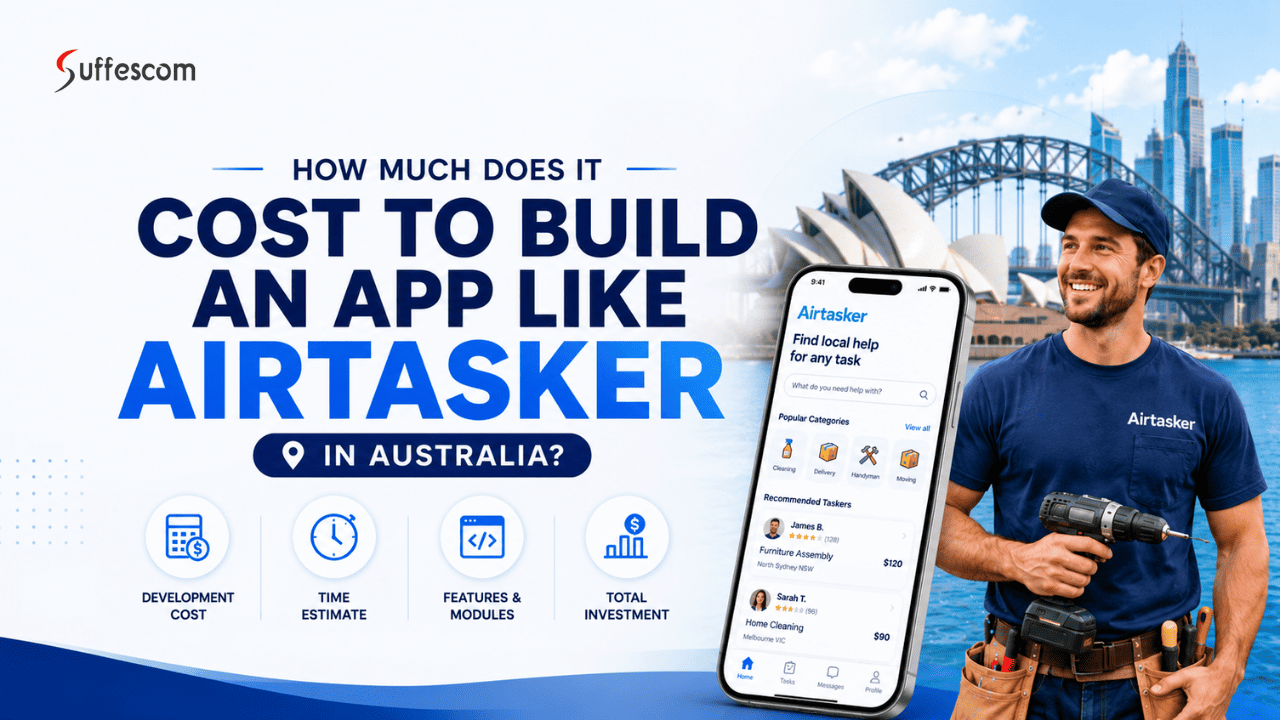
Australia is currently seeing rising demand for online marketplaces and service-based economy apps. These apps provide users with an easy way to find professional services. Platforms like Airtasker have successfully tapped into this demand by introducing a solution that makes hiring local service providers faster and more convenient. The app ranks in 6th position in the Business and Consumer Services Category.
With this growing market potential, many app founders are now considering developing a similar application. However, one of the primary questions that these budding entrepreneurs often have is: What is the cost of building an app like Airtasker?
In Australia, the development cost of an Airtasker-type app development can be considered from about $20k to $40k for an MVP with basic marketplace capabilities. On the other hand, a more serious startup marketplace app can be priced somewhere in the range of $40k-$100k. Large-scale and enterprise solutions can cost $200k or more.
But these are surface-level upfront prices. In reality, there are many factors that drive the cost of Airtasker-type app development.
Here in our guide, we will uncover what actually drives the cost of Airtasker-type app development in Australia, discuss different price ranges, consider whether MVP or full-scale development approaches are more profitable for the marketplace solution, and much more!
Airtasker-Like App Development Cost at a Glance
The price of creating an application such as Airtasker in Australia can be estimated within AUD 20k–AUD 250k+ based on the complexity of the application, its features, platforms, and scalability needs. The majority of start-ups start with developing an MVP marketplace app to prove that there is a market need before investing in advanced marketplace software.
An MVP marketplace mobile application featuring capabilities like task creation, bidding, communication, payments, and user management is estimated to cost about AUD 20k-AUD 40k. On the other hand, an advanced service marketplace mobile app featuring real-time technologies, recommendations, analytics, etc., can significantly escalate the development costs.
| Development Type | Estimated Cost (AUD) | Timeline |
| Lean MVP | $20k – $40k | 4 Weeks |
| Startup Marketplace App | $40k – $80K | 3 Months |
| Advanced Service Marketplace | $100K– $200K | 6 Months |
| Enterprise Gig Platform | $250k | 8 Months |
Main Factors That Affect Airtasker-Like App Development Cost
The total marketplace app development cost in Australia is mainly influenced by:
- Real-Time Chat Systems
- Secure Payment Gateway Integration
- GPS Tracking And Live Location Services
- Provider Dashboards And Earnings Management
- AI-Based Provider Recommendations
- Admin Dashboards And Analytics
- Scalability Infrastructure
- Third-Party Integrations
- Multi-Platform App Development
Why the On-Demand Services Market Is Booming in Australia
On-demand services in Australia have been experiencing rapid growth since many people would rather book their local services via their mobile phones or other online portals. Apps such as Airtasker have revolutionized the way that Australians source tradies, cleaners, removalists, dog walkers, and other local professionals.
These factors are being propelled by shifting consumer habits, the widespread use of smartphones, and the rising popularity of convenience-based services. Rather than seeking recommendations or reading classifieds, customers want fast booking processes, transparent pricing, reliable providers, and instant communication.
This development offers an exciting new business opportunity for startups and companies.
Rise of the Gig Economy
Australia’s gig economy is continuously growing as more and more people are moving towards flexible employment. The rising trend of tradie economy, increasing freelance services, and high demand for additional income are all playing their part in making service marketplace apps successful.
On the other hand, many local service industries are fast-paced in adopting technologies. Companies that used to depend on offline appointments have started turning to apps for customer acquisition and managing their services.
The following factors are driving the growth of marketplace apps:
- High demand for tradies and professional services
- Increase in freelancing and contractual services
- Trust in online marketplace apps by consumers
- Digital transformation of local service businesses
- Demand for instant booking and communication
- Consumers using mobile apps for service discovery
In this regard, marketplace apps are one of the most promising app categories in Australia’s digital economy.
Why Businesses Want Marketplace Apps
Marketplace applications enable businesses to build scalable platforms where service providers can interact with customers directly to make money from commissions, subscriptions, featured listings, and charges.
In contrast to regular service businesses, marketplaces can be scaled across various service types and locations without maintaining an extensive operational team.
| Industry | Marketplace Opportunity |
| Home Services | Very High |
| Cleaning | High |
| Handyman Services | High |
| Pet Services | Growing |
| Logistics | High |
| Healthcare Services | Growing |
Understanding the Airtasker Business Model
A platform similar to Airtasker is a two-sided market that allows customers seeking services to meet professionals or freelancers who can help them perform these tasks. Such applications are popular for providing home services, cleaning, assembling furniture, moving, handyman work, delivery, and other local services.
Such a platform serves as an intermediary between customers seeking services and providers, handling all the necessary steps, including payment, communication, task management, and even customer security.
Task marketplace applications have become increasingly popular in Australia due to their benefits, including convenience, a fast hiring process, clear prices, and flexibility for workers.
How Task Marketplace Apps Work
Airtasker-type applications usually have a very straightforward process flow for their users to post tasks and get offers from service providers.
The usual marketplace flow is as follows:
– User posts a task
– Service providers make bids/offers
– User chooses provider
– Payment is made using the application
– Task completion
– Ratings and feedback submission
With such a marketplace process flow, we are able to ensure transparency, competitiveness, and trustworthiness among service providers, and ultimately give better customer satisfaction.
Core Revenue Model
Marketplace apps make their money from different streams of monetization rather than depending on one stream of income only.
| Revenue Stream | Description |
| Commission Fees | Percentage charged per booking |
| Featured Listings | Paid task or provider promotion |
| Subscription Plans | Premium plans for service providers |
| In-App Ads | Additional monetization opportunities |
Exact Cost Breakdown to Build an App Like Airtasker
The overall cost of development of an application like Airtasker in Australia will depend on several processes involved in app development, which include the following: UI/UX designing, front-end development, back-end development, testing, integration, and others.
The marketplace application can be considered much more complicated to develop compared to normal mobile applications, as it involves many more features, like user differentiation, instant messaging capabilities, payment systems, management systems, etc. Hence, having a clear understanding of all costs of application development is crucial.
UI/UX Design
In terms of marketplace applications, UI/UX design is an important component that guarantees high user engagement as well as efficient task management for users who post tasks.
| Design Component | Estimated Cost (AUD) |
| Wireframes | $2k – $5k |
| Custom UI Design | $5k- $15k |
| Advanced Animations | $5k – $20k |
The final design cost depends on:
- Number of app screens
- Custom branding requirements
- Animation complexity
- User flow architecture
- Platform support for iOS, Android, and web
Frontend Development Cost
Frontend development involves developing the customer apps, the provider portal, and the administration panel. The need for several user panels within marketplace applications makes frontend development more expensive than normal business software.
| Frontend Module | Estimated Cost |
| User App | $10k – $40k |
| Provider App | $10k – $35k |
| Admin Dashboard | $5k – $20k |
Frontend development costs increase when adding:
- Real-time notifications
- Live task updates
- GPS tracking
- Advanced filters
- Multilingual support
- Cross-platform compatibility
Backend Development Cost
The backend infrastructure supports the fundamental features of the marketplace platform, which include authentication, chat features, payments, databases, and API integrations.
| Backend Feature | Estimated Cost |
| Authentication | $2k– $5k |
| Real-Time Database | $5k – $15k |
| Chat System | $4k – $12k |
| Payment System | $5k – $15k |
| APIs & Integrations | $5k – $20k |
Factors affecting the cost of the backend include:
- Scalability needs
- Architecture that supports real-time data
- Integration with third parties
- Cloud computing infrastructure
- Security measures
- AI capabilities
Australian startups opt for Firebase-based architectures when building their minimum viable product. They usually opt to develop their MVPs using Firebase architecture due to its simplicity and cost-effectiveness in the early stages of development.
QA & Testing Cost
Testing is crucial in order to ensure that the marketplace application works properly on all types of devices, various operating systems, and for all sorts of user actions. Marketplace applications have something to do with payments and user interaction; testing becomes a must-do prior to release.
| Testing Type | Estimated Cost (AUD) |
| Manual QA | $2k – $8k |
| Automated QA | $5k – $15k |
Costs associated with testing can rise based on:
- Application complexity
- Variety of supported devices
- Testing automation extent
- Security testing
- Payment flow testing
- Live feature testing
A fully tested market application will minimize problems after release and ensure users’ confidence.
Essential Features Needed in a Task Marketplace App
The success of such an application is heavily dependent on the functions provided to clients, suppliers, and platform managers. The right design should offer an efficient way of posting the job, making bids, communicating, conducting transactions, and managing services provided.
Most Australian startups first develop the basic functions of their marketplaces in the MVP version, with further developments following once a user base develops.
Customer App Features
The customer app is designed to help users quickly post tasks, connect with service providers, and manage bookings securely.
| Feature | Priority |
| Signup/Login | Essential |
| Task Posting | Essential |
| In-App Chat | High |
| Payments | Essential |
| Ratings & Reviews | Essential |
| Push Notifications | High |
These features enhance the customer experience through:
- Rapid onboarding process
- Effective communication
- Secure financial transactions
- Transparent service provider selection
- Constant booking status updates
Push notifications and in-app messaging can further boost user interaction and booking success rates.
Service Provider Features
Service providers require separate features for task management, income tracking, customer communication, and availability monitoring.
| Feature | Purpose |
| Task Bidding | Win jobs |
| Earnings Dashboard | Track income |
| Availability Settings | Manage schedules |
| Verification System | Build trust |
Such attributes are essential for assisting providers in:
- Rapidly responding to duties
- Handling their daily workload
- Keeping track of their completed duties
- Increasing their profile credibility
- Gaining customers’ trust
Verification systems are particularly essential within the Australian service marketplace industry, where trust and reliability significantly impact customer decisions.
Admin Panel Features
The admin dashboard helps platform owners manage users, monitor platform activity, handle disputes, and optimize revenue generation.
| Feature | Benefit |
| User Management | Platform control |
| Analytics Dashboard | Business insights |
| Commission Settings | Revenue optimization |
| Dispute Resolution | Customer support |
The benefits of having an efficient admin panel are as follows:
- Tracking performance of the marketplace
- Approving providers
- Managing income and bookings
- Handling payment disputes
- Commission and fee management
The growth of the marketplace dictates the need for advanced functionality of the admin panel.
Firebase vs Traditional Backend for Marketplace Apps
Selecting an appropriate backend architecture is the critical decision-making step involved in developing an app similar to Airtasker. The backend architecture handles key marketplace functions, including authentication, databases, instant messaging, payment processing, notifications, APIs, and scaling capabilities.
Australian startups intending to build their marketplace applications generally opt for either Firebase-backed backend architecture development or completely customized backend architecture development.
Firebase is usually chosen for MVP development owing to its capability to help startups launch their projects quickly with minimal infrastructure and DevOps overhead. Conversely, customized backend systems offer higher levels of flexibility and control required for enterprise-grade marketplace applications.
| Feature | Firebase | Custom Backend |
| MVP Speed | Faster | Slower |
| Initial Cost | Lower | Higher |
| Real-Time Chat | Built-In | Custom Setup |
| Scalability | High | Very High |
| Maintenance | Lower | Higher |
For the majority of initial-stage marketplace startups in Australia, Firebase provides a considerable simplification of the development process, as many services that constitute the platform’s backend are already implemented and ready for use.
That said, when a platform begins to grow in scale and becomes more complex, featuring such things as personalized workflows, sophisticated AI, powerful analytics, or enterprise-grade infrastructure, custom backend architecture usually becomes the option of choice.
Why Startups Prefer Firebase
There are several reasons why Australian startups choose Firebase as their backend solution when developing marketplace applications.
The main advantages of Firebase include:
- Fastened timeline for product launches
- Cost savings related to DevOps operations
- Built-in real-time database solutions
- Authentication system facilitation
- Quick implementation of chat and notifications functionality
- Scalability of the cloud environment
- Minimal backend maintenance needs
With Firebase, startups that are still validating their ideas will be able to create essential functionality fast without focusing on implementing advanced backend solutions at the beginning.
How Long Does It Take to Build an App Like Airtasker?
The mobile application development timeline is greatly driven by a couple of factors. First, what kind of vision do you have for your product, or mainly what kind of platform you are planning to build? Then, what functionality are you planning to add to your app? What integrations must your app be able to support, and how strong do you want your backend to be? These are some crucial points to get started with.
The timeframe required to create a marketplace application is higher than that needed to develop any regular mobile app because of various reasons, such as having different user interfaces, having communication channels in real-time, the capability of handling payments, and scalability.
Generally, in most instances, Australian startups prefer creating the MVP development before adding more features to the application.
| Development Stage | Timeline |
| Discovery & Planning | 2–3 Weeks |
| UI/UX Design | 3–5 Weeks |
| MVP Development | 2–4 Months |
| Advanced Features | 4–8 Months |
| QA & Launch | 2–4 Weeks |
What Increases Marketplace App Development Cost?
The price of creating an app similar to Airtasker will depend greatly on the specific features, integration capabilities, infrastructure, and scalability that you need to include in your application.
Although it is possible to create an MVP app on the basis of a fixed budget, adding complex functionalities will make the development and operation of such an application rather costly.
Awareness of these main factors can be helpful in planning the future roadmap for startups.
Real Time Features
The use of real-time functions is one of the main elements driving up the cost of creating apps for marketplaces. These functions demand sophisticated backend design, frequent server interaction, and robust cloud infrastructure.
Some examples of real-time functions are:
- In-app messaging services
- Instant notifications
- Task update notifications
- GPS location tracking
- Provider availability notifications
- Booking status updates
AI-Powered Matching Systems
Many current marketplace applications have begun implementing AI-enabled systems for enhancing their user experience, automating recommendations, and matching services.
Some advanced AI capabilities that can be included in the process are:
- Intelligent provider recommendations
- AI-based search engines
- Prediction of prices
- Automated classification of tasks
- Personalized user experiences
- Ranking algorithms
All these capabilities will involve increased costs due to the need for more development efforts, data analysis, and machine learning.
Nonetheless, the implementation of AI technology leads to enhanced platform engagement.
Multi-Platform Development
The number of supported platforms directly impacts development cost, testing complexity, and maintenance requirements.
| Platform | Cost Impact |
| Web Only | Lower |
| Android Development | Medium |
| Android + iOS development | Higher |
| Web + Mobile | Highest |
The development of different applications for each of these platforms entails extra work on the frontend part, user interface improvement, and maintenance.
Australian startups prefer to minimize their initial expenses when developing mobile apps by leveraging cross-platform development tools such as Flutter and React Native.
Third-Party Integrations
Marketplace apps often rely on external services for payments, maps, authentication, communication, and backend infrastructure.
| Integration | Use Case |
| Stripe | Payments |
| Google Maps | Location services |
| Twilio | SMS verification |
| Firebase | Backend infrastructure |
The costs associated with third-party integration are high because it involves:
- Configuring APIs
- Implementing security
- Backend synchronizing
- Testing and monitoring
- Maintaining
Nevertheless, the integrations make development faster and allow startups to create marketplaces more quickly by not having to build everything themselves.
MVP vs Full Marketplace App: Which Should Startups Build First?
It is typically more sensible for Australian entrepreneurs to construct an MVP prior to constructing the whole marketplace platform. The MVP will allow entrepreneurs to validate their business model ideas, find out whether users have demands for their product and service, collect feedback, and launch their products in the marketplace earlier.
Examples of many existing successful marketplace platforms, like that of Airtasker, prove that they all started out with basic functionalities before becoming complex platforms.
Although the full marketplace platform can provide a greater number of functions, it also means higher costs and complexity involved.
| MVP App | Full Marketplace Platform |
| Lower cost | Higher investment |
| Faster launch | Longer timeline |
| Core features only | Full ecosystem |
| Best for validation | Best for scaling |
Launching an MVP for startups before going into a market has many benefits that include:
- Quick time-to-market
- Less financial risk
- Product validation process
- Rapid customer feedback
- Low infrastructure cost
- Capacity to enhance features over time
After creating a successful market, a company can scale its platform by introducing features like AI recommendations, analytics dashboard, workflow automation, service provider verification, and enterprise-level infrastructure.
Recommended MVP Features
A marketplace MVP should focus only on the features required to launch, validate demand, and support basic marketplace operations.
- MVP Checklist
- User registration
- Task posting
- Provider bidding
- Payment gateway
- Reviews and ratings
- Push notifications
These core features are usually enough to:
- Connect customers with providers
- Manage bookings
- Process payments
- Build trust within the platform
- Validate marketplace demand
Hidden Costs of Building an App Like Airtasker
Most startup companies consider the budget that will go into the creation of the application only. Yet, the reality is that the cost associated with the maintenance and operations of the Airtasker-like platform would go far beyond the initial budget spent during the development stage.
Some operational costs that come with creating this kind of application are hosting fees, maintenance fees, customer support, and acquisition costs. This information can help a startup create a realistic budget estimate before going into full-scale development.
| Hidden Expense | Estimated Cost |
| App Store Fees | Ongoing |
| Cloud Hosting | Monthly |
| Maintenance | 15–20% annually |
| Marketing & User Acquisition | Variable |
| Customer Support | Ongoing |
App Store Charges
There are yearly charges applicable for developers to access both the Apple and Google Play Stores. In addition, commissions could be charged by the app marketplace based on the payment model adopted.
Cloud Hosting
Cloud-based servers need to be put in place to handle:
- Real-time chats
- Notifications
- Databases
- Storage
- Traffic
- Transactions
As such, monthly costs for cloud hosting tend to rise with the number of users and traffic.
Maintenance Expenses
The majority of marketplace applications need maintenance post-launch for:
- Bug fixes
- Features
- Security upgrades
- APIs
- Optimization
- Compatibility
For apps developed in Australia, maintenance costs are usually calculated to be roughly 15-20% of the initial development cost on an annual basis.
Marketing & User Acquisition
User acquisition is one of the highest hidden costs for startups in the marketplace niche due to the fact that both customers and vendors are needed. Companies tend to spend a lot of money on:
- Paid ads
- SEO
- Influencers
- Referrals
- Local promotion
- Performance marketing
Without proper marketing campaigns, even the most effective marketplace app will fail to thrive.
How to Reduce Airtasker App Development Cost
Creation of a marketplace similar to Airtasker might be quite costly for a startup because of the need to develop complex marketplace solutions and proper scalable infrastructure. Nevertheless, it is possible to minimize the development cost by choosing the right development approach from the very beginning.
Typically, successful marketplaces start their development process not from the creation of enterprise-level platforms, but from the development of a basic solution that allows entrepreneurs to test demand and grow step-by-step.
Create MVP First
Development of an MVP is one of the best ways to minimize marketplace app development costs. Instead of building all advanced features at once, entrepreneurs could concentrate only on the implementation of functionality that will allow them to test the business model.
Basic MVP functionality typically includes:
- Registration
- Job posting
- Bidding
- Payment system
- Feedback and ratings
- Notification system
This approach helps startups:
- Reduce initial investment
- Launch faster
- Gather real user feedback
- Avoid unnecessary development expenses
- Improve the product gradually
Use Cross-Platform Development
Building separate native apps for iOS and Android significantly increases frontend development costs. Many Australian startups reduce expenses by using cross-platform frameworks such as Flutter or React Native.
Cross-platform development helps by:
- Using a shared codebase
- Reducing development time
- Lowering testing costs
- Simplifying maintenance
- Speeding up updates across platforms
This approach is especially useful for startups targeting faster market entry with controlled budgets.
Use Firebase Backend
Firebase is widely used for marketplace MVP development because it reduces backend complexity and infrastructure management costs.
Using Firebase can help startups:
- Launch faster
- Reduce DevOps expenses
- Simplify authentication
- Implement real-time chat quickly
- Reduce server maintenance
- Scale efficiently during early growth stages
With respect to early-stage marketplaces, Firebase frequently offers adequate scaling capability without necessitating a substantial back-end engineering team.
Prioritize Core Features
The worst mistake a startup can make is over-engineering the product during the first stage of development. This can quickly lead to unnecessary costs and increased development time.
Startups should focus on:
- Core marketplace functionality
- Payment systems
- User management
- Provider onboarding
- Communication tools
Advanced features such as AI recommendations, automation systems, and predictive analytics can be added later after validating the market.
Launch in Phases
Instead of building a complete enterprise marketplace platform at once, many startups reduce risk by launching the product in phases.
A phased development strategy allows businesses to:
- Control spending
- Validate features gradually
- Improve scalability over time
- Reduce technical risk
- Prioritize features based on user feedback
This strategy also assists startups in being able to change their approach according to new demands without spending large sums of money on unnecessary development work.
Best Tech Stack for Airtasker-Like App Development
The technology stack will be important while developing a similar application to that of Airtasker. There will be certain consequences for choosing specific technologies in relation to performance, scalability, development time, security, and maintenance.
Startups in Australia will typically choose technology stacks that will ensure that their app is built and scaled up efficiently.
| Layer | Recommended Technology |
| Frontend | Flutter/React Native |
| Backend | Firebase/Node.js |
| Database | Firestore/PostgreSQL |
| Payments | Stripe |
| Cloud Hosting | Google Cloud/AWS |
Frontend Technologies
Cross-platform frameworks like Flutter and React Native are very much favored for creating marketplaces because they enable the development of applications that are compatible with both iOS and Android platforms through the same single code base. This saves a lot of time and resources spent during the development process.
Backend Technologies
Firebase, famous for its real-time databases, push notifications, scalability, and pre-made authentication tools, is preferred for MVP creation owing to the large number of readily available features. Large and customized marketplaces are generally created with the help of Node.js backend.
Database Solutions
To use real-time synchronization, one should consider using the Firestore database; otherwise, to follow a conventional method, one could opt for the PostgreSQL database.
Payment Integration
One of the most popular payment gateway providers is Stripe, which allows handling online payments, billing, split payments, and subscriptions in a seamless manner.
Cloud Hosting Infrastructure
It is common practice to use cloud computing providers such as Google Cloud and AWS to host marketplace applications thanks to their scalability, reliability, and security features.
The scalability of the tech stack becomes particularly relevant in the case of marketplaces because the traffic on the application might increase dramatically as the marketplace develops.
Why Choose an Australian App Development Team
Creating a platform similar to Airtasker involves not only technical creation but also considerations such as trust from users, payments, compliance issues, scalability, and product management.
Startups usually appreciate cooperation with software development companies located in Australia because native developers may have a greater insight into the local market, consumer behavior, and general service economy.
When it comes to creating a marketplace for the Australian audience, the involvement of native developers is important because it will minimize miscommunications.
Better Market Understanding
Australian app developers usually have stronger knowledge of:
- Local marketplace trends
- Gig economy behavior
- Tradie and service industry workflows
- Australian consumer expectations
- Regional competition
- Local payment preferences
This market understanding helps businesses build platforms that better match Australian user behavior and service marketplace demand.
Compliance & Security
Marketplace apps often handle:
- Customer data
- Payment information
- Provider verification
- Real-time communication
- Transaction management
Australian development teams would be better versed in Australian regulations and security practices required for marketplaces to operate in Australia.
This would prove particularly useful when developing applications in areas that include:
- Payment gateway systems
- Identity authentication
- Customer data storage
- Health care services
- Enterprise marketplace applications
Improved Collaboration
Collaborating with an Australian-based app development company is beneficial due to:
- Similar time zones
- Improved communication
- Quicker feedback loops
- Smooth project management
- Accessibility of local businesses
The process of developing a platform involves constant collaboration, which helps in the effective handling of feature planning, testing, reworking, and scaling of the product.
Product Maintenance
After launching marketplace apps, there will always be a need for constant updates and long-term maintenance. Once the platform starts gaining popularity and users, it may require:
- New features
- Optimization
- Improvements in scalability
- Bug fixes
- Security updates
- Monitoring of infrastructure
Marketplace Apps We Can Build
Tradie Marketplace App
We can build a scalable tradie marketplace platform that connects homeowners and businesses with electricians, plumbers, carpenters, painters, and other skilled professionals across Australia.
Features We Can Build:
- Real-time task posting and bidding system
- Provider verification and ratings
- GPS-based tradie discovery
- In-app chat and notifications
- Secure payment integration
- Provider earnings dashboard
- Admin analytics and commission management
Ideal For:
- Tradie startups
- Home service businesses
- Local contractor marketplaces
- Hyperlocal service platforms
Cleaning Services Marketplace App
We can develop a cleaning services app that allows users to book residential or commercial cleaning professionals through a seamless mobile experience.
Features We Can Build:
- Instant and scheduled bookings
- Recurring cleaning subscriptions
- Provider availability management
- Real-time booking updates
- Secure online payments
- Reviews and ratings system
- Customer support dashboard
Ideal For:
- Residential cleaning startups
- Commercial cleaning businesses
- Subscription-based cleaning platforms
Logistics & Delivery Marketplace Platform
We can build a logistics and delivery management platform designed for real-time tracking, driver coordination, and delivery automation.
Features We Can Build:
- Live GPS tracking
- Route optimization
- Driver management dashboard
- Automated delivery notifications
- Proof of delivery systems
- Multi-location order handling
- Analytics and reporting tools
Ideal For:
- Courier startups
- Last-mile delivery businesses
- Fleet management companies
- Logistics service providers
Hyperlocal Task Marketplace App
We can create a hyperlocal marketplace app that connects users with nearby service providers for everyday tasks and on-demand services.
Features We Can Build:
- Location-based service matching
- Instant booking functionality
- Provider onboarding and verification
- Real-time order tracking
- Push notifications
- Commission-based monetization
- Scalable multi-category marketplace infrastructure
Ideal For:
- Local startup marketplaces
- On-demand service apps
- Gig economy platforms
- Multi-service marketplace businesses
Conclusion
The Australian on-demand service industry is booming, presenting great chances for entrepreneurs and enterprises to develop scalable marketplace applications. No matter what marketplace platform you’re interested in creating, whether a tradie marketplace, cleaning services application, logistics solution, or hyper-local tasking application, having the correct development approach will enable you to launch quicker while keeping costs under control.
Develop your Airtasker clone app with a scalable infrastructure, real-time capabilities, and strategic approaches that cater to startups. From MVP development to cost assessment, as well as building out your marketplace, taking the proper technological approach can help you launch your marketplace more confidently.
FAQs
How much does it cost to build an app like Airtasker in Australia?
In general, developing an app similar to Airtasker in Australia may cost somewhere from AUD $20k–$40k. This price range is for MVP development. But when you want to add some additional features, such as AI matching, tracking, or multi-platform compatibility, etc, your development costs may increase. The total price for a scalable platform could exceed AUD $200k. To know the exact cost estimate, it’s advisable to talk to the development agency.
Our agency offers a free, non-obligatory consultation session where you can ask any questions you may have regarding product development, cost, and more. Schedule a call now!
How long does marketplace app development take?
There isn’t any fixed timeframe since each platform of marketplaces is unique. But drawing from our experience, usually, an initial MVP for a simple marketplace app could take up to 2 to 4 months to develop. However, in case you are building an extensive platform for marketplaces with real-time technology and other features, it may take up to 6 to 12 months or even more.
What are the key features of a service marketplace app?
A few critical features that must be incorporated into any service marketplace app are:
- User registration
- Task submission
- Service provider bids
- In-app messaging
- Payments
- Reviews
- Push notifications
- Service provider dashboard
- Management tools for administrators
Is Firebase good for marketplace app development?
Yes, especially start-ups or companies that are looking to develop an MVP. Firebase is capable of easing the process of developing a back end since many features that are important in app development are already built into the platform. It will assist businesses in releasing products faster and lower the costs associated with DevOps and infrastructure.
Can I start with an MVP first?
Definitely, in fact, many Australian businesses that develop marketplace platforms usually start out by developing an MVP. It is beneficial because it allows you to understand whether there is demand for your product on the market. It also helps you get feedback from users and avoid spending money on developing unnecessary functionality at an early stage.
What is the best tech stack for Airtasker-like apps?
It is not possible to have a tech stack that works universally, and that is because everyone will need something different depending on their needs. Budget and flexibility are also important factors that need to be considered. Nevertheless, there are frameworks such as Flutter and React Native that developers favor when developing the app’s frontend, especially for creating cross-platform applications. The two preferred choices when considering the backend include Firebase and Node.js, whereas Firestore or PostgreSQL can be considered for databases.
How do task marketplace apps make money?
You can make money from task marketplace apps, and there are generally many ways to do it. One such common business model involves taking commissions based on each successful task booking. Besides, other sources of income may include listing promotions. You may also offer provider subscriptions and can earn through them. Then, there are promotions, service advertising, and premium services for the marketplace, which can also help generate revenue.
What is the maintenance cost of marketplace apps?
Most often, maintenance expenses for development will be nearly 15% to 20% of the cost of its development each year. This usually consists of addressing any bugs, securing software, and paying for cloud server costs, etc. Boosting the efficiency of apps, adding new features, updating APIs, and enhancing scalability also fall under maintenance.
Should I build native or cross-platform apps?
Cross-platform development is a sensible option for most startups in the beginning because both development time and costs are lower. Frameworks such as Flutter and React Native enable you to skip dedicated iOS development and Android development. With a single codebase, your app will be accessible on both kinds of devices. But native app development might be considered when apps have high-performance requirements or need optimization at a hardware level.
How can I reduce development costs for my marketplace app?
The most intelligent way to cut down the costs involved in developing apps for the market is to begin with an MVP rather than going full scale from the beginning. Businesses can save on costs through cross-platform development, using Firebase backend infrastructure, focusing solely on critical functionalities in the first place, and releasing the product gradually.

Senior Content Strategist
Jonathan Raabe works as a Senior Content Writer at Suffescom Solutions with an experience of 7+ years of writing for the technology and app development industry. He writes quality content about mobile app development, AI solutions, cloud technologies, enterprise software, and new trends in the digital world. Rabby creates content that both educates and contributes to business success. His skill in breaking down complex topics into understandable and relatable narratives has helped companies build their digital presence.

Need Help With
Development?