Get a quick blog summary with:

Key Takeaways
- You can even use outsourcing mobile app developers to launch the apps as quickly as possible, create a minimum viable product, and use the specialised knowledge of the experts without hiring employees.
- Having your own development team provides you with more control over the processes and product ownership.
- A combination of both outsourcing and in-house teams gives the best possible outcome.
- Cost doesn’t only involve salaries or money that is spent, but also time, productivity, and sustainability.
- The appropriate development model is dynamic and may change along with your business growth and maturity.
- There are certain industries where outsourcing is not preferred because of legal reasons and security issues.
- It is common for many businesses to start working with agencies and then transition to in-house teams.
Introduction
In Australia, the development of mobile apps remains a highly dynamic area, where enterprises from various sectors are increasingly allocating resources for creating new digital products aimed at enhancing their clients’ experience, optimising internal processes, and generating additional revenue. Be it a financial company, a startup in the field of healthcare or retail, or a corporation, all of them need mobile apps to help ensure sustainable growth. Australia is a mature, mobile-first economy with over 22 million active smartphone users (nearly 80% of the population) and some of the highest digital adoption rates globally, further increasing the demand for innovative mobile applications.
Nevertheless, one of the main decisions a company has to make in preparation for creating an application is related to the way the application will be created. Would it be wise to collaborate with a professional mobile app development agency offering expertise to external developers or to create an internal development department within a company?
This decision can have great effects on project costs, project time, quality of the product, scalability, and the final ROI. Although some companies prefer absolute control due to having their own development department, other companies manage to create high-quality applications faster due to collaboration with an experienced mobile app development agency.
Agency vs In-House Team at a Glance
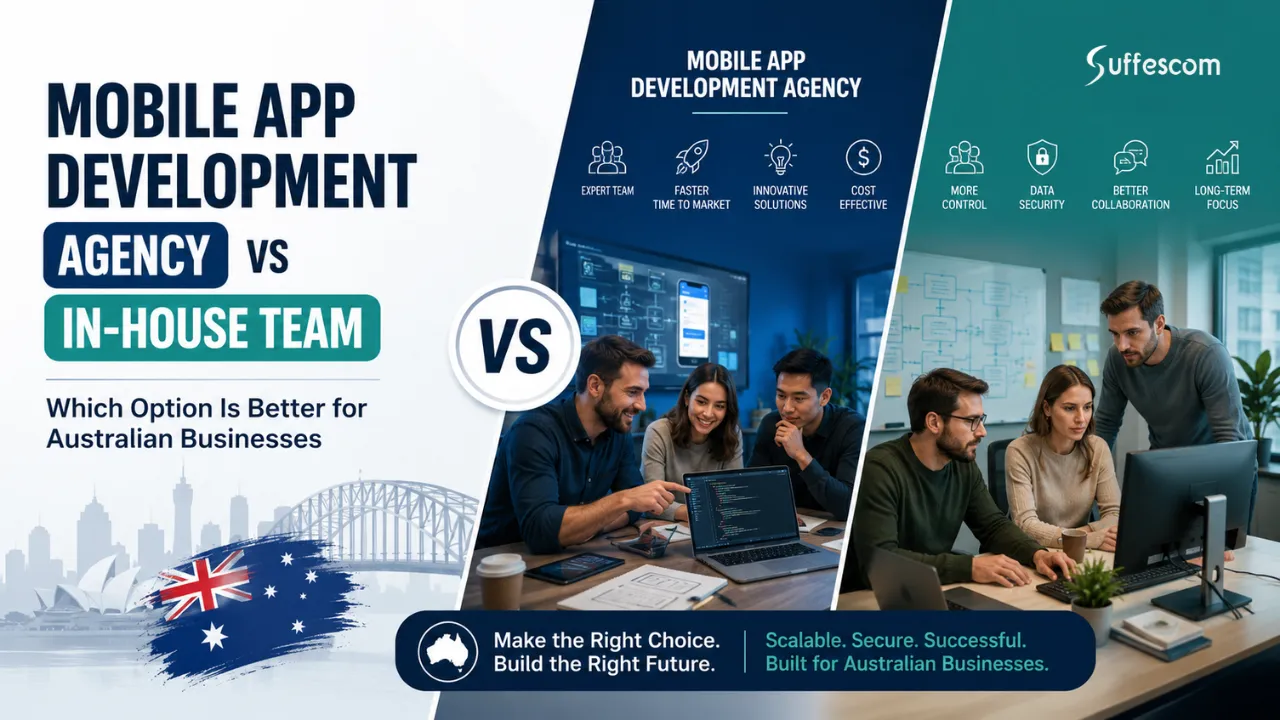
Mobile application developers are companies which employ a multidisciplinary group of professionals such as developers, designers, project managers, and quality assurance specialists in creating mobile applications on a project or recurring engagement basis. Mobile application developers have the ability to create teams quickly, bring in expertise and have known costs.
On the other hand, an in-house development team is one where a company hires professionals directly for its team. Such teams bring control, knowledge of the organisation, and long-term ownership of the product. However, hiring an in-house team is costly.
What You’ll Learn in This Guide
Within this guide, you will find an informative analysis that will allow making a conscious decision about whether to entrust mobile app development services to an outsourcing agency or create an in-house team from scratch.
Let’s also consider what the differences between a mobile app development agency vs in-house team will entail, with regard to:
- Real differences in development cost, hiring effort, and long-term ROI
- How each model impacts speed to market and product launch timelines
- The level of access you get to specialised talent and modern technologies
- Differences in quality control, security, and compliance handling
- Scalability challenges and how each model supports business growth
- Project management styles and communication structures in both setups
- Which model works best for different industries in Australia
- When a hybrid approach delivers better results than a single model
By the end, you’ll have a simple decision framework to confidently choose between an agency, in-house team, or hybrid model based on your goals, budget, and growth stage.
Understanding the Two Mobile App Development Models
However, before comparing the cost-effectiveness, timeframes, and other business results, one should be aware of how each model functions. Although both models can produce top-quality mobile apps, they are quite different in terms of team setup, resource distribution, managerial involvement, and scalability.
For Australian companies developing a mobile app for the first time, choosing the most appropriate model might be dependent on a number of factors.
What Is a Mobile App Development Agency?
The mobile app development agency is basically a professional company where you can hire the complete suite of resources for app development. Agencies have a range of personnel such as app developers for mobile platforms, UI/UX designers, project managers, business analysts, QA team and even DevOps engineers.
By hiring a mobile app development agency, you can take advantage of a whole team without having to hire each member in person.
Most agencies offer services such as:
- Mobile app strategy and consulting
- UI/UX design
- iOS and Android app development
- Cross-platform development using Flutter or React Native
- Backend and API development
- Quality assurance and testing
- App store deployment
- Ongoing maintenance and support
The business benefits from skilled and experienced individuals at a fraction of the cost and time associated with building and maintaining its own in-house staff.
How Mobile App Development Agencies Work
Mobile app development companies, more commonly than not, have in-depth, defined processes to minimise project risk and achieve quick time-to-market.
A typical engagement includes:
- Discovery and requirements gathering
- Product strategy and roadmap planning
- UI/UX design and prototyping
- Agile development sprints
- Quality assurance and testing
- Deployment to app stores
- Post-launch maintenance and feature enhancements
According to different needs for the project, agencies could provide fixed price contracts, dedicated teams, time & material services, or even hybrid cooperation.
Agencies, as they deal with numerous industries and projects, can help in achieving a greater project result through their valuable experience.
What Is an In-House Mobile App Development Team?
In-house mobile applications development is carried out by a team of individuals employed by the company itself. They are fully dedicated to developing the products of their employer and work according to the company’s rules.
For those firms that opt for this type of application development, the entire process of staffing and hiring people involved in developing mobile apps falls to them.
An internal team can provide:
- Greater visibility into daily development activities
- Full control over priorities and workflows
- Deep understanding of business operations
- Strong alignment with long-term product goals
- Immediate access to development resources
For organisations building complex digital products over many years, maintaining internal expertise may offer strategic advantages.
Typical Structure of an Internal App Development Team
It is important to remember that developing a productive in-house application team is not only about recruiting developers. Indeed, most successful app developments require the collaboration of a number of specific positions.
A typical internal team may include:
- Product Manager
- Project Manager or Scrum Master
- Mobile App Developers (iOS, Android, or Cross-Platform)
- UI/UX Designer
- Backend Developer
- QA Engineer
- DevOps Engineer
- Security Specialist (for regulated industries)
The more complicated the project becomes, the larger a team may need to become for its success.
Key Differences Between Agency and In-House Development
Even though both of these models strive to deliver successful mobile apps, there are many differences between them.
Resource Availability: Agencies offer access to multi-skilled employees instantly, while internal teams need to be formed from scratch with recruitment and training.
Cost Structure: In the case of agencies, work is usually performed according to projects or monthly fees, but in-house teams cost additional salaries and benefits.
Scalability: Agencies can always increase their scope of workers depending on the project’s needs very fast, while in-house teams will need a lot more time for that.
Knowledge Retention: The internal team possesses institutional knowledge, while the agency has the documentation and exchange of information throughout the process of the project handover.
Time-to-Market: The agency usually gets the work started sooner, as the project and team structure are already in place.
Control: While the internal team supervises the developmental activities directly, agencies have their processes set based on workflow and project management.
Ultimately, there is no superior option; there always is “an appropriate choice for your needs in your given budget, growth stage and long-term strategic roadmap in your product. What separates the two models is as outlined above.
Build Your Mobile App Without Hiring a Full Team
Access designers, developers, and QA experts without the cost of building an in-house team.
Mobile App Development Agency vs In-House Team: Quick Comparison
To the right of this table, there is a broad comparison of the two development models against the key elements that most directly affect the project.
Side-by-Side Comparison Table
| Factor | Mobile App Development Agency | In-House Team |
| Cost | Lower upfront investment with predictable project-based pricing | Higher long-term investment due to salaries, benefits, and operational costs |
| Hiring Time | Immediate access to an established team | Recruitment can take several weeks or months |
| Expertise | Access to specialists across multiple technologies and industries | Expertise depends on the skills of hired employees |
| Scalability | Resources can be increased or reduced quickly | Scaling requires additional hiring and onboarding |
| Project Control | Shared control through project governance and reporting | Complete internal control over priorities and workflows |
| Time-to-Market | Faster due to established processes and experienced teams | Slower due to hiring, onboarding, and team-building requirements |
| Maintenance & Support | Usually offered through ongoing support contracts | Managed internally by dedicated staff |
| Risk Management | Proven methodologies and experienced delivery teams reduce project risks | Greater responsibility for managing technical and operational risks internally |
| Innovation | Contact with new technology and cross-industry good practices | Innovations rely on internal training and information acquisition |
| Long-Term Commitment | Flexible models for collaboration with varying resource provision | Continuous funding for salaries, retention, and facilities |
Cost Comparison: Agency vs In-House App Development in Australia
Often, cost becomes the critical factor when firms decide whether to go for hiring an application development agency or create their own development team. Although both methods may lead to successful apps, the costs involved are quite different from each other.
The complete understanding of the whole mobile app development cost structure becomes crucial for determining ROI and choosing the most viable model of development.
Average Cost of Hiring an In-House Mobile App Development Team
A large amount of money should be invested in the establishment of your own Australian-based mobile app development team. Simply for salaries of the staff members of the small team – comprising a mobile app developer, UI/UX developer, QA engineer, a Project Manager and DevOps engineer- the price would range from AUD $540, 000 to AUD $750,000 per year.
With additional costs of superannuation, benefits for employees, recruitment costs, training, licensing fees, hardware, office rent, and staff retention programs included, the total cost could very well go above AU$800,000 per year. If a more complex project requires more developers, backend developers, security personnel, or even product managers, annual costs could be much higher – even up to AU$1 million.
Salary Comparison Table
| Role | Average Annual Salary (AUD) |
| Mobile App Developer | $110,000 – $150,000 |
| UI/UX Designer | $95,000 – $130,000 |
| QA Engineer | $85,000 – $120,000 |
| Project Manager | $130,000 – $180,000 |
| DevOps Engineer | $120,000 – $170,000 |
Cost of Hiring a Mobile App Development Agency
An alternative to establishing an in-house app development team would be to employ a mobile app development company, which can save money, especially when it comes to firms that require highly qualified specialists but are not able to hire permanent members of staff.
As for the prices for hiring a mobile app development company, it might vary between $30,000 and $500,000+ AUD, depending on the nature and complexity of an app.
| Project Type | Estimated Agency Cost (AUD) |
| MVP or Startup App | $30,000 – $80,000 |
| Medium Complexity Business App | $80,000 – $200,000 |
| Enterprise Mobile Application | $200,000 – $500,000+ |
| Ongoing Dedicated Development Team | $15,000 – $60,000+ per month |
Hidden Costs of Building an Internal Development Team
Most businesses do not realise how much it actually costs to develop in-house apps because all they are doing is looking at the wages.
However, there are actually a number of associated costs you never think about.
Common hidden costs include:
- Recruitment agency fees
- Job advertising expenses
- Employee onboarding and training
- Staff turnover and replacement hiring
- Paid leave and benefits
- Performance management
- Professional development programs
- Internal management overhead
- Productivity losses during hiring gaps
These costs can add tens of thousands of dollars annually to each technical hire.
Infrastructure and Software Expenses
A wide variety of tools and technologies, as well as infrastructure services, are required by internal development teams.
Typical expenses include:
- Development hardware and devices
- Testing smartphones and tablets
- Cloud hosting environments
- Project management platforms
- Source code repositories
- Security and compliance tools
- Design software subscriptions
- Continuous integration and deployment systems
- Monitoring and analytics platforms
Based on the scale of the project, expenses related to infrastructure and software may range from several thousand to tens of thousands of dollars per year. These operating expenses are usually covered within the cost of services provided by agencies.
Recruitment and Employee Retention Costs
The IT industry in Australia is very competitive; therefore, it is becoming more challenging for companies to acquire and retain skilled developers of mobile applications.
Organisations often face challenges such as:
- Long hiring cycles
- High salary expectations
- Competition from large enterprises and global technology companies
- Employee turnover
- Skills shortages in specialised technologies
In case one such developer quits, there may be certain issues related to delays, gaps in knowledge, and costs associated with hiring another developer.
IT development companies are able to eliminate the majority of these problems because they have access to more resources and recruitment processes.
Which Option Delivers Better ROI?
The answer depends on the business’s goals, project duration, and software strategy.
A mobile app development agency often delivers stronger short- to medium-term ROI because businesses can:
- Launch products faster
- Avoid recruitment delays
- Reduce operational overhead
- Access specialised expertise immediately
- Scale resources as needed
- Minimise hiring and retention risks
An in-house team may provide a stronger ROI over the long term when:
- Mobile applications are central to the company’s business model
- Continuous development is required for many years
- Extensive proprietary knowledge must remain internal
- The organisation can support ongoing hiring and management costs
However, for most startups, SMEs, or organisations creating their first app, working together with a professional app development company will be a safer and more affordable option. In contrast, companies with developed digital products and well-planned development paths might derive more benefit from keeping their own in-house teams.
Although the budget remains an essential criterion when making such choices, it is not the only one. An equally significant issue is how fast each approach enables you to get your product on the market, which will be discussed in the following section.
Reduce App Development Costs
Discover how the right development model can help you maximise ROI while controlling project expenses.
Time-to-Market: Which Development Model Launches Faster?
The selection of an app development company or building a dedicated team has a significant effect on time to market. Although external companies can provide immediate access to professionals, in-house teams need some more time to recruit employees, familiarise them with their duties, and organise them into a working team.
Agency Development Timeline Explained
Immediate commencement of mobile application development is another major benefit that businesses get from mobile app development agencies. This is because agencies already have teams composed of developers, designers, Quality Assurance testers, and project managers. Businesses can go ahead to discover and plan projects right away without losing precious months looking for staff members.
It will take only 3 to 6 months for a typical Australian business to develop an MVP by an agency, whereas more sophisticated applications will require up to 8 months to be created.
Typical Agency Development Timeline
- Discovery & Planning: 1–2 Weeks
- UI/UX Design: 2–4 Weeks
- Development: 8–16 Weeks
- Testing & QA: 2–4 Weeks
- Deployment & Launch: 1 Week
Total Timeline: 3–6 Months for MVPs, 4–8 Months for Enterprise Apps
In-House Team Development Timeline Explained
Creating an in-house development team takes considerable time before getting to the actual coding process. The company will need to hire developers, designers, QA engineers, and project managers, along with building processes for workflow and cooperation.
It will take the recruitment process several months in the cutthroat tech environment of Australia. This means that companies that create an in-house team find themselves having longer development cycles than those who contract an agency.
Typical In-House Development Timeline
- Recruitment & Hiring: 2–6 Months
- Onboarding & Team Setup: 2–4 Weeks
- Product Planning & Design: 3–6 Weeks
- Development: 4–8 Months
- Testing & QA: 3–6 Weeks
- Deployment & Launch: 1–2 Weeks
Total Timeline: 6–12 Months for MVPs, 8–15 Months for Enterprise Apps
Impact of Faster App Launches on Revenue
A timely release of the app can provide a significant economic advantage for the company. The firm will be able to start attracting users, performing transactions, testing the product-market fit, and making money prior to competing products being developed.
Early release of the app would also enable the business to obtain consumer feedback and make any necessary changes. Most times, the benefits of an app that is released on schedule outweigh the extra costs incurred in the process of developing the application.
Common Delays in Mobile App Projects
Regardless of the development model selected, certain challenges can slow down app delivery.
Common causes of delays include:
- Poorly defined project requirements
- Frequent scope changes
- Insufficient stakeholder involvement
- Delayed design approvals
- Technical integration challenges
- Inadequate testing processes
- Resource shortages
- Communication breakdowns
- Compliance and security reviews
Project management is one way of avoiding such risks for agency-led projects. Internally based teams have more knowledge regarding products than other teams, but they may suffer delays in case of limited resources or hiring problems.
Timeline Comparison Table
| Development Factor | Mobile App Development Agency | In-House Team |
| Team Availability | Immediate | Requires Recruitment |
| Project Kickoff | Within Days | Often Delayed by Hiring |
| Development Speed | Faster Due to Established Processes | Depends on Team Maturity |
| Resource Flexibility | High | Limited by Team size |
| MVP Launch Timeline | 3–6 Months | 6–12 Months |
| Enterprise App Timeline | 4–8 Months | 8–15 Months |
| Time-to-Market Advantage | Strong | Moderate |
Access to Talent, Skills, and Emerging Technologies
A mobile app can’t be a success without a talented and resourceful team. Developing modern apps often involves Mobile Development expertise, UI/UX Design skills, Cloud computing know-how, Cybersecurity skills, Data Analytics abilities, Artificial Intelligence knowledge, Quality assurance specialists and much more. For many Australian tech companies, talent can be hard to access and to maintain.
When deciding whether to use a mobile app development company versus developing internally, it’s important for a business to consider not just their skill sets, but their technological future as well. The advantage that an agile mobile development company offers its client is that they can immediately provide the right specialists when needed for various aspects of development, which drastically impacts time-to-market, quality and scalability.
Agency Access to Specialised Experts
Typically, mobile application development agencies have a wide range of personnel who include developers, designers, QA engineers, DevOps professionals, solution architects, cybersecurity experts, and project managers. This helps organisations to benefit from a variety of skills without having to hire a different specialist to fill each skill gap.
Since agencies work on a number of projects from different fields of interest, they get acquainted with the latest innovations and technology trends, and organisations do not need to look anywhere else when there is a requirement for such knowledge and skills.
Building Specialised Expertise In-House
Bringing an in-house team with the necessary technical skills together involves a substantial investment in hiring, training, and retaining employees. Though they offer businesses better control over processes and knowledge, there may be a shortage of candidates who are specialists in niche fields, which can lead to an increase in the overall cost of hiring and lengthy search processes.
Businesses in-house would need to continually upskill staff to manage changing technologies, security best practices, and development frameworks, which may work well for businesses that plan on a product roadmap over a number of years, but might reduce flexibility when immediate new skills are necessary.
Experience with Cross-Platform App Development
Because of their potential to let businesses deploy both iOS and Android apps by using a single codebase, Flutter and React Native have now become an integral part of numerous organisations. The use of such frameworks can lead to a lower cost of development and a faster timeline.
Since most experienced application development companies are well-versed in the process of developing cross-platform applications, their experience will come in handy. The internal teams within companies may need further training on some of these frameworks, thereby giving the company an edge.
AI, Machine Learning, and Emerging Technology Capabilities
Artificial Intelligence, Machine learning, Predictive Analytics, IoTs and automation have now become defining elements for smart mobile applications. Popular examples include prediction models, sophisticated intelligent bots, detection of fraud, voice-based interaction & real-time analysis.
Most development firms already have people on their team who deal with cutting-edge technology and use it in their other projects as well. This experience allows them to integrate new technology into your application efficiently. Of course, you can do the same thing with your own team, but at an extra cost.
Industry-Specific Mobile App Development Experience
Domain knowledge is equally important as technical knowledge. In industries like healthcare, financial services, online shopping, transport and logistics, education, and government, mobile applications have their own set of regulations, requirements, and standards to comply with.
Firms with experience executing projects in different industries will have knowledge, best practices, and experience accumulated from implementing projects before. While internal staff might have knowledge in a certain industry, they lack knowledge and experience from implementing other projects in other industries.
Quality, Security, and Compliance Considerations
High quality, security, and compliance are important components in ensuring the success of any mobile app. Security risks and non-compliance will result in loss of consumer trust and high costs for businesses. Whether you decide on hiring an agency or working with your own development team, it is wise to incorporate all these elements during development.
Mobile App Security Best Practices
Security measures are to be taken by mobile applications to protect them from any kind of data breach, unauthorised access, and vulnerability of APIs. The best way to secure your application is to implement security at the time of development, not later.
Important things for security include data encryption, authentication, multi-factor authentication (MFA), conducting security testing, and securing API integration.
Australian Privacy and Data Protection Requirements
The businesses that operate in Australia have to be certain that their applications manage their customers’ data in accordance with all the required rules. It is especially important to mention that any application that deals with confidential data should make sure that it complies with all the required privacy laws.
Quality Assurance and App Testing Processes
Thorough app testing makes sure that your app behaves in an orderly and steady manner regardless of device, OS, or the ways in which users are interacting. If bugs and defects are detected before release, the number of potential negative reviews and repair expenses will decrease significantly. A decent testing process typically involves function, performance, compatibility, security and usability testing.
Managing Compliance Risks Across Industries
Different sectors have varying compliance needs. For instance, health applications need to secure patients’ information, whereas fintech applications need adequate security mechanisms. Partnering with a knowledgeable team with industry regulations can prevent businesses from falling into traps due to non-compliance.
Which Model Offers Better Security Control?
The advantage of in-house developers is that security is directly under their control in terms of policy, infrastructure, and process, which makes them very appealing to companies with highly stringent governance standards.
However, when it comes to experienced application development firms, they are likely to have professionals who specialise in security and well-defined compliance mechanisms. The majority of the time, security is largely dependent on experience and processes rather than the nature of development.
Scalability and Long-Term Growth
However, development doesn’t stop with the creation of the mobile app. Business goals and the changing needs of users dictate adding new features and growing in performance and scale. Quick adaptation can lead to long-term viability. Scalability is more than technological when looking at how to approach your mobile app development agency versus hiring your in-house staff. It means scaling resources, tapping into a range of skills, supporting larger user communities and accommodating shifting business priorities.
Scaling Resources Through an App Development Agency
Flexibility is one of the key benefits of using agencies. It is easy for companies to add or subtract resources that are necessary for development, depending on the demands of the particular project.
It is especially useful when more developers, designers, QA engineers, and even specialists in artificial intelligence are required for a project, since the agency would have no difficulty assigning those people to a project right away.
Challenges of Scaling an Internal Team
Scaling your mobile application development team within the organisation can be a lengthy and costly process. As the requirements of the project increase, firms encounter many issues which might slow down the entire process.
Common challenges include:
- Difficulty finding skilled mobile developers in a competitive job market
- Long recruitment and onboarding cycles
- Increased salary and retention costs
- Knowledge gaps when employees leave the business
- The low number of specialists for specialised skills like AI, DevOps, security, etc.
- Higher management and coordination overhead as the team grows
- Reduced flexibility when project priorities change quickly
Adapting to Changing Project Requirements
Rarely do mobile applications stay the same as the projects go on. Due to customer needs and competitive pressure, companies often need to adjust their approach towards development. Agencies are experienced in dealing with changes and will be able to engage necessary specialists easily due to changing technologies and features. On the other hand, internal teams have more expertise in the product itself but may lack resources.
Supporting Future App Updates and New Features
It is important to remember that your mobile app will need support, security, and performance updates and will evolve with added features even after the initial deployment of the app. You should ask yourself what your long-term plans for the upkeep and maintenance of the app will be.
You can often get your app development company to provide long-term support and maintenance services. You can benefit from a dedicated in-house app development team that can offer you full long-term ownership, but you will need to continue to invest.
Scalability Comparison Table
| Factor | Mobile App Development Agency | In-House Team |
| Resource Scaling | Fast and Flexible | Dependent on Hiring |
| Access to New Skills | Immediate | Requires Recruitment or Training |
| Adapting to Scope Changes | Easier | May Be Resource-Constrained |
| Cost of Scaling | Variable | High Long-Term Commitment |
| Ongoing Support | Available Through Service Agreements | Managed Internally |
| Long-Term Flexibility | High | Moderate |
Project Management and Operational Efficiency
Project management has a very important place in the development of a mobile application. Besides the actual process of technical implementation, it’s the efficient coordination of teams, communication, and proper workflow that will make the difference between a successful project and failure.
If you compare a mobile app development company and an in-house team in terms of their operational efficiency, then everything depends on the distribution of tasks and how they are organised.
How Agencies Manage Mobile App Projects
Mobile app development companies work under a structured project management process aimed at creating predictability and minimising risks. The vast majority of companies use an Agile or Scrum framework, whereby work is done in short cycles called sprints with specific milestones and deadlines.
The projects are usually supervised by a project manager who acts as a mediator between developers, designers, and quality assurance specialists. This system makes it possible for organisations to monitor progress via reporting, without having to engage in the execution of tasks.
Internal Team Management Responsibilities
Project Ownership
Internal teams need internal control of project planning, execution, and delivery. The organisation should give ownership of a project either to a project manager or a technical leader.
Resource Coordination
The internal team is supposed to manage the workload, prioritise tasks, and make sure that developers and designers work towards organisational objectives.
Workflow Setup
The organisation should come up with its development process, report system, and collaboration process from scratch.
Communication and Stakeholder Alignment
Organisations usually communicate structured updates via periodic updates, sprint reviews, and other formal reporting processes. This guarantees that the stakeholders will be getting progress updates in a clear manner without the need for technical information.
In-house teams, although they have the advantage of faster communication on a daily basis, usually experience difficulties when it comes to communicating with many stakeholders at once.
Accountability and Performance Measurement
A clear delineation of deliverables, timing, and agreements of services exists for agencies. In turn, the process of accountability becomes easy because the progress can be tracked by comparing it with set milestones.
An in-house team uses internal KPIs and management processes to measure performance. This brings in some level of flexibility, but more control is needed at the same time.
Managing Multiple App Development Projects
The agencies have an advantage over the other teams in that they can effectively balance more than one project at the same time as they have various resources in different skill sets.
The team in-house can face certain challenges due to a lack of capacity. With several projects being done concurrently, there is a likelihood of delivery being delayed due to conflicting demands and limited headcount.
Scale Your Product with Confidence
From MVP to enterprise-grade solutions, build apps that grow alongside your business.
Pros and Cons of Hiring a Mobile App Development Agency
When to hire a mobile app development agency. Often, a business’s decision to go with an external mobile development agency comes down to the desire to execute on the app idea quicker, to leverage experience that they may not have in-house and to simplify the hiring process of having to source their own talent.
Benefits of Working with an Agency
Faster Project Kickoff
Development teams are already created by agencies. It means that companies will not waste time recruiting people or getting them onboarded, and they can start developing right away.
Access to Specialised Expertise
Since agencies operate in different industries and with different technologies, they have a chance to work with various things, from Flutter and React Native to AI integration and cloud computing solutions.
Scalable Development Resources
Resources can be easily expanded according to the needs of the business, and when more developers or testers are required, they can be easily.
Lower Hiring and Management Burden
The firms don’t have to worry about recruiting, training and retaining employees. It greatly helps in decreasing the workload related to HR and other administrative functions.
Potential Drawbacks of Agency Partnerships
Reduced Day-to-Day Control
Since the development process is conducted outside the firm’s premises, they depend on updates, reports and other scheduled communication instead of supervision of the day-to-day operations of employees.
Dependency on External Teams
Maintenance and updating will be carried out based on further involvement of the firms with the agencies, and hence dependency will arise if there is no adequate transfer of knowledge.
Communication Structure Limitations
Although agencies adhere to a structured communication system, there could still be some lacunae due to a lack of clarity in requirements or delays in the stakeholder feedback cycle.
Ongoing Service Costs
Even though agencies help firms in cutting down costs involved in recruiting new employees, they themselves charge their fees based on a project or retainer basis.
Agency Pros and Cons Table
| Pros | Cons |
| Faster project kickoff and delivery | Less direct control over daily development |
| Access to specialised expertise | Dependency on the external team |
| Lower hiring and HR overhead | Potential communication gaps if not managed well |
| Scalable resources on demand | Ongoing cost of engagement |
Pros and Cons of Building an In-House Mobile App Development Team
The other option is to have an in-house mobile app development team. An organisation might decide to take this approach in order to gain a complete level of ownership and have tight integration within its business objectives, along with ownership of the intellectual property. This method, though, involves considerable expenses in both the staffing and the ongoing management of personnel.
Benefits of In-House Development
Full Product Control
Working with in-house teams, companies have full control over development processes and make all decisions in-house. It helps to approve all actions more quickly and get closer to the strategy of the product.
Stronger Business Alignment
As the team is dedicated only to the product of the company, developers and designers better understand its strategy and business objectives.
Better Knowledge Retention
The company owns all knowledge about its product as well as all codes, which do not depend on any third parties.
Direct Communication
Allow the team to do their best work on their own schedule and also have spontaneous collaboration that does not require formal external updates. Help their teams do what they already do best – by being available.
Potential Drawbacks of Internal Teams
High Hiring and Operational Costs
Hiring a good team costs a lot. Employees, salaries, benefits, office setup – it’s one of the costliest forms of development.
Longer Time to Build Team
It takes a few months to hire skilled Mobile Developers, Designers, QA Engineers and PMs for a project, and this normally hampers the initiation of a project
Limited Skill Diversity
This can limit internal teams’ exposure to emerging technologies, like AI, cutting-edge DevOps or inter-industry practices, unless a steady stream of hiring or continuous learning and development takes place.
Scaling Challenges
It’s harder to rapidly grow the team, because of hiring cycles, onboarding time and complexity when it comes to management.
In-House Pros and Cons Table
| Pros | Cons |
| Full control over the development process | High recruitment and operational costs |
| Strong alignment with business goals | Longer time to build a team |
| Complete knowledge ownership | Limited access to niche expertise |
| Faster internal communication | Difficult to scale quickly |
Which Option Is Best for Different Types of Businesses?
The best development process should reflect the level of your organisation, your budget, organisational capabilities, and your business’s long-term plan for the product. Some businesses value quickness and flexibility, whereas other businesses need control and continuous development.
Below is a more balanced breakdown that provides a better understanding of what methodology to use for various Australian businesses.
Startups Building an MVP
Being startups, companies have limited budgets and require fast validation of ideas in the market. Speed, efficiency, and rapid iterations are more significant than hiring teams internally.
For most companies, agencies are the most efficient solution as they offer immediate access to experts and shorten the time-to-market drastically. However, startups that have good technical co-founders can go for hybrid solutions too.
Best Option: Mobile App Development Agency
Small and Medium-sized Businesses
Often, SMEs require dependable app development without the burden of recruiting and maintaining an entire engineering team. They concentrate more on growing and acquiring clients than on establishing engineering teams.
This would mostly be Agencies; however, with long-term strategy and solid revenues, some SMEs may have in-house specialists (with product ownership) for their central product (e.g. SaaS).
Best Option: Mobile App Development Agency (Hybrid possible for mature SMEs)
Enterprise Organisations
Typically, businesses need a lengthy process of digital transformation, proper governance, and integration with their own systems. In addition, they can afford to have their own engineering team.
The in-house or hybrid approach is preferable since it offers greater control over the architecture, security, and scalability. The agency model is used when there is a special project to be done.
Best Option: In-House Team or Hybrid Model
SaaS Companies
Saas organisations rely on constant innovation and rapid product improvement through product-led growth. The innovation process needs to be designed to facilitate ongoing iteration and speed of feature release.
Typically, a company will start using the agency, but a developed product requires efficiency for internal/mixed teams.
Best Option: Hybrid Model (Agency + In-House Team)
E-commerce Businesses
E-commerce systems demand constant optimisation, season-specific changes, integration, and performance enhancement. It is more crucial to have speed and agility than big internal teams of engineers.
Agencies can be better in terms of timely delivery and scalability, particularly for companies that regularly introduce new features and run campaigns.
Best Option: Mobile App Development Agency
Healthcare and Fintech Companies
Healthcare apps and fintech software are examples of highly regulated spheres where data security and long-term governance play an essential role. In many cases, these industries have high requirements for system and data control.
Although certain firms do exist that can achieve these particular projects well, firms still possess choices concerning wholly-in-house teams, wholly-mixed teams, or hybrid approaches.
Best Option: In-House Team or Hybrid Model (Highly Recommended)
Government and Public Sector Organisations
The government and other public sector entities demand high levels of security architectures, compliance with regulations, and a long-term commitment to owning the systems.
For that reason, there is a preference in these institutions for internal programmers or contracted programmers for extended periods of time.
Best Option: In-House Team or Long-Term Agency Contract
Business Type Recommendation Table
| Business Type | Recommended Model |
| Startups (MVP Stage) | Agency |
| SMEs | Agency / Hybrid |
| Enterprise Organisations | In-House / Hybrid |
| SaaS Companies | Hybrid |
| E-commerce Businesses | Agency |
| Healthcare & Fintech | In-House / Hybrid |
| Government & Public Sector | In-House / Long-Term Agency |
Real-World Scenarios: Agency vs In-House Team
The process of selecting between an outsourcing firm for developing mobile applications and an in-house team can be made clearer by examining examples from the business world. Each business growth stage has its own set of concerns, like speed, control, scalability, and efficiency.
Scenario 1: Startup Launching a New Mobile App
Generally, when entering the market, a startup has insufficient budget but aims at validating its business idea as soon as possible. The major aim is to introduce an MVP, find early adopters, and validate product-market fit with minimum effort.
Here, cooperation with a mobile app development company lets the startup act fast while not creating an internal team. Such companies already have all the necessary skills and can deliver products faster compared to an internal team.
Scenario 2: Enterprise Digital Transformation Project
Organisations that are experiencing digital transformation generally have complicated systems, demanding governance, and multiple internal stakeholders. The objective isn’t simply developing an app but also integrating it into the organisation’s systems and securing and controlling it in the long run.
This is where in-house development or hybrid development becomes a more viable option since they offer greater control over the process and integration within the organisation. In some cases, agencies might become part of the process, too.
Scenario 3: Scaling a Successful App Product
As an application becomes more popular and the demand for its services grows, the issue becomes the scalability of the performance and implementation of additional functionalities. In such situations, the speed of execution and availability of necessary experts become extremely important.
A lot of companies decide to use a mixed strategy at that point. External agencies can assist in scaling up the development capabilities, while the internal team retains ownership and responsibility for further development of the product.
Lessons Learned from Each Scenario
In all three cases, what comes out is that there is no perfect mobile application development methodology for every stage of business. This is dependent on what one wishes to achieve.
Key insights include:
- In startups, speed and cost are key factors; therefore, it would be wise to go with an agency as the approach of choice.
- With enterprises, control, security, and integration are the factors that matter, going for an internal or hybrid approach would make sense.
- In product scaling, flexibility and faster execution are what matter, so a hybrid approach will suit better.
- An effective methodology keeps changing depending on business needs and growth stage.
Hybrid Development Model: Combining Agency and In-House Expertise
The hybrid development method capitalises on the advantages of both mobile app development firms and in-house staff. Rather than depending exclusively on one methodology, companies assign tasks based on expertise, quickness, and requirements for eventual ownership. This type of development model is gaining in popularity amongst growing start-ups and corporations.
What Is a Hybrid App Development Model?
Hybrid app development is a framework in which both internal employees and outside agencies collaborate on the same project. Usually, the internal team will take care of strategy and business logic, while the external agency will do the implementation or development.
The benefit of such a framework is that businesses get to make their own decisions while also leveraging outside help in executing projects quickly. This works best for organisations that require ongoing development but don’t have the resources to hire developers internally.
Benefits of Hybrid Development Teams
The hybrid solution strikes the ideal balance between flexibility, control and scalability that a hybrid model provides. This helps businesses mitigate resource pool limitations and increases the speed of delivery.
Key benefits include:
- Faster development cycles through external support
- Strong internal control over product vision and strategy
- Access to specialised skills without full-time hiring
- Better scalability during peak development phases
- Reduced hiring pressure on internal teams
Above all, it makes companies remain agile yet in charge of the product roadmap.
Common Hybrid Team Structures
Hybrid teams are designed in multiple ways depending on the organisation’s and project requirements. More often, the company has the primary product team in the company, whereas the agency may be supporting the production or adding in the expertise required.
Typical structures include:
- In-house product manager + agency development team
- Internal tech lead + external full-stack developers
- In-house strategy/design team + outsourced engineering team
- Shared QA responsibilities between internal and external teams
Each structure is designed to optimise both control and delivery efficiency.
When a Hybrid Approach Makes Sense
Although the hybrid business model may not be applicable for all enterprises, it functions exceedingly well in cases where the business requires versatility and scalability.
It is commonly used when:
- A startup has funding but lacks full technical capacity
- An enterprise needs faster delivery without expanding headcount
- A product is scaling and requires additional development support
- Certain technical skills (AI, DevOps, security) are not available internally
- Businesses want to gradually transition from agency to in-house ownership
In such cases, the hybrid model facilitates overcoming operational bottlenecks while keeping strategic authority.
Agency-to-In-House Transition Strategy
Most companies usually start with the use of an agency for product launch and then move slowly to building internal capability.
Start with full agency development (MVP phase): In this case, the agency takes care of all the product development, enabling quick launch and validation of the concept without delays in the hiring process.
Introduce key internal roles early: The company starts recruiting its people, such as product managers, tech leads or CTOs who have an understanding of the system and can take control of decision-making.
Gradual knowledge transfer phase: There will be a transfer of documentation, code ownership, and system architecture information from the agency to the company in order to build up internal capability.
Reduce dependency over time: As the internal capability develops further, the agency will move into a support position.
Maintain agencies for specialised needs: Despite the transition, the agencies can be used by the company for complex functionality, scaling, or even technologies such as artificial intelligence, DevOps, or security improvements.
Common Reasons Mobile App Projects Fail Regardless of Team Structure
Not all projects that end up failing do so because of the development method, but rather bad planning and implementation. Regardless of whether an organisation decides to go with an agency, in-house team or the hybrid model, the following factors may influence project delivery.
Poor Product Requirement Planning
Another very common reason why projects fail is ambiguous or missing product requirements. Without proper alignment of business, user and technical objectives at the start of a project, a development team will face changes in priorities throughout the process, resulting in numerous delays and expenses.
Hiring Based on Cost Instead of Expertise
Selecting developers/development agencies only because of lower prices is a mistake that often leads to bad quality of deliverables. In order to build an efficient solution, you need to choose the most experienced company and only then consider the price factor.
Lack of User Experience (UX) Strategy
The importance of a solid UX plan cannot be overstated in order for your app to attract and retain users. The reason why projects fail is that the process of UX design is seen as an afterthought rather than a fundamental component of the development process.
Inadequate Testing and Quality Assurance
Another important factor that results in the failure of mobile applications is insufficient testing. If testing isn’t carried out properly, there might be problems like bug detection, performance problems, and compatibility problems. These affect the user experience in a bad way.
Weak Project Management and Communication
Lack of coordination among stakeholders, developers, and decision makers may result in misalignment of expectations. This could result from poor project management practices and a lack of a communication network through which the tasks will be coordinated properly.
Failure to Plan for App Maintenance and Scaling
Many companies only consider the process of launching an app while ignoring maintenance. In the absence of an adequate strategy for upgrading the app, it becomes difficult for an app to be updated as time passes.
Project Failure Statistics Table
| Failure Factor | Impact on Projects |
| Poor Requirement Planning | High risk of scope changes and delays |
| Cost-Based Hiring Decisions | Reduced product quality and technical debt |
| Weak UX Strategy | Low user engagement and retention |
| Insufficient QA Testing | Increased post-launch bugs and issues |
| Poor Communication | Missed deadlines and misalignment |
| No Maintenance Planning | Long-term instability and app degradation |
Agency vs In-House Team ROI Calculator Framework
The choice between a mobile application development agency and the in-house developers is not only a strategic one but a financial one as well. It is important for businesses to calculate the total investment, development process effectiveness, and revenue impact in order to realise which option offers higher ROI.
This structure will help analyse ROI and calculate app development costs by component to compare both options without focusing solely on the initial investment.
Understanding Mobile App Development ROI
Return on Investment in mobile application development depends on how effectively the investment impacts various business results like acquisition of users, revenue generation, and market reach. ROI does not only depend on development costs, but also on the speed of product release, scalability, and maintenance efficiency.
Faster product release or higher development efficiency may result in higher lifetime revenue for the application, especially in markets where timing is of high importance.
Cost Per Feature Analysis
One method to measure the ROI is to compute the cost of creating each particular feature that will be incorporated into the app. The agencies usually provide pricing on a package basis, which is created through a team working together to develop various features at once.
On the other hand, the cost per feature may go up when an in-house team receives fixed salary costs, irrespective of the number of features being generated.
Team Productivity Metrics
ROI is directly affected by productivity. It is common practice for agencies to work within specialised positions and parallel processes where many activities can be undertaken concurrently, like design, development, and testing.
Internal teams will certainly be more knowledgeable about the product, yet their productivity will differ according to the experience and the amount of work allocated.
Revenue Impact of Faster App Delivery
Time to market is very important when it comes to income generation. A quick time to market enables the business to bring in users sooner, test its suitability for the market, and begin making money.
Agencies usually assist in shortening the time needed since they have teams that are ready to go, whereas in-house systems take longer time for recruitment and training.
ROI Comparison Table
| Metric | Agency | In-House |
| Initial Investment | Lower upfront cost | High hiring and setup cost |
| Annual Cost | Predictable project-based cost | High fixed operational cost |
| Development Speed | Faster time-to-market | Slower due to hiring and scaling |
| Revenue Opportunity | Faster revenue realisation | Delayed revenue generation |
| ROI Efficiency | Higher in the short-to-mid term | Higher in the long-term for mature teams |
Mobile App Development Trends in Australia for 2026 and Beyond
Development of mobile apps in Australia is rapidly growing, thanks to the developments in AI technology and the changing demands of consumers and security considerations. This is making businesses reconsider the options of agency, in-house, or hybrid models of mobile app development.
AI-Powered Mobile Applications
AI technology is emerging as a crucial component of contemporary mobile application development on account of characteristics including personalisation, prediction, chatbots, and automation. Companies have started employing AI to increase their decision-making capabilities and user experience. This calls for specific expertise that the traditional in-house team lacks.
Rise of Cross-Platform Development Frameworks
Frameworks such as Flutter, as well as React Native, are very preferred today due to the fact that they empower developers to build both iOS and Android applications much more rapidly by using a single code base, thus saving expenses and shipping time, which has made them preferable, especially amongst start-ups and agencies where speed is of the essence.
Growth of Dedicated Development Teams
Most firms are now adopting either dedicated or hybrid teams, whereby they have a combination of an in-house strategy and outside execution. It is more flexible and scalable, particularly for those firms which require ongoing development but are not yet ready to increase their staff.
Low-Code and No-Code Development Trends
Low-code/no-code application development is gaining traction because it helps develop applications or tools quickly. While being less time-consuming and less costly, low-code/no-code development is not able to provide solutions to complex and customisable mobile applications.
Mobile App Cybersecurity Trends
Security is now a very important issue in the design of mobile applications due to rising cyber attacks. Companies are now concerned with the incorporation of encryption, secure APIs, and multi-level authentication in their applications. It becomes all the more essential in sectors like finance, health care, and enterprise applications.
Privacy Regulations Shaping App Development
More stringent laws and policies regarding data protection and privacy are affecting the design and deployment of apps. There is a need for businesses to embrace better security practices in the way that they handle data and user consent.
How Future Trends Affect Agency vs In-House Decisions
This trend makes development a more difficult and skill-based process, particularly given the need for AI and cybersecurity. Organisations usually have a clear advantage in being able to access expert knowledge rapidly, whereas internal teams have a clear advantage in product control and knowledge accumulation. In consequence, many organisations are seeking a hybrid approach.
Mobile App Development Agency vs In-House Team Decision Checklist
It will be easier to pick an appropriate development model once its decision criteria are presented in terms of practicalities. Businesses must look into their needs in regard to speed, control, budget, and strategic plans, rather than make assumptions.
Choose an Agency If…
You need a fast product launch
Agencies are the best choice when fast entry into the market is crucial. They have ready teams, established procedures, and technical skills that enable fast app creation without wasting time on hiring and organising teams.
You have limited hiring capacity
If the business does not want to spend money on recruiting people, hiring and managing teams, then agencies are a perfect solution to these issues.
You require specialised expertise on demand
The agency gives access to developers, designers, quality assurance engineers, and other professionals in niche domains without the need for full-time employment. It is helpful if your project requires many technical skills.
You prefer lower operational complexity
In the case of agencies, project execution, project management, and delivery are done externally, which makes it easier for your internal team to make business decisions.
Choose an In-House Team If…
You need full control over development
In-house teams provide complete transparency and control over architecture, processes, and execution. This becomes crucial when the product is critical to your business.
You are building a long-term product
If your app is one of your business’s most valuable assets, having an in-house team allows for consistent involvement and ownership of the product roadmap.
You want stronger data and security control
Industries that work with confidential data usually prefer in-house teams for maintaining control over security and internal operations.
You can support higher operational investment
The creation of an internal team requires high costs of salary, equipment, infrastructure, and management. This model fits better for firms that have steady funding.
Choose a Hybrid Model If…
You need a balance between speed and control
The hybrid model is used when firms desire to work quickly as agencies, but want to retain ownership of strategy and product development.
You are scaling an existing product
When it comes to scaling up applications, hybrid teams help to scale the development fast without burdening the internal team.
You need flexible access to talent
In a hybrid system, firms can invite experts from outside the firm to undertake difficult projects while having development and decision-making inside their organisations.
You are transitioning from MVP to full product ownership
Firms often begin with agencies and then slowly shift into an internal team. A hybrid model helps your organisation achieve that.
Decision Comparison Table
| Business Requirement | Agency | In-House | Hybrid |
| Fast Launch | ✓ | ||
| Full Control | ✓ | ||
| Specialist Skills | ✓ | ✓ | |
| Limited Hiring Resources | ✓ | ||
| Long-Term Product Ownership | ✓ | ✓ | |
| Rapid Scaling | ✓ |
Self-Assessment Scorecard for Businesses
Prior to making decisions about the development approach, businesses need to measure the level of readiness within the company, budget elasticity, and product roadmaps. Based on this scorecard, a development approach will be chosen, which is the most relevant for the business at the moment.
How urgent is your product launch?
In case market timeliness is of crucial importance, and there are risks connected with delays, agencies or hybrid models will be more relevant. An in-house approach is preferable in case of a flexible timeframe.
Do you have the budget for long-term hiring and retention?
If the budget can support salaries, infrastructure, and HR costs, an in-house approach becomes relevant. If not, agencies represent more predictable costs.
How important is full control over development?
If you need tight control over architecture, security, and execution, then the in-house model will serve you better. Working with agencies makes operations lighter but relinquishes control.
Do you have access to skilled technical talent?
If it’s hard for you to hire qualified developers and specialists, then the agency approach or hybrid approach gives you an opportunity to utilise their expertise right away.
Is your product expected to scale continuously?
If scaling and feature development on an ongoing basis are essential for your product, then hybrid or in-house development will work better than agency-only development.
Conclusion
In terms of deciding which model will be the best fit for a particular business, everything boils down to strategic choices and depends on what goals you have at the moment, as well as how much you can spend on your project. It means that there is no universal model which would always bring the best results; each is designed for its specific purposes within the product lifecycle.
An app development agency is obviously a better solution for quick implementation, cost-saving and accessing specialised professionals without hiring them or managing them in any way. At the same time, an in-house team provides you with a greater level of control and ownership, and is the better choice if you want to grow digitally in the long run.
It means that the most reasonable strategy for most Australian businesses in 2026 is to evolve the chosen model instead of sticking to just one of them forever. For example, startups start their journey with agencies in order to launch quickly and then slowly transition to in-house or hybrid models.
Ready to Build Your Next Mobile App?
Connect with our app development specialists and transform your vision into a successful digital product.
Frequently Asked Questions
Is it cheaper to hire a mobile app development agency or build an in-house team?
Generally, outsourcing the application development process at the earliest level will cost you the least as there are no employment, recruitment or any setup costs. In-house specialists prove themselves profitable when the organisation faces constant and prolonged development.
How much does mobile app development cost in Australia?
Depending on the complexity, the costs of apps may vary considerably. The charges for an application can range from AUD $30K–$80K for an application that has little sophistication, AUD $80K–$200K+ for a medium level of functionality or AUD $300K+ for an enterprise app.
What are the advantages of outsourcing mobile app development?
Advantages of outsourcing include access to professional specialists, quick turnaround, less burden on management, and fast and easy resource scaling.
When should a startup hire a mobile app development agency?
Startups that want MVP up and running quickly, or want to prove out their idea on a limited budget and with less staff, should look into hiring an agency.
Is an in-house app development team worth the investment?
Sure, however, only for companies that have a product vision in the long term, consistent income, and full control over development and architecture is required.
How long does it take to build a mobile app?
For simple app development the timeline can range between 2 – 4 months, and for complex apps, it can range from 6 – 12 months.
What skills are required for an internal app development team?
Your in-house team should consist of mobile developers, QA engineers, UI/UX designers, backend developers, DevOps engineers and a Project Manager or Technical Lead.
Can an agency provide long-term maintenance and support?
Yes – the majority of agencies do provide after development through the way of retainer or support with ongoing maintenance, updates, bug fixing and added new features.
How do app development agencies ensure quality?
In short, the entire approach to testing is a formal, tested and automated process combined with manual code review and a multi-phased release cycle, which guarantees a secure and high-performing application that works everywhere and always the same.
What are the risks of outsourcing app development?
Risks involved range from Lack of communications with third parties, dependence on other internal departments or unrealistic expectations if requirements had not been determined up front.
Can I transition from an agency to an in-house team later?
Many companies start in agencies and gradually build in-house teams. However, you’ll need a structured knowledge transfer in place to enable your team members to be able to seamlessly pick things up when the existing agency teams leave the organisation.
What is a dedicated development team model?
This setup refers to an outer agency furnishing committed employees working just for you as part of the in-house staff on the project.
Which option offers faster time-to-market?
When developing a mobile application with a development company or agency, you can often speed up the time to market due to already built-in teams, proven methods and no need to spend too long in the process of recruiting personnel.
How do Australian businesses reduce app development costs?
The cost-saving measures for business include starting with MVP, adopting cross-platform development, giving priority to features and choosing a good development approach depending on scale.
What should be included in a mobile app development contract?
There is a need for inclusion of the scope of work, timelines, milestones, payment method, ownership, maintenance terms and confidentiality clauses in the contract.
How do I evaluate a mobile app development agency?
Portfolio, technical skills, client feedback, industry experience, communication process and scalability should be considered.
Is a hybrid development model better than agency or in-house?
Hybrid models may be more suitable for developing companies that require both flexibility and control by merging in-house strategies with external implementation support.
What is the best app development model for long-term growth?
If it comes to sustainable growth in the future, the in-house and hybrid models would be more advantageous as they allow better product ownership and scaling capabilities.

Senior Content Strategist
Jonathan Raabe works as a Senior Content Writer at Suffescom Solutions with an experience of 7+ years of writing for the technology and app development industry. He writes quality content about mobile app development, AI solutions, cloud technologies, enterprise software, and new trends in the digital world. Rabby creates content that both educates and contributes to business success. His skill in breaking down complex topics into understandable and relatable narratives has helped companies build their digital presence.

Need Help With
Development?