Get a quick blog summary with:

Introduction — The Rising Cost of Manual Operations in Modern Businesses
In Australia, businesses are under immense pressure due in part to rising labor costs, boredom from repetitive administrative tasks and the use of manual processes that can inhibit the ability to be productive and achieve Australian business growth opportunities. Many organizations still use spreadsheets, paper work, manual approval processes and employee dependent workflows; these all create obstacles which can impact an organization’s ability to operate effectively, create unnecessary delays in delivering products and services, create gaps in communication, cause human error and ultimately negatively affect customer experience.
Additionally, as the healthcare, logistics, retail, finance and recruitment industries continue to grow at an accelerating rate, manually managing these operations becomes more expensive and difficult to implement at an effective and efficient scale. Therefore, many Australian businesses are increasingly using artificial intelligence (AI) based workflow automation solutions as a means to streamline their operations, reduce their operational costs, increase their productivity and to achieve scalable growth without having to continually increase the size of their workforces.
Why Businesses Are Struggling With Operational Inefficiencies
Throughout Australia, many businesses continue to experience inefficiencies in operations as a result of repetitive manual labour, increasing employee costs, and inefficient business processes. Much of the dependence on manual approvals, use of spreadsheets, paper-based systems and human-operated systems leads to lower productivity and increased chances of making an error. With increased organisation size, so too comes an increased challenge to manage these inefficiencies, resulting in delayed workflow, poor customer service and lower profits.
Sectors such as healthcare, logistics, retail and finance are particularly affected due to the continued increase in administrative workloads and the expectations of customers are continuing to rise along with the complexities of everyday operations.
The Hidden Problems of Expanding Teams Without Automation
In Australia, businesses are under immense pressure due in part to rising labor costs, boredom from repetitive administrative tasks and the use of manual processes that can inhibit the ability to be productive and achieve business growth opportunities. Many organizations still use spreadsheets, paper work, manual approval processes and employee dependent workflows; these all create obstacles which can impact an organization’s ability to operate effectively, create unnecessary delays in delivering products and services, create gaps in communication, cause human error and ultimately negatively affect customer experience.
Additionally, as the healthcare, logistics, retail, finance and recruitment industries continue to grow at an accelerating rate, manually managing these operations becomes more expensive and difficult to implement at an effective and efficient scale. Therefore, many Australian businesses are increasingly using artificial intelligence (AI) based workflow automation solutions as a means to streamline their operations, reduce their operational costs, increase their productivity and to achieve scalable growth without having to continually increase the size of their workforces.
Why Australian Businesses Are Choosing Workflow Automation Over Hiring
Many of the challenges facing companies today–high competition, limited access to talent, and rising labour costs–prompted businesses to explore automation technologies and cloud-based systems to maximise productivity. With workflow automation, businesses can automate many tasks such as scheduling, invoicing, communicating with customers, issuing approvals, creating reports, and managing data without having to continually add new employees. These efficiencies allow an organisation to do more with its existing resources by increasing the speed of operations; decreasing the number of manual errors; increasing the accuracy of operations; and providing real-time visibility to business activities.
Workflow automation gives organisations the opportunity to grow their workforce in an efficient and cost-effective way compared to traditional methods of hiring. Organisations that utilise intelligent automation can achieve higher levels of productivity, realise a faster ROI, satisfy customers and allow their employees to focus on strategy or other high-value activities.
Stop overspending on manual operations.
Discover how AI workflow automation can streamline your business and significantly reduce operational costs.
Why Hiring More Employees Is No Longer a Scalable Business Strategy
Rising Employee Salaries & Labour Costs in Australia
There have been massive rises in labor prices in Australian businesses owing to increases in minimum wage rates, the need for superannuation, employee perks, and inflationary pressure on wage rates. It is becoming increasingly hard for most small and medium sized businesses to be able to afford recruiting any further employees in terms of administrative or operational roles.
For instance, if a logistics firm operating in Sydney decides to hire five extra dispatchers, the annual cost incurred could be above AUD 350,000. The majority of firms are now opting for workflow management software solutions instead of adding more labor.
Increasing Recruitment & Training Expenses
Australia is finding that hiring well-qualified candidates can take quite a long time or can be an expensive process. There will be a need for businesses to spend money on job advertisements, recruitment agencies, onboarding, training programs, and compliance processes before the employee will be capable of being productive. Due to staff shortages in many industries including healthcare and retail, hiring candidates has become extremely competitive.
For example, a medical clinic in Melbourne that is trying to hire an administration employee may spend months recruiting and training reception staff and then might need to spend additional money if either has left shortly thereafter. Recruitment workflow automation reduces dependency on the ongoing need to hire by automating repetitive tasks (i.e., appointment scheduling, invoicing, report preparation and communication with customers).
Human Errors Reduce Operational Efficiency
Recruiting talented employees in Australia has proven to be a lengthy and expensive task for many companies as there are costs associated with advertising, third party agencies, and employee training to get employees proficient in their job. There are a lot of competing organisations to hire for the limited amount of employees available in certain sectors such as healthcare and retail, resulting in some companies (for example, a Melbourne medical practice recruiting receptionists) having an increase in cost when new employees leave the job shortly after being hired. Implementing workflows can save organisations money through the automation of repetitive tasks such as appointment scheduling and sending out invoices.
Employee Burnout & Productivity Challenges
During periods of high demand, workers in the business and health sectors must juggle an ever-growing number of administrative chores as well as perform their fundamental roles. The additional stress and fatigue created by these duplicated efforts may have negative effects on the worker’s ability to produce their best work. An example of this can be found in hospitals, where many of the administrative teams are responsible for completing all aspects of the documentation and records associated with patient care by hand.
This typically results in long days of stressful and high-pressure working conditions for team members. Workflow automation enables organisations to maximise the performance of their employees by automating low-value repetitive operational functions so that they can invest their time and efforts on activities of higher value that increase performance and quality of service.
Scaling Teams Creates Management Complexity
Adding more teams to achieve short-term operational goals may be accomplished, however, creates additional management difficulties from the perspective of having more people interacting with one another resulting in the need to have increased levels of monitoring, communication, reporting, and coordination. As businesses continue to grow, maintaining efficiency becomes increasingly more difficult.
For instance: an expanding retail organisation in Australia, while a manual process may be sufficient for small teams, coordinating the actions of multiple stores can present challenges, such as customer service and inventory. By automating workflow processes, efficiency is improved due to reduced complexity of how jobs are done in an organisation.
Higher Staff Turnover Increases Business Costs
One of the largest issues facing companies in Australia today is employee turnover. This challenge affects all businesses, but it’s particularly evident in industries where there is a large number of administrative functions (e.g., customer service-related positions). When there are experienced employees that leave, that affects the productivity of the company because they will need to spend time (and also money) to find, on-board, and train new employees. High levels of employee turnover can cause a disruption to the customer experience, and affect how the company operates.
For example; a transport firm that has a large reliance on dispatching functionality being performed manually by dispatchers will see delays and inefficiencies when a key employee resigns. Automating work processes will reduce a company’s dependence on a single individual by allowing for the creation of standardised, electronic processes that help keep their operations consistent even during periods of change in staff.
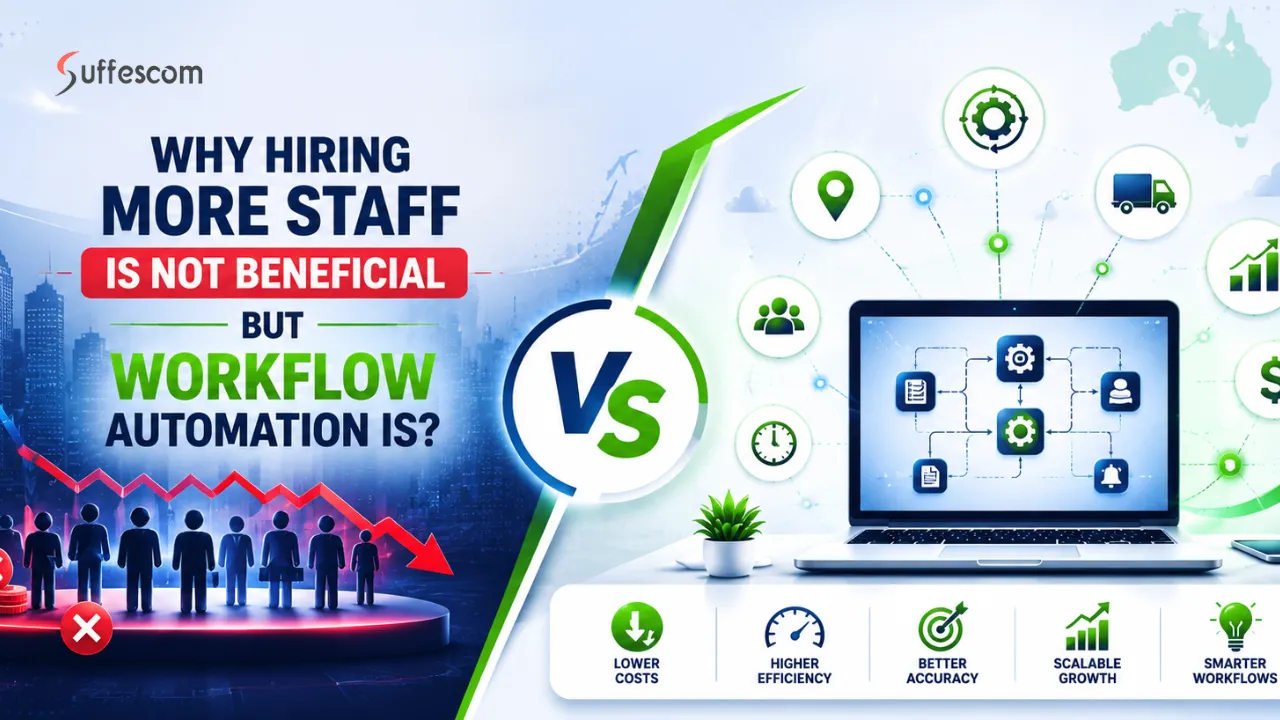
Workflow Automation vs Hiring More Staff — Cost Comparison
| Business Expense | Hiring More Staff | Workflow Automation |
| Recruitment Costs | High recurring expense | One-time setup cost |
| Employee Salaries | Monthly recurring | Minimal operational cost |
| Human Errors | Frequent | Significantly reduced |
| Productivity | Limited by workforce size | 24/7 automation efficiency |
| Scalability | Difficult & expensive | Easily scalable |
| Operational Speed | Manual delays | Real-time execution |
| ROI | Slower | Faster long-term ROI |
Why Automation Delivers Better Long-Term ROI
In comparison to repeatedly hiring more employees, Australian businesses realize significant savings through workflow automation. With wages, superannuation, recruiting, paid time off, and training expenses rising annually, it is much less expensive to implement and maintain automated processes than to continue paying for additional employees. Automation significantly decreases operational costs while improving the accuracy of processing transactions and efficiencies in conducting business over time.
A good example of how much time and money can be saved through automation is related to a logistics company in Brisbane in automating the scheduling of shipments and processing of invoices. The logistics company reduced its administrative workload by 60% plus, as compared to manual processes, which resulted in faster turnaround times and therefore lower labour costs than they would experience if they had to grow their workforce due to increased volumes of work. Automating allows businesses to handle higher volumes of transactions without having to proportionately increase their operating costs.
Manual Operations vs Automated Business Processes
Many companies rely on manual processes, which are cumbersome and time-consuming. They require a lot of human effort, causing delays in completing client onboarding and appointment scheduling. In addition, they tend to create inaccuracies and potential loss of time due to error. The repetitive nature of process completion makes it difficult to keep track of where things are in the system and can take away valuable staff time from working on areas where their contribution adds value.
Workflow automation software can streamline repetitive processes into one easy-to-use workflow by providing users with an intuitive interface that combines AI workflows with automated alerts and real-time data processing. By automating appointment scheduling, a healthcare clinic in Australia could have experienced scheduling conflicts that would have resulted in drastically longer wait times, but using an automated appointment scheduling system will allow you to instantly handle the appointment, send out automatic/reminders and cancellations without having an administrative bottleneck on the other side of the appointment process.
Automated workflows not only make operations more consistent by eliminating possible errors but also allows employees to spend time on strategic initiatives instead of processing repetitive administrative tasks.
How Automation Helps Businesses Scale Faster
Workflow automation has proved to be a major benefit for companies that want to achieve rapid growth without needing to hire significantly more employees. Australian agencies that expand into new locations or develop new segments of clients usually find it increasingly hard to do the work manually with a required level of work efficiency. Workflow automation allows businesses to scale their operations while still providing speed, consistency, and quality of service.
For instance, a rapidly growing eCommerce business based in Melbourne can process thousands of orders each week through automated inventory management systems, order tracking systems, and automated systems for communicating with customers – allowing the business to accommodate the increase in orders while doing so without requiring a large staff of people to handle those orders. This enables companies to grow quickly, give better overall customer service, and remain profitable while keeping their operating costs low.
Hidden Costs of Hiring More Employees
Recruitment Agency Fees
Most businesses underestimate the costs associated with hiring new employees in Australia. Many firms rely on recruitment agencies, job advertising apps, LinkedIn ads, and HR consultants to source suitable candidates for positions. Depending on the role, recruitment agencies charge the employer a fee of between (15% and 25%) from the employee’s salary.
For instance, an administrative staff member or operations manager employed by a healthcare provider in Australia would have potentially cost the employer thousands of dollars in placement costs before even being onboarded. With these recurring recruitment costs, businesses may see an impact on profitability, especially for businesses experiencing continual growth and expansion in their overall workforce.
Employee Benefits & Insurance Costs
In addition to salaries, Australian employers must also factor in other financial commitments relating to employment, including superannuation contributions, paid leave entitlements, workers’ compensation insurance, payroll tax, and various forms of employee benefit. Ongoing costs related to maintaining a larger workforce contribute to significantly increasing the total cost of maintaining that workforce.
For example, when a retail business employs a number of customer service representatives, there are considerable annual costs associated with providing benefits and insurance. Businesses can reduce reliance on the need for new staff by utilising workflow automation solutions, allowing them to better manage future costs.
Training & Onboarding Expenses
Companies while onboarding and training new employees need to provide time for them to get acquainted with their company processes so they can be productive. To do this, businesses typically invest a lot of money into providing workplace/classroom training (including, but not limited to, operational guidance; compliance training; and system-related training). Onboarding can take numerous days or several months based on the industry type (i.e. logistics to healthcare).
For example, a dispatch coordinator who has been hired by a Melbourne-based logistics company will normally have decreased productivity when getting up to speed with the company’s internal systems/workflows. The use of an automation platform assists with standardising and optimising these repetitive processes (and, therefore, reduces the need for continual employee training).
HR Management Overheads
As an organisation grows its staff, the HR requirements also greatly increase. Managing attendance, payroll, leave requests, performance reviews, compliance documentation and employee disputes requires dedicated resources and significant administrative effort in completing the tasks. These HR management overheads can become a costly and time-consuming issue for any organisation in Australia that is growing.
Many of these administrative functions can be streamlined with workflow automation software, which can allow for automated approvals, digital employee records and payroll integrations, thereby reducing manual HR work and improving efficiency in HR processes.
Office Infrastructure & Equipment Costs
Adding new personnel leads to infrastructure costs associated with the following: office space, workstations, laptops, software licenses, internet service, utilities, and office maintenance. Employers will incur significantly greater commercial office costs when hiring employees for their operations in major Australian cities such as Sydney or Melbourne than employers with no operations in those areas.
For example, to expand an administrative team, an agency had to buy or rent new desks and hardware & had to construct additional meeting places, and engage additional IT service providers. Using workflow automation allows a company to digitally scale its business operations without needing to constantly invest additional resources into physical infrastructure and operational support.
Productivity Loss During Employee Turnover
High worker turnover creates significant operational disruptions and hidden financial losses to all organisations. When experienced employees leave, organisations experience service delays, lower levels of employee productivity, and greater staff pressure to cover vacant positions while searching for replacement employees and training new employees. Turnover is most prevalent in industries that have repetitive administrative task functions and high levels of operational stress. A customer service organisation who only uses manual processes for customer support often has service interruptions when an employee unexpectedly quits.
Utilising workflow automation provides organisations with an automated digital process so that employee turnover does not negatively impact operational continuity.
What Is Workflow Automation?
Understanding Business Process Automation
Workflow Automation is When Businesses use Software, Artificial Intelligence and Digital technologies to Automate Routine (Repetitive) Business activities and Operational processes Without the need for Constant Manual intervention. In today’s business environment, companies are moving away from the old way of doing business and towards new ways of doing business (Automation). Rather than relying on Human resources to provide Support for the Approval, Scheduling, Data Entry, Reporting, Invoice processing or Communication functions on a daily basis; Workflow Automation Systems Streamline these Activities by Creating Predefined Rules for Workflow management.
As more and more Australian businesses (across Many Industries, including Healthcare, Logistics, Finance, Retail) are implementing business process automation into their Operations to improve Productivity, Reduce the Cost of Doing Business, and Eliminate Human Errors; some examples include Auto Sending Appointment Reminders and Automating Billing processes in a Healthcare practice; as well as Automating Dispatch Scheduling and Delivery Tracking in a Logistics company.
By Automating Routine Operational processes through the use of Workflow Automation; Businesses will be able to Spend Less Time on Administrative Tasks, and More Time on Growing their Business, Providing Excellent Customer Service, and Making Strategic Decisions.
How Workflow Automation Software Works
Workflow automation software connects various business systems, applications, and processes into a chronologically automated workflow. These platforms like these use triggers, conditional statements, and artificial intelligence-based actions to perform tasks based on pre-defined business rules automatically. For example, when an individual fills out an online inquiry form to ask a question about a product or service, the software will automatically assign the lead to a sales person, send an email confirming request, update respective CRM, and schedule reminders for that sales person to follow up, all of which is done without any human interaction.
Likewise, in hospitals throughout Australia, workflow automation software allows hospitals to perform patient registration, appointment scheduling, medical billing, and updating records in real-time without human input. Today’s workflow automation solutions seamlessly integrate with ERP systems, CRM systems, cloud services, accounting software packages, and communication platforms to provide companies with efficient digital operations.
Types of Workflow Automation Solutions
HR Workflow Automation
HR Workflow Automation Streamlining HR workflows via automation will enable organisations to increase efficiencies by automating activities such as recruitment, onboarding, attendance management, payroll processing, leave approvals, and employee performance tracking. HR workflow automation has been adopted by Australian companies to streamline their operations and reduce the amount of time spent on administrative tasks.
Finance Process Automation
Finance Process Automation Automating finance processes such as invoicing, expense approvals, payroll processing, tax reporting and financial reconciliation will enable organisations to reduce manual entry errors and improve both transparency and compliance within their finance departments through improved processing.
Logistics & Dispatch Automation
Logistics and Dispatch Automation Logistics workflow automation allows organisations to automate many repetitive processes such as dispatch scheduling, route optimisation, fleet tracking, inventory coordination and delivery notifications. Logistics automation is prevalent among both Australian eCommerce companies and transport companies due to its ability to improve delivery efficiency and decrease the amount of time required for operational delays.
Customer Support Automation
Customer Support Automation Customer support automation is the implementation of a variety of tools that assist customer support teams with their daily activities. Some of these tools include AI chatbots, automated ticketing systems, and self-service workflows. By automating their customer support processes, organisations can provide faster responses to customer inquiries, and, therefore, reduce the need for a large number of customer service representatives.
Sales & CRM Automation
Lead Management, Customer Follow-Up, Sales Reports and Marketing Workflows can all be automated in a way that increases your chances of qualifying leads, following up on leads, and generating sales. Sales operations and customer relationship management (CRM) automation make generating sales and engaging customers much easier. For example, by automating CRM, businesses improve the conversion rate (the number of prospects that actually become customers) for their businesses.
Document Workflow Automation
Document workflow automation allows for digitizing the approval process, obtaining the ability to share documents between parties, manage contracts and securely store records. Companies can switch from paper-based operations to electronic-based operations, increasing speed, compliance (more accessible), and operational efficiency.
Key Benefits of Workflow Automation for Modern Businesses
Increased Productivity Without Increasing Headcount
Using workflow automation allows an organization to succeed in a larger amount of work than they would be able to without hiring additional resources. Business processes can be achieved much quicker with automated systems completing repetitive business processes such as approvals, scheduling, invoicing and reporting than with people manually doing business processes. An Australian transportation company can use workflow automation to manage the dispatch schedule and update customers on the delivery schedule, instead of hiring multiple coordination resources to manage the daily operations. Therefore, organizations can also realize higher operational efficiency and higher production rates with the use of workflow automation while maintaining lower payroll costs than what they would otherwise be able to do without automation.
Faster Task Execution & Process Efficiency
Paperwork, required approvals, email communications, and reliance on people are factors which most often slow down an organization’s ability to conduct business. Automation streamlines these processes; it can instantly complete procedures through defined workflows and AI-enabled systems. For example, a healthcare clinic in Melbourne has used an automated scheduling system to confirm appointments, send appointment reminders, and edit patient records without any manual effort involved in the process. In addition to improving the speed at which tasks are executed, which can assist in improving an organization’s speed of operations, it also can provide improved customer experiences.
Reduced Human Errors in Operations
Data entry, invoicing, scheduling, and managing inventory are all areas where many businesses experience human errors which disrupt their operations and cause financial losses. Automating workflows reduces these types of errors through standardizing processes and minimizing the amount of manual input required. For example, a retail company in Australia was able to successfully implement an automated inventory management system, which in turn has helped to ensure the accuracy of the fulfilment of customer orders. Additionally, the increased consistency provided by automation allows for fewer mistakes, which results in better reliability of operations.
Improved Customer Experience
In today’s marketplace, consumers expect quick replies, updated information, and easy service. Workflow automation helps companies provide their customers with the ability to receive fast responses, receive accurate information, and receive better support for their customers. For instance, if an eCommerce store uses automated customer service chatbots and real-time delivery notification systems to respond to customer inquiries, an eCommerce store would be able to respond to customers immediately, provide real-time delivery notifications, and help to show that customers are satisfied with the products and services; thus increasing customer loyalty and retaining customers for long-term periods.
Real-Time Reporting & Business Visibility
Right now, a live screen shows exactly how things are moving inside your business. Because of that, keeping an eye on results becomes easier, spotting slowdowns happens faster, while choices rely more on facts than guesses. Picture a delivery service based in Sydney choosing automated workflows. Instead of guessing, they see every truck location, package update, and driver behavior on one shared view. When updates appear instantly, handling sudden shifts gets simpler since adjustments follow right after new info arrives.
Lower Operational Costs
Workflow automation has the ability to reduce operation costs for the long term. By automating processes that traditionally require significant labour, businesses can decrease their costs related to administrative activities and decrease reliance on large operating teams. For instance, if an accountant were to automate invoice approvals and payroll processing, that accountant could save considerable amounts of money on manual accounting while also improving efficiencies. Consequently, businesses that utilise workflow automation will benefit by having an optimal usage of their resources, allowing them to continue to remain profitable as the demands of their businesses increase.
Better Resource Allocation
When workers spend less time on routine paperwork, they shift focus to what moves the needle – strategy and problem solving. Take clinics that set up automatic check-ins and invoicing systems. That change frees office teams to assist visitors instead of typing data all day. Machines handle forms and follow-ups, people handle care and coordination. Efficiency increases when effort flows where it’s important. Performance gets improved not by just pushing harder but by working more smartly. Tasks get done faster, decisions taken quicker, results grow fast.
Ready to cut operational costs with AI-powered workflow automation?
Talk to our experts and explore the best automation strategy tailored for your business needs.
Industries Benefiting Most From Workflow Automation in Australia
Healthcare & Patient Management Workflow Automation
The healthcare industry in Australia has begun using workflow automation tools to ease their burden and increase patient care quality. This process involves the use of automation healthcare apps for Australian hospitals and other medical institutions such as diagnostic centres to schedule appointments, register patients, perform medical billing, manage Electronic Health Records, and issue reminders. A medical clinic in Sydney can benefit from automation processes in patient intake and appointment confirmations.
Retail & eCommerce Process Automation
Down under, shops and online sellers lean on smart systems to handle stock, purchases, payments, refunds, along with support tasks – keeping things running smooth. Instead of people stepping in every time, machines sort out web orders fast, adjust what’s in storage, shoot off delivery alerts, while also handling reward schemes quietly in the background. Take a clothing brand based in Melbourne – they tap into automatic updates for order status, stay in touch with buyers, pushing through huge waves of sales each holiday rush, yet never hiring extra hands.
Logistics & Delivery Workflow Automation
Workflow automation is used by logistics and transportation firms in order to automate processes such as dispatch management, routing optimization, fleet management, and other activities. This process can help firms save money on fuel, make deliveries efficiently and manage their business in real-time mode. An example would be the automation of the delivery process of a courier firm in Melbourne with the aid of automated dispatch software.
Banking & Financial Automation Solutions
Banks, financial institutions and fintech enterprises are automating their processes in order to achieve compliance, enhance onboarding, detect fraud, manage loan applications and improve their financial reports. Automated finance-related workflows reduce potential for human errors and accelerate processes while ensuring better data protection. A finance company operating in Australia can use automated workflow software in order to approve and process payments and invoices.
Real Estate Workflow Automation
One way some real estate firms handle leads is through automated workflows that also cover questions about rentals. Instead of manual follow-ups, software tracks each step – like signing new tenants or collecting rent. A team in Brisbane might set up alerts for when leases near their end. These digital tools take care of messages sent to renters plus log repair needs as they come. Efficiency rises because staff spend less time shuffling paperwork around. Client responses tend to be better when replies arrive faster. Behind the scenes, CRM platforms organize conversations so nothing slips through cracks.
Manufacturing Process Automation
One factory in Australia runs its schedule through automated systems, linking each step without gaps. Because of this setup, supplies move smoothly between suppliers and assembly lines. When stock gets low, machines trigger orders on their own – no waiting for human input. This kind of flow keeps materials arriving just when needed. Errors drop because fewer people handle data manually. Production rarely stalls now that alerts go off before shortages hit. Machines log every change, so reports form without extra effort. Even small plants notice shifts in how fast things run. Downtime shrinks as tasks sync automatically across departments. Workers shift focus from tracking items to solving bigger issues.
Recruitment Process Automation
Nowadays, some hiring teams rely on automated tools to handle job ads, sort through applications, set up meetings, bring new staff onboard, plus keep in touch internally. These digital helpers cut down how long it takes to fill roles by making steps faster and more consistent. One agency based in Australia might use smart software that picks likely applicants without human input, lines up call times across time zones, then sends replies after chats – saving hours every week while keeping people applying feeling heard and moving smoothly forward.
Real-World Examples — How Automation Replaces Manual Work Efficiently
| Business Function | Manual Process | Automated Workflow |
| Invoice Processing | Manual data entry | AI invoice automation |
| Customer Support | Large support teams | AI chatbots & ticketing |
| Dispatch Management | Manual scheduling | Automated route optimization |
| HR Operations | Paper-based approvals | Digital HR workflow automation |
| Lead Management | Manual follow-ups | CRM workflow automation |
| Patient Management | Manual appointment handling & patient records | Automated patient workflow management |
| Recruitment Process | Manual candidate screening & interview coordination | AI-powered recruitment workflow automation |
How AI Automation Reduces Operational Delays
Automated workflows that utilize Artificial Intelligence are important for mitigating hiccups in business operations. Repetitive manual procedures such as typing data, answering emails, handling documents, or managing operations between departments may cause significant delays during business operations. On the other hand, automated programs run all these processes instantaneously through workflows and decision-making processes.
For instance, an Australia finance firm may automate the process of data extraction, validation, and approval from invoices using AI invoicing tools, saving the time taken to do this manually, usually hours. An example of logistics organizations using automated dispatch systems includes assigning drivers to specific deliveries and optimizing delivery routes instantly using the system.
Why Companies Prefer Digital Workflow Systems
Most companies across Australia now lean on digital workflows simply due to speed, fewer errors, yet stronger room to grow when stacked against old-school methods. With automated setups, tasks come together in one place instead of scattered files, cutting down forms while showing what’s happening at any moment. Take support desks – teams running AI chats plus auto-ticket tools manage waves of questions all at once, even with smaller staff counts. In similar fashion, human resources offices shift quicker through time-off requests, new hires, pay runs, along with worker data thanks to digitised steps. Firms keep choosing these systems since routines stay steady, service feels smoother, while hands-on admin fades into background noise.
Automation Success Stories Across Industries
Nowhere is efficiency gaining ground faster than in Aussie workplaces turning to smart workflows. Clinics swap paperwork chaos for smooth booking and payment flows that ease staff days plus please visitors too. Retail outfits handle sales spikes without adding bodies thanks to self-running stock and checkout logic. Delivery fleets move smarter these days, guided by learning software that trims fuel waste even as parcels arrive quicker.
Some staffing firms now move faster because smart tools sort applicants then set up interviews automatically. From here you see tasks flow smoother when machines handle steps people used to do by hand. Faster results come not from bigger teams but from doing work differently behind the scenes. Each step saved adds up – less waiting, fewer errors, tighter budgets held. Growth happens quieter now, not with more hires but smarter routines running beneath.
Signs Your Business Needs Workflow Automation Instead of More Staff
Employees Spending Time on Repetitive Tasks
Spending too much time entering data by hand? That slow approval chain eating up hours? Picture schedules built automatically, reports that write themselves. When tasks like these run on autopilot, focus shifts – energy moves from repetition to real work. Effort drops. Output climbs. Time once lost now adds up elsewhere.
Frequent Operational Errors & Delays
When replies take too long, promises go unmet, or help feels spotty, people notice. Machines working behind the scenes quietly fix those gaps by moving tasks without pause.
Increasing Customer Complaints
Delayed responses, missed follow-ups, and inconsistent service often lead to customer dissatisfaction. Workflow automation helps businesses deliver faster and more reliable customer experiences.
Rising Operational Costs
Continued increases in labour costs, overhead costs, and overtime costs without commensurate business growth are the reasons why automation becomes cheaper compared to manual work.
Difficulty Scaling Business Operations
Workload piling up? Hiring nonstop might mean it’s time to rethink processes. Scaling through people alone often signals a gap where automated workflows could step in. Instead of adding staff, building smarter systems can handle rising demands smoothly.
Lack of Real-Time Business Visibility
Out there, some companies still count on spreadsheets, stuck juggling reports by hand. When that happens, seeing how well things run gets messy fast. Instead of guessing, automated workflows step in – showing live updates through dashboards. Clear views pop up where chaos used to sit. Decisions start lining up with what’s actually happening. Control shifts from reactive to steady.
AI-Powered Workflow Automation Technologies Businesses Are Using
Robotic Process Automation (RPA)
Startups run routine steps by machine, cutting human effort. Machines handle forms, payments, records, reports – each step locked into clear rules. Firms swap slow typing for steady digital hands that never slip. Speed climbs when bots take over the daily grind. Accuracy jumps without a team added. Tasks once handed out across desks now finish in silence, line by line, click by click.
Artificial Intelligence & Machine Learning
Smart computers learn tasks by spotting trends in information, then act on them without being commanded each time. Because of this, companies run smoother operations using clever bots that reply to customers, catch suspicious activity, guess what users might want, handle paperwork fast – each piece working behind the scenes. Efficiency grows while people get quicker, cleaner service.
Cloud-Based Workflow Systems
Out here, companies tap into cloud-powered tools that handle tasks online, making it possible to track progress from any location. Instead of stacking servers onsite, teams down under rely on these systems to grow smoothly, share work safely, stay connected during disruptions – all while spending less on tech setup.
Intelligent Document Processing
Out of sight, piles of paper get sorted by smart systems that see words like humans do. Machines snap details from bills, agreements, forms – no hands needed. Where once clerks typed data, now software reads, grabs, moves it. Errors fade when automation takes over routine steps. Hospitals, banks, shipping firms run smoother this way. Speed climbs while mistakes drop behind the scenes. Reading documents becomes invisible work, done before you blink.
Automated Notifications & Approvals
Updates fly out fast when workflows run on auto – emails, texts, or system alerts fire off the moment something needs attention. Take time-off requests, say: once submitted, they move ahead without someone clicking each step. Bills get signed off by rules built into software, not paper trails piling up on desks. Clients hear back because a trigger knows it is time, not because an employee remembers mid-chaos. Even meeting nudges pop up where people already look, skipping endless calendar checks.
Predictive Business Analytics
Forecasting what comes next happens when machines study patterns in data – like how shoppers act or where delays might pop up. Down under, companies let these smart systems shape their choices, making sure time and tools get used wisely. Smoother operations emerge not by accident but through constant learning from past results. Growth paths appear clearer once guesswork fades into background noise.
Workflow Automation Cost vs Employee Hiring Cost in Australia
| Investment Type | Estimated Annual Cost (AUD) |
| Hiring 5 Administrative Employees | $300,000 – $500,000 |
| Workflow Automation Software | $40,000 – $120,000 |
| AI Business Automation Platform | $80,000 – $250,000 |
| Manual Operations Scaling Cost | Very High Long-Term |
| Automation Maintenance Cost | Predictable & Lower |
Why Automation Is More Affordable Over Time
Most companies in Australia find machines cheaper over years than piling on more workers. Year after year, paychecks grow, benefits climb, offices need space – costs never stop rising. But software? Pay once, fix it now and then, move on. Picture a freight firm near the river city: four hundred grand gone each year just on coordinator wages. Swap that role for smart tools managing orders and scheduling, suddenly spending drops like a stone. Efficiency climbs without new hires crowding desks. Savings stack up quietly behind the scenes.
Reducing Dependency on Large Operational Teams
When tasks like sending invoices or setting appointments happen automatically, companies rely less on big office teams. As work piles up, extra hires aren’t always needed because smart systems handle the load. One clinic in Australia shifted scheduling and billing to software, easing pressure at reception. Staff numbers stayed the same even as patient visits grew. Routine duties run smoother now, with fewer people involved. Costs tied to salaries and training drop when digital tools take over repeatable jobs. Operations stay steady without constant staffing changes. Efficiency rises simply by swapping manual steps for automatic ones. Fewer workers are required to keep things moving behind the scenes. Overhead shrinks where technology replaces human hours. The daily flow stays balanced, regardless of demand shifts.
Business Growth Without Increasing Payroll Costs
Growth doesn’t always mean hiring more people. When orders rise, teams often think they must bring on new staff – yet that cuts into profits fast. Instead, machines handle heavier loads without extra paychecks. Picture a shop online in Australia: software tracks stock, manages clients, handles questions – all day, every day. Thousands of purchases move through smoothly, even if the team stays small. Costs stay predictable. Work flows smoother. Expansion feels less like chaos, more like quiet progress. Efficiency isn’t loud; it runs behind the scenes.
Workflow Automation ROI & Business Growth Benefits
Faster Decision-Making Through Automated Processes
Real-time data flows into systems, so choices happen quicker plus stay sharper. Automated reports pop up without delay, while workflow permissions clear in seconds, not days. Manual checks fade away when alerts snap to attention across teams. Long chains of sign-offs lose their grip once digital steps take over. Responses sharpen because information moves before requests land. Customer pulses match internal rhythms, making service feel like reflex instead of routine.
Improved Operational Accuracy
When tasks run on autopilot, slips in billing, planning, updates, stock tracking, or talking to clients happen less often. Following set routines helps companies stay steady, avoid expensive slipups, while keeping daily work flowing without hiccups.
Reduced Turnaround Time
Minutes replace hours when software handles routine jobs. Dispatching work orders now moves fast because machines take care of steps once done by hand. Invoice checks happen quicker without people needing to review every detail manually. Scheduling meetings fits into tight calendars since systems adjust on their own. Signing up new clients feels smoother as forms fill themselves behind the scenes.
Better Customer Satisfaction & Retention
Speed matters when customers reach out. Because waiting feels like being ignored, smooth processes keep things moving. A single delay can hurt the trust earned, yet consistent replies build goodwill. When messages flow without interruption, people notice the difference. Accuracy in every step prevents confusion later on. Over time, these small wins add up – satisfaction grows quietly. Retention follows naturally when users feel heard.
Higher Profit Margins Through Automation
When tasks run smoother, companies spend less on day-to-day work. Fewer people are needed for repetitive jobs because systems handle more behind the scenes. This shift means output goes up while effort drops. Profits grow not by chance but through smarter routines. Expanding becomes easier since growth doesn’t rely only on hiring more staff. Costs stay low even when activity rises.
| Business Metric | Before Automation | After Automation |
| Task Completion Speed | Slow | 3x Faster |
| Operational Errors | High | Reduced by 70%–90% |
| Customer Response Time | Delayed | Instant or Real-Time |
| Employee Productivity | Limited | Highly Optimized |
| Operational Costs | Increasing | Reduced Significantly |
Looking to scale your operations without increasing headcount?
Speak with our workflow automation specialists and build a future-ready digital workflow system.
Why Australian Businesses Are Investing in AI Workflow Automation
Rising Labour Costs Across Industries
Pay goes up, retirement fund rules tighten, workers are hard to find – suddenly doing things by hand costs a lot more down under. When tasks run on their own, companies hold steady without losing speed.
Growing Need for Digital Transformation
Out of nowhere, companies in Australia started using digital tools just to keep up. Not only does it tighten their workflow, but machines now handle tasks once done by hand. Suddenly, routine jobs shift faster, without delays piling up. Efficiency creeps in where chaos used to live. Automation isn’t new, yet its impact hits harder each month. Behind the scenes, small changes add up – less waiting, more moving. Modern work feels different because systems talk to each other now. Performance climbs when humans aren’t stuck on repeat.
Demand for Faster Customer Service
Nowadays people want answers right away, fixes without delay, smooth online interactions. Thanks to smart software running tasks automatically, companies reply quicker – happiness goes up.
Remote Work & Cloud Automation Trends
Working from home or splitting time between office and home now means more people rely on cloud tools. These platforms help groups stay in sync without being in the same place. Approval steps move forward even when team members are scattered. Tasks get handled remotely, without delays. Access stays open no matter where someone logs in from.
Increasing Business Competition
Out there, shops, clinics, delivery networks, and banks in Australia keep bumping into more rivals every year. When companies automate tasks, they move quicker, spend less, while others stuck doing things by hand fall behind.
Common Myths About Workflow Automation
Automation Replaces Every Employee
Most times, workflow automation takes over routine chores so people can spend energy elsewhere. Instead of getting stuck on paperwork, workers handle projects needing original ideas. Often, it clears space for problem solving that machines cannot manage. Usually, human roles shift toward guiding outcomes rather than pushing data.
Automation Is Only for Large Enterprises
Startups down under now tap tools that grow as they do. Clinics find ease without overspending. Logistics outfits adapt quickly. Even corner shops manage tasks smarter. Small teams in retail keep up, thanks to systems built for tight budgets and big dreams.
Workflow Automation Is Too Expensive
At first glance, putting money into automation might seem steep. Still, skipping the endless cycle of hiring people pays off later. Instead of wrestling growing expenses, machines handle tasks without extra demands. Over months or years, that balance shifts quietly but surely.
Automation Takes Too Long to Implement
Starting fast isn’t always needed – some cloud tools fit into daily work within weeks, shaped by what a company truly needs. One step at a time works too; teams often roll out changes piece by piece, letting habits shift slowly.
AI Automation Is Difficult to Manage
Out here, automated workflows powered by AI come packed with clear dashboards – linking smoothly into existing tools while tracking performance without extra effort. Efficiency slips in quietly when everything stays visible, connected, backed by live reports. Management becomes lighter once the clutter fades and insights stand out. These setups adapt fast because they speak the same language as daily tasks do. Watching progress feels natural, almost like flipping through a familiar notebook. Fewer hurdles show up when design thinks ahead about real use.
How to Successfully Implement Workflow Automation in Your Business
Identify Repetitive Manual Processes
Picture employees stuck doing the same thing over and over – typing numbers, sending reminders, setting meetings, signing off on requests. Tasks like these often eat up hours every week without adding much new value. Think about invoice handling, appointment booking, internal clearances, status summaries, reaching out to clients, or feeding information into systems. When machines take over such chores, gains show up quickly. Speedy results tend to come from routines that repeat in a predictable way.
Start With High-Impact Operations
Start by focusing on parts of the work that shape how fast things get done, how customers feel, or what gets spent day to day. Take dispatch tracking, staff request reviews, or booking appointments – hand these tasks to automated tools. Results often show up fast: fewer holdups, smoother flow, less time lost. Efficiency climbs when routine steps run without constant oversight.
Choose Scalable Automation Solutions
One step at a time, growth needs room – software should stretch when your work does. When more people join or tasks shift, the right system adapts quietly behind the scenes. Instead of starting over later, pick tools ready for what comes next. New steps, fresh connections, extra hands – it handles them without breaking rhythm.
Integrate Automation With Existing Systems
Most of the time, getting automation right means it fits smoothly into current tools like CRM, ERP, payroll, personnel records, or online services. When software works together, teams see what is happening more clearly because tasks no longer stall between groups.
Measure ROI & Operational Improvements
One way firms stay on track is by watching how fast tasks finish. Another sign shows up in daily expenses dropping over months. Workers getting more done each day matters just as much. Customers expect quicker replies, which becomes a clear signal. Mistakes fading away hint at deeper gains underneath. All these pieces together paint a picture of real value built slowly.
Future of Business Operations — Automation Over Manual Workforce Expansion
AI-Driven Business Process Automation
Out there, machines that learn are quietly reshaping how companies work – handling routine jobs while spotting patterns in numbers most people would miss. Instead of waiting on humans, these systems adjust on their own, slowly shifting how choices get made behind the scenes. Efficiency creeps upward when tasks run themselves, guided more by code than constant oversight.
Hyperautomation & Smart Workflows
Fueled by smarter tools, companies now link processes in ways once thought impossible – artificial intelligence flows into robotic automation, while cloud systems hold it all together. Intelligence spreads through routines once stuck on repeat. Machines learn patterns, then act without waiting. Work moves faster because decisions happen mid-step, guided by data. What used to take hours now finishes before a human even checks. Connectedness becomes the norm, not the goal. Efficiency grows not by effort, but by design.
Intelligent Decision-Making Systems
Out of nowhere, smart tools track patterns while suggesting next steps before problems hit. These systems update live data so choices happen quicker than waiting for reports. Instead of guessing, teams see what is unfolding right away through clear feedback loops.
Predictive Analytics & Automation
Instead of reacting, teams adjust plans early by watching how operations could shift under pressure. Inventory needs start making sense once past rhythms reveal likely demand. Trends begin to surface clearly through repeated data signals over months. Early warnings help leaders stay steady amid changing conditions across departments.
Cloud-Native Workflow Infrastructure
Working across distances becomes easier when tools live online. Teams grow without breaking stride because systems adjust on their own. People join from offices or homes with equal ease. Information stays protected while showing up instantly where it is needed.
Why Choose Suffescom Solutions for Workflow Automation Development Services
In today’s world, smart, scalable, and affordable automation solutions for business work processes are necessary for staying ahead of the competition in the ever-changing technological environment. From eliminating unnecessary manual processes to increasing efficiency and visibility within the organisation, workflow automation is now a necessity in modern Australian businesses. Suffescom Solutions assists businesses in automating their complex work processes using advanced workflow automation solutions that utilise artificial intelligence technology and cater to the specific requirements of particular industries. With knowledge and experience in cloud technologies, enterprise application development, and intelligent process automation, Suffescom helps businesses automate faster and smarter.
Custom Workflow Automation Solutions for Australian Businesses
From healthcare to recruitment, Suffescom Solutions builds smart automation tools shaped by real business needs. Not just off-the-shelf software – each system fits how a company actually works. Because every industry moves differently, so do their workflows. Efficiency grows when tech matches daily operations. Scaling becomes smoother when processes adapt naturally. Logistics firms handle shipments faster. Retailers manage stock without delays. Finance teams cut manual steps. Even hiring gets simpler. Challenges unique to each field get practical fixes. Systems evolve as goals shift. What matters most? Tools that fit like gloves, not puzzles.
Expertise in AI-Powered Business Automation
From smart algorithms to workflow streamlining, Suffescom guides companies through automating routine tasks. Instead of guesswork, decisions gain support from data-driven insights. Repetitive steps fade as systems handle more behind the scenes. Efficiency grows when machines take over tedious work. Precision rises alongside smoother daily operations. Organisations move faster once digital tools manage key processes.
End-to-End Workflow Automation Development Services
From start to finish, Suffescom handles every part of building automated workflows. Talking through goals comes before digging into how things work now. Designing screens and user paths happens hand in hand with planning logic flow. Coding follows clear blueprints made during earlier phases. Moving systems online uses secure cloud setups tailored per need. Connecting tools together ensures data moves without hiccups. Checks happen at each stage so problems show up early. Support continues after launch to keep everything running smooth.
Scalable & Secure Enterprise Automation Systems
Out of growth comes a need – this team builds tools that scale smoothly under pressure. When workloads climb, the platform stays steady. Security? Always locked down tight. Rules get followed without shortcuts. Even at full tilt, everything runs on time, every day.
Seamless Integration With Existing Business Software
From day one, workflows start clicking when Suffescom links up your current ERP setups. Connections form naturally with CRM environments already in place. Instead of friction, there is flow – HR platforms sync without hiccups. Accounting tools join the loop just as easily. Cloud backbones get pulled into alignment, quietly doing their part. Outside apps? They fit right in, like they were always meant to be there.
| Suffescom Workflow Automation Services | Business Benefits |
| AI Workflow Automation Development | Reduced manual operations |
| Logistics & Dispatch Automation | Faster operational efficiency |
| CRM & Sales Workflow Automation | Improved lead conversion |
| HR & Employee Workflow Systems | Streamlined workforce management |
| ERP & Business Process Integration | Centralized operations |
| Cloud-Based Automation Platforms | Remote accessibility & scalability |
How Suffescom Helps Businesses Reduce Operational Costs Through Automation
One way firms cut expenses is through support from Suffescom. Instead of handling tedious work themselves, things like sending invoices or managing deliveries happen more smoothly. Approvals in human resources move quicker too. Talking with customers becomes simpler. Reports take less time to prepare. Tracking potential clients feels lighter on staff. Overhead drops because fewer people are tied up in paperwork. Tasks finish sooner than before. Teams depend less on large groups doing routine jobs.
Why Businesses Prefer Suffescom Over Traditional Software Vendors
What drives firms toward Suffescom isn’t just one thing – it’s how fresh ideas take center stage. Automation built around artificial intelligence plays a big role. Growth-ready systems shape long-term plans differently here. Deep know-how in specific fields sets them apart from others. Instead of cookie-cutter fixes, outcomes guide every move forward.
Transform Manual Operations Into Intelligent Automated Workflows
Out of old routines, new paths emerge when machines learn to act. Intelligence builds on repetition, yet shifts how tasks unfold across departments. One step at a time, systems start thinking, reacting without constant guidance. With learning woven in, daily actions evolve beyond simple rules. Change creeps in quietly, shaped by patterns only algorithms notice. Results gain speed while effort fades behind screens. Actions once manual now breathe on their own.
Transform your business operations with intelligent automation.
Connect with our team today to build a smarter, faster, and cost-efficient workflow system.
Conclusion
Automation is an increasingly productive method to scale up processes with a minimum of additional hiring employees to perform operational functions. Labour costs are high in Australia, and businesses have experienced hiring difficulties as there is high employee turnover, and inefficiencies caused by labour-intensive manual work processes are causing businesses a lot of loss. Automating numerous operational processes such as; invoice processing, appointment scheduling, dispatch management, approval workflows, customer communication, and report generation will aid businesses in reducing their operational costs, increasing their overall efficiency and enhancing their service delivery processes.
Companies that utilize workflow automation alongside AI tooling are discovering that they have greater operational efficiency, quicker turnarounds, better customer satisfaction and maximum Return on Investment (ROI) in the long run. Collaborating with reputable workflow automation service providers like Suffescom Solutions will enhance the success of your workflow automation program within any business environment. Suffescom has extensive AI automation experience, enterprise workflow design, cloud-based connectivity solutions and other digital automation strategies to help your business create efficient workflows system
Frequently Asked Questions
1. Why is workflow automation better than hiring more employees?
Starting off, workflow automation cuts down on tasks done by hand over and over. It makes operations run smoother while needing fewer people to fix mistakes. Instead of hiring more staff, systems handle routine steps reliably. Over time, companies spend less keeping things running smoothly. Mistakes drop when machines take care of consistent processes.
2. How much can businesses save with workflow automation?
Most Aussie firms see a drop in admin and operations expenses once they bring in automated workflows. Size matters, along with how deep the tech goes into daily tasks. Some save just under a third, others cut nearly seven out of ten dollars spent before. Results shift based on setup scale. Tech rollout depth changes outcomes too. Not every company hits the top range, yet gains show up often enough. Real numbers differ per team. What stays true is the downward trend in spending.
3. What industries benefit most from business process automation?
Automation helps sectors like healthcare, where tasks numbers get high fast. Logistics moves smoother when routine steps run on their own. Retail handles daily chores easier without constant oversight. Finance reduces errors by streamlining repetitive processes. Manufacturing gains time when paperwork flows without delays. Real estate teams keep track of details more reliably. Recruitment speeds up hiring through automated follow-ups.
4. Is workflow automation expensive for small businesses?
Starting out small? Cloud tools grow right alongside you. Cost stays low even as tasks pile up. Big companies lean on them just as much as new teams do.
5. How long does it take to implement workflow automation?
Some setups take longer when companies have tangled processes or need tight software links. A handful of weeks might do it for simpler cases, though tougher jobs stretch into months. Timing shifts based on how messy things are underneath.
6. Can AI automation reduce operational costs?
Yes, Most businesses find that using artificial intelligence to handle routine work cuts down on busywork. Instead of people doing repetitive steps, systems run them automatically. This shift often means fewer mistakes slip through. Operations move faster when waiting periods shrink unexpectedly. Productivity climbs without needing more staff. Costs drop as efficiency rises behind the scenes.
7. What processes should businesses automate first?
Start with the boring stuff that eats up hours – think invoices, calendar headaches, sign-offs, helping customers, paying people, moving information around. Machines handle these without slowing down. Freeing staff means they can do things only humans manage well. Repetition fades when software takes over. Time saved piles up fast. Tasks once done by hand now finish in seconds. Workflows shift quietly but completely.
8. Does workflow automation replace employees completely?
Far from replacing workers, automation steps in where routine work piles up. When machines take over the predictable stuff, people shift toward planning and problem-solving. Focus moves to big-picture thinking when repetition fades. Creative efforts grow once manual chores shrink. Helping customers becomes easier without constant task switching.
9. What is the ROI of workflow automation software?
Over time, automating workflows pays off because people get more done. Efficiency rises when repetitive steps run on their own. Tasks finish quicker without waiting around. Costs shrink as manual effort drops away. Mistakes happen less often with consistent processes. Customers notice smoother interactions after changes roll out. Long-term gains come from steady improvements like these.
10. How secure are cloud-based automation systems?
Business data stays safe because modern cloud workflow tools rely on strong safeguards like encrypted storage alongside strict entry rules. Security grows stronger through built-in standards that match industry requirements plus resilient network backbones underneath. Hidden layers within the system guard information by limiting who can interact with sensitive parts. Protection does not stop at setup – ongoing checks support a stable environment where trust forms naturally over time.
11. Can workflow automation integrate with ERP and CRM software?
Most workflow automation tools link smoothly with ERPs, thanks to built-in compatibility. Connecting to CRMs happens without extra coding in many cases. Accounting programs often sync right away through standard APIs. Some HR platforms pair up easily due to shared data formats. Other business apps join the flow using preset adapters.
12. How does workflow automation improve customer experience?
Because tasks move quicker when handled automatically, waiting periods shrink noticeably. Communication lands correctly more often since errors drop off. Faster replies become possible, simply because steps link together without pause. Customers experience steadier results each time they reach out. Efficiency grows, not by pushing people harder but by smoothing how work flows.

Senior Content Strategist
Jonathan Raabe works as a Senior Content Writer at Suffescom Solutions with an experience of 7+ years of writing for the technology and app development industry. He writes quality content about mobile app development, AI solutions, cloud technologies, enterprise software, and new trends in the digital world. Rabby creates content that both educates and contributes to business success. His skill in breaking down complex topics into understandable and relatable narratives has helped companies build their digital presence.

Need Help With
Development?