Get a quick blog summary with:

Key Takeaways
- Explore how Replit’s AI-assisted coding approach compares with Bubble’s no-code visual development system.
- See how pricing, maintenance costs, and scalability expenses differ for startups, SaaS products, and MVPs.
- Discover which platform is better suited for AI apps, SaaS platforms, marketplaces, booking systems, and internal business tools.
- Understand how both platforms handle backend flexibility, APIs, infrastructure management, and growing user traffic.
In the current scenario, what once took months of development can now be created easily with AI-assisted coding and no-code platforms. As founders continue to take the faster approach and less expensive strategies to launch their products and test their idea, they are increasingly using platforms that provide no-code app development moving forward.
The shift is happening fast, as evidenced by industry reports that show the global market for no-code app development is expected to exceed $101.68 by 2030. It shows more businesses looking for faster ways to create apps.
Two platforms dominating this conversation are Replit and Bubble.
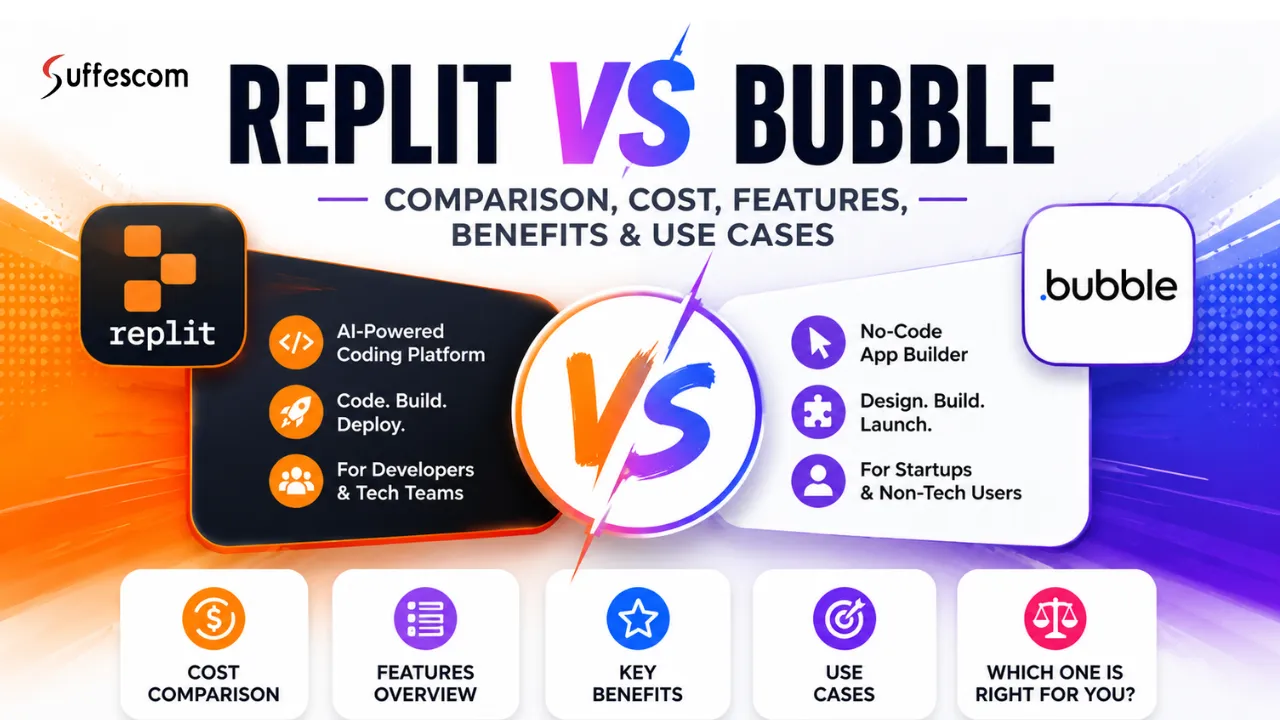
Replit is an AI-powered coding platform that provides all the tools and features developers require to design fully functional, customised applications via the intelligence of an AI-assisted coding assistant and web-based development tools. Bubble, on the other hand, is a tool for non-technical entrepreneurs that provides a simple way to create web applications through visual workflows that employ a drag and drop methodology.
This guide compares Bubble and Replit on features, pricing, speed to MVP, and best use cases to help you identify the platform for your app development needs in 2026.
What Is Replit?
Replit is an AI-enabled & cloud based software development platform that enables teams to develop, deploy, and scale solutions quickly and efficiently via intelligent automation and collaboration.
At the centre of the platform is Replit Agent 4, which is an AI assistant powered by artificial intelligence capable of producing production-quality code, managing software development processes, and converting basic prompts into applications.
Contrary to typical IDEs, Replit runs in the browser and provides all functions necessary for development including coding, deployment, database management, hosting, authentication, and monitoring.
The platform supports building:
- Web apps
- Mobile apps
- Landing pages
- Internal tools
- AI applications
- Full-stack SaaS products
The Replit platform, with its integrated infrastructure and AI capabilities, has been embraced by many startups, product teams, and enterprises as a means to expedite software development in 2026.
Key Features of Replit
- AI Code Generation
- Real-Time Collaboration
- Hosting & Deployment
- Backend Flexibility
- Multi-Language Support
Pros of Using Replit
- Full coding freedom and customisation
- Better scalability for growing applications
- Faster workflows for developers
- Strong AI-assisted development support
- Suitable for technical startup teams
Cons of Using Replit
- Requires coding knowledge
- Higher learning curve for beginners
- Developers handle maintenance and debugging
- More infrastructure responsibility compared to no-code platforms
What Is Bubble?
Bubble is a no-code application development platform that lets users create web apps without coding. It’s a user-friendly way for anyone to build an app for iOS or Android, as it has a visual drag-and-drop interface.
Because of this, many startups and even non-technical founders tend to use Bubble.
All of the tools you need to create your own website/app are available on one platform with Bubble. The entire process of designing the frontend, creating the backend workflows, managing the database, hosting, and deploying your application can be done on Paper.
The platform is commonly used for:
- MVP development
- Marketplaces
- Client portals
- CRMs
- Internal business tools
- Booking platforms
Bubble has built-in security features, hosting capabilities, and an infrastructure to help manage your application, so that you don’t have to deal with servers.
Key Features of Bubble
- Visual Workflows
- Database Management
- API Integrations
- Responsive Design Tools
- Plugin Ecosystem
- Built-In Security Features
Pros of Using Bubble
- No coding knowledge required
- Very fast MVP development
- Lower upfront development costs
- Easier maintenance compared to custom-coded apps
- Built-in hosting and security features
- Beginner-friendly visual development system
Cons of Using Bubble
- Scalability limitations for complex applications
- Vendor lock-in due to platform dependency
- Performance bottlenecks with large workflows or heavy traffic
- Limited backend flexibility compared to custom development
- Advanced customisation can become difficult over time
Replit vs Bubble: Quick Comparison Table
| Feature | Replit | Bubble |
| Development Style | AI-assisted coding platform | No-code visual app builder |
| Best For | Developers, SaaS startups, technical teams | Non-technical founders, small businesses |
| Learning Curve | Medium to High | Low |
| Customisation | Very High | Moderate |
| Scalability | High | Moderate |
| Speed to MVP | Fast | Very Fast |
| Backend Flexibility | Excellent | Limited |
| Hosting | Built-in hosting and deployment | Built-in hosting |
| AI Capabilities | Advanced AI coding assistance | Limited AI functionality |
| Database Control | Full backend and database flexibility | Built-in visual database system |
| Collaboration | Real-time developer collaboration | Team collaboration features |
| Security Control | High customisation and infrastructure control | Built-in security and privacy tools |
| Monthly Cost | Variable based on usage and infrastructure | Subscription-based pricing |
| Best Use Cases | SaaS apps, AI tools, scalable platforms | MVPs, marketplaces, internal tools |
Replit vs Bubble Development Cost Comparison
The cost to create an app with Replit or Bubble is highly dependent on your complexity requirements and business goals.
For example, Bubble tends to be less expensive to build early-stage MVPs and for non-developers, whereas Replit has more potential to grow with a startup developing scalable products.
Replit Development Costs
Replit app development costs vary based on the complexity of the project, as well as requirements and integrations. There are many cost-effective ways to develop simple applications; however, most highly complex SaaS and AI platforms require significant development investment due to unique architecture and infrastructure planning.
Replit App Development Cost
| Solution Level | Estimated Cost (AUD) | Typical Use Cases |
| Basic Solution | $8,000 – $15,000 | Internal tools, simple dashboards, small business apps |
| Mid-Level Solution | $15,000 – $30,000 | SaaS MVPs, marketplaces, workflow automation |
| Advanced Solution | $30,000 – $50,000+ | AI platforms, fintech apps, scalable SaaS products |
For example, a small hotel reservation system with standard workflows would fall under a low-cost development solution. However, a SaaS based hotel reservation system that uses AI and has a custom API and back office integrations will fall under higher-end pricing.
Additionally, with Replit’s use of AI-assisted coding tools, development teams can save time and costs by leveraging AI to assist with code creation and rapid debugging.
Bubble Development Costs
Bubble tends to be cheaper than other platforms for startups since there is less dependency on large development teams and expensive backend software engineering.
Founders can develop marketplaces, booking systems, client portals, and other applications faster with the help of Bubble’s visual no-code application.
The typical Bubble project will always have some subscription fees, plugins, workflows, and even the occasional assistance from freelancers or application development agencies.
Bubble App Development Cost
| Solution Level | Estimated Cost (AUD) | Typical Use Cases |
| Basic Solution | $3,000 – $10,000 | Internal tools, simple booking systems, landing portals |
| Mid-Level Solution | $10,000 – $20,000 | Marketplace MVPs, client portals, CRM platforms |
| Advanced Solution | $20,000 – $40,000+ | Multi-user platforms, complex workflows, larger marketplaces |
For instance, a straightforward internal CRM or appointment booking system could qualify as a basic Bubble application, whereas a marketplace with payment processing, advanced workflows, and automated systems would be considered mid-range or advanced Bubble.
While Bubble helps decrease the cost of development, scaling costs can go up with the use of premium plugins and workflow optimisation.
Cost Breakdown Table
| Cost Factor | Replit | Bubble |
| Initial MVP Cost | Medium | Low |
| Monthly Maintenance | Medium | Low to Medium |
| Scaling Costs | More predictable | Can increase rapidly |
| Developer Dependency | High | Low |
| Long-Term Flexibility | High | Medium |
Which Platform Offers Better ROI?
The better ROI is based on your startup goals and project requirements.
Bubble Offers Better ROI If:
- You want to launch an MVP quickly
- You have a limited budget
- You do not have developers
- Fast validation is the priority
For example, if you create a marketplace or booking platform, it can be built at less expense with Bubble.
Replit Offers Better ROI If:
- You need long-term scalability
- Your product requires custom backend logic
- You already have developers
- You are building a SaaS or AI product
For example, AI tools and fintech platforms usually benefit more from Replit’s flexibility and scalability.
Many startups also use Bubble for early MVP validation and later move to Replit as the product grows.
Launch Your App Faster Without Wasting Budget
Get expert guidance on choosing the right platform for your startup idea.
Replit vs Bubble App Development Process
Process of App Development With Replit
Requirement Gathering
The requirement-gathering phase will usually help shape the product goals, how to connect services to be integrated with it, and what to consider for scale.
This step is important when working with SaaS products, AI tools, and other custom-built applications.
Tech Stack Planning
During this phase, developers will select which front end framework they will use, which back-end technology, which databases will be chosen, how the different APIs will be connected, and what type of hosting will be selected.
Replit supports a wide range of programming languages and frameworks, giving developers the ability to have more flexibility with their technology.
Backend & Frontend Setup
Once developers have completed the planning phase, they can configure and set up their application architecture, front-end user interface, back-end business logic and database structure, authentication/authorisation systems, etc.
This stage of the app development process serves as an initial foundation for eventually providing developers with fully scalable and complete full-stack development capabilities.
AI Coding Workflows
By using Replit, you can leverage AI tools to generate source code and decrease the time required to complete repetitive tasks. This expedites the overall development cycle.
As a result, you can develop new features more quickly and apply less effort towards manual code implementations.
Testing & Deployment
Once developers have completed the development of the application, they must complete application testing to identify whether or not there are errors present within the application before being taken into production through deployment.
In addition to this, Replit provides built-in hosting and deployment features to allow for faster time to market for applications.
Ongoing Optimisation
Once applications have been launched into production, developers will provide continual performance enhancements to address performance optimisations, bug fixes of previously deployed applications; they will also add new features or functionality to the applications based on the growth of their user base.
Process of App Development With Bubble
Product Development Process from Bubble
Visual App Designing
Bubble apps typically start with designing the app structure and user interface through the visual builder tool.
This step enables founders to plan the product rapidly without writing any code.
Workflow Design
In this process, users design visual workflows that govern the actions, automations, and user interactions on the app.
This phase substitutes the typical backend coding required in most MVPs.
Database Design
Bubble offers an in-built database management system that enables users to build the database visually.
This process simplifies the creation of backend logic for non-technical teams.
Plugins Integration
The team can incorporate plugins from the Bubble Marketplace as well as other external systems to improve the functionality of the solution.
Examples include payment gateways, CRMs, analytics systems, and AI services.
Responsiveness Setup
Bubble allows users to make responsive designs for desktops and smartphones within its visual environment.
Testing & Launch
Prior to launching the app, testing is carried out to check the workflow and responsiveness of the app before deployment.
Development Timeline Comparison
| Development Stage | Replit | Bubble |
| Planning | Medium | Fast |
| MVP Development | Moderate | Very Fast |
| Customisation | Extensive | Limited |
| Testing Complexity | Higher | Lower |
| Launch Speed | Fast | Very Fast |
| Scaling Preparation | Strong | Moderate |
Replit vs Bubble for MVP Development
The selection of which platform is best for your MVP app idea can impact your launch speed and future scaling costs.
Replit and Bubble both help startups build MVPs quicker than traditional methods, but they are designed for very different product requirements. In general, Replit is a better fit for startups that develop scalable or complex applications, while Bubble is more appropriate for idea validation and non-technical projects.
When Replit Is Better for MVPs
Replit is a better tool when your MVP requires custom functionality, backend capabilities, or scalability.
AI Startups
AI startups will often have a number of requirements that are easier to address with Replit, including API integration, custom logic, connection to models, and scalable architecture.
If you’re developing a sales assistant powered by AI or an automated content creation platform, Replit is likely a better solution for your MVP.
SaaS Platforms
SaaS MVPs will require user authentication, dashboards, subscriptions, databases, and scalable architecture.
Developing project management software or a customer relationship management platform can be simplified with Replit at the MVP stage.
Custom Backend-Heavy Products
A product that has an advanced workflow, custom API, or complicated data operations will benefit from Replit.
To develop a fintech app with an MVP approach, payment gateway integration and workflows for user verification will likely need deeper backend control compared to what is provided by most no-code platforms.
Products Requiring Scalability
Companies with expectations of rapid growth will likely benefit from choosing Replit early on so that they don’t need to rewrite their products in the future.
Products that have high traffic expectations or require custom infrastructure will find more freedom in Replit.
When Bubble Is Better for MVPs
Bubble suits startup founders who want to test their ideas quickly without forming a full-fledged engineering team.
Marketplace Prototypes
Bubble is usually chosen for marketplaces since founders will be able to prototype their products quickly using visual workflows.
For example, building a local services marketplace or rental booking platform may take just a few weeks in Bubble.
Internal Tools
Businesses often choose Bubble to build internal tools such as dashboards, CRMs, and workflow management systems.
This allows them to cut down on development costs and improve operational efficiency.
Client Portals
Bubble is ideal for client portals that involve user accounts, forms, dashboards, and simple automations.
Consultancies, agencies, and service companies frequently implement Bubble to create customer portals swiftly.
Fast Investor Demos
Startups commonly use Bubble to make professional-looking demos of their products without spending a fortune on engineering.
An early stage entrepreneur pitching a healthcare app solution could easily make a working demo of the product.
Replit vs Bubble: Scalability & Performance
Scalability and performance become important factors when MVP starts acquiring users, handling larger amounts of data, or adding complex functionality.
Although both tools provide developers with quick development opportunities, their long-term performance is significantly different. Replit gives more opportunities to scale applications than Bubble does, which is focused on quick deployment.
Scalability in Replit
Scalability is more advanced in Replit for startups creating custom and scalable applications.
Better Server-Side Flexibility
More options for controlling servers, backend, databases, and other components.
This makes it easier to optimise applications for performance as user traffic increases.
Easier Migration
As Replit provides support for conventional coding practices, it is easier to migrate or scale applications across various cloud architectures.
This will help startups be more flexible in the long run as their product develops.
Full-Stack Architecture Support
The use of Replit allows full-stack architecture, enabling companies to develop scalable frontend and backend infrastructures.
A SaaS product that deals with subscriptions, dashboard functionalities, and artificial intelligence processes can benefit from scalable infrastructure in Replit.
Scalability in Bubble
Bubble is good for MVPs, but may have problems when used for complex applications.
Workflow Limitations
Highly complex workflow structures and automation can affect the speed and responsiveness of applications.
Complex business logic may become harder to manage over time.
Database Constraints
Bubble uses a visual database structure, which is useful for building small applications but can be problematic for larger, data intensive products.
Scaling Challenges for High Traffic Apps
Applications with thousands of users, high API calls, and other performance requirements may face problems in scaling through Bubble.
For example, a growing marketplace or social platform with large user activity can require significant optimisation as traffic increases.
Performance Considerations
App Speed
Replit generally delivers better performance optimisation options because developers can control the application architecture directly.
Bubble apps can perform well for simple MVPs but may slow down as workflows and database operations become more complex.
API Handling
Replit provides stronger flexibility for managing custom APIs, third-party integrations, and real-time data processing.
Bubble supports API integrations but may struggle with highly advanced or backend-intensive workflows.
Load Management
Replit is better suited for applications expecting high traffic volumes or rapid scaling because developers can optimise infrastructure and server resources more efficiently.
Bubble works best for lightweight to moderately complex applications during the early growth stage.
Real-World Performance Differences
In startup environments, Bubble is chosen for speed and MVP validation, while Replit becomes the preferred option for scalable AI platforms and applications requiring advanced backend control.
Need Help Choosing Between Replit and Bubble?
Talk to app development experts and find the best fit for your product goals.
Security & Maintenance Comparison Between Replit & Bubble App Development
Security in Replit Apps
Custom Authentication
Replit usually offers superior possibilities regarding performance optimisation because it allows direct control over the application architecture.
While Bubble apps can work well for simple MVPs, they may be inefficient for complex workflows and databases.
Infrastructure Responsibility
Replit offers better possibilities for custom API management, as well as third-party integrations and real-time data processing.
While Bubble allows API integration, it may have difficulties in handling highly complex or backend-oriented workflows.
Better Security Customisation
Replit will work better for apps that require scalability due to high traffic volumes, as developers are able to optimise infrastructure and server capabilities more effectively.
On the other hand, Bubble is better for lightweight and moderately complex apps that are just starting out on their way.
Security in Bubble Apps
Built-In Protections
Some of the built-in security features in Bubble include authentication, privacy policies, data encryption, and protection from DDoS attacks.
This enables startups to build secure applications easily without creating complex backend frameworks.
Easier Setup
Non-technical entrepreneurs can handle app security using Bubble’s dashboard and privacy policy options.
For instance, a booking website or a client portal can achieve secure user access without extensive technical knowledge.
Less Infrastructure Control
Much of the backend framework is managed by Bubble itself, making it easier to run the application but limiting customisation.
This is useful for MVPs and less complex apps, but could be constraining for more intricate applications.
Maintenance Comparison
Ongoing Updates
Bubble takes care of most of the hosting and infrastructure management tasks automatically.
On the other hand, the code and backend infrastructure for Replit apps need more hands-on management by the team.
Debugging
Debugging can be much easier in Bubble for smaller applications due to its visual nature. In Replit, debugging will depend on the structure of the project and the skills of the developers.
Technical Debt
As Bubble apps grow, large workflows and visual logic can become difficult to manage.
With Replit, technical debt depends heavily on code quality and development practices.
Dependency Management
Replit developers manage frameworks, libraries, APIs, and backend dependencies manually, giving more flexibility for scaling products.
Bubble reduces dependency management complexity by handling much of the infrastructure internally.
Best Use Cases for Replit
Replit is best suited for businesses that need flexibility and complete control in app development. Since Replit allows AI assisted coding, it is particularly useful for products that require customisation.
Ideal Industries
SaaS Startups
Replit is a perfect fit for SaaS startups because it enables developers to implement custom dashboards, authentication processes, APIs, and subscription flows without any limitations of the platform.
As an example, a company creating a project management app or a customer relationship management system can take advantage of Replit’s capabilities to develop scalable backends and quickly add new features with AI assistance.
AI Applications
AI integration in apps may require complex real-time processing and customised backends. Replit provides you with the necessary flexibility to implement various integrations, automations, and logic.
A startup building an AI content generation platform or virtual assistant can benefit from Replit’s ability to support scalable full-stack development.
Developer Tools
Replit is also commonly used for developer-focused products because the platform itself is designed around coding workflows and collaboration.
Products such as API platforms, automation tools, testing environments, and technical SaaS products are often easier to build and manage within a customisable development environment like Replit.
Fintech Products
To develop a fintech app typically requires strong backend security, custom workflows, and scalable infrastructure. Replit allows teams to implement payment integrations, financial dashboards, and secure authentication systems with greater technical control.
For example, a startup building an expense management platform or invoicing software may choose Replit because it supports more advanced backend customisation and security configurations.
Best Team Types
Technical Founders
Technical founders usually like using Replit because they can operate at a high pace while having direct access to the codebase and overall product architecture.
Additionally, AI-assisted coding helps decrease development time when creating an MVP and scaling up.
Startup Engineering Teams
Small-sized engineering teams can collaborate in Replit to deploy applications faster and work on frontend and backend development in one tool.
For instance, a young SaaS company with a small development team will be able to develop features of the product quickly and effectively without using any other infrastructure tools.
Agile Product Teams
Replit provides agile teams with fast iteration capabilities and collaboration.
This means that companies with quick releases and tests of features that constantly improve the product based on customers’ feedback will find this platform useful.
Best Use Cases for Bubble
Bubble is most appropriate for businesses that want to build applications quickly and do not have to deal with complicated coding and infrastructure issues. Its visual no code approach makes it useful for founders and teams focused on MVP development.
Ideal Industries
Marketplaces
Bubble is often chosen by founders when building marketplace platforms since they can easily create user dashboards, listings, messaging, and payments functionality with visual development.
For instance, a startup developing a local services marketplace or rental website can create MVPs much faster than with traditional coding, without a large engineering team.
Coaching Businesses
Coaches and consultants often leverage Bubble to build member sites, booking tools, educational platforms, and client management software.
A business coach who wants to develop an online mentoring platform can create onboarding flows, payment systems and client dashboards without writing code.
CRMs
Bubble is suitable for custom CRM platforms since businesses can visually create workflow automation, database and reporting systems based on their requirements.
Many startups and agencies build lightweight CRM tools in Bubble to manage leads, customer interactions, and project workflows.
Booking Platforms
Businesses working with bookings and appointments usually choose Bubble because the platform makes building booking workflows and managing users simple.
For example, you easily develop a fitness app for your business with functionalities like membership registration, online sessions, and more.
Best Team Types
Solopreneurs
Solopreneurs opt for Bubble as it enables them to create and release products without a lot of developer intervention.
It reduces costs and accelerates the process of validating ideas.
Non-Technical Founders
The platform of Bubble is popular with non-technical founders due to the lack of coding requirements through its intuitive visual interface.
Founders are able to create workflows, work with databases, and MVPs without thinking about development as much and focusing on business and customers.
Small Businesses
Small businesses benefit from the platform as it makes developing, maintaining, and running apps easier.
When a company needs to develop some internal tools, a customer portal or any other simple application, it can become quite affordable and quick.
Planning to Build a SaaS or AI Product?
Work with an experienced app development agency to avoid costly technical mistakes.
Which Platform Should You Choose?
Depending on how complex your product is, how fast you want to launch and how you see your business in the future, you may go for Replit or Bubble.
Both platforms can help startups save time and money on development, yet they are different in terms of their advantages.
This shift is growing, with the global no-code AI platforms market projected to reach USD 44.15 billion by 2033. This growth is driven by demand for faster and more efficient app development solutions. Let’s discuss which platform will best fit your needs.
Choose Replit If…
If your company wants to develop scalable, customisable, and highly technical applications, then Replit is the way to go.
You Need Scalability
In case your product needs to support increasing user traffic, complex processes, and/or big data, Replit offers better scalability opportunities compared to no-code solutions.
For instance, SaaS products, AI-powered apps, and fintech applications need customised APIs, optimised databases, and server-side management, which is hard to implement due to the limitations of no-code platforms over time.
You Have Developers
Using Replit becomes most effective if your company has engineers or technical resources at its disposal.
They can take advantage of the code generation capabilities of AI to increase productivity and automate tedious work while keeping full control of the app structure.
It is particularly beneficial for startups for agile software development and deployment approaches.
You Need Custom Architecture
Products with advanced backend functionality, real-time capabilities, or custom integrations will be more efficient when developed with Replit.
For instance, an AI-driven automation tool connecting several APIs and processing systems requires an architecture that cannot be fully implemented using visual no-code platforms.
Replit also allows you to:
- Build custom authentication systems
- Manage complex databases
- Optimise APIs
- Configure server-side workflows
- Integrate external services at scale
Long-Term Growth Matters
Many startups choose Replit because it reduces long term platform dependency and offers ownership over the product infrastructure.
This becomes important once businesses move beyond MVP validation and start focusing on:
- Product scalability
- Performance optimisation
- Advanced feature expansion
- Multi-platform integrations
- Enterprise-grade infrastructure
Choose Bubble If…
Bubble is better suited for founders who value speed, cost-effectiveness, and simplicity while building their product.
You Want Fast MVP Validation
With Bubble, startups can quickly go from concept to MVP.
Without needing any coding skills, founders can easily create workflows and marketplaces, which makes it perfect for testing their startup idea before diving into costly engineering.
For instance, a founder who wants to validate a coaching platform can develop an MVP within some days.
You Have No Technical Team
Bubble is designed for non-technical users, which significantly lowers the barrier to entry for app development.
This allows startups to:
- Launch products without hiring developers
- Reduce operational complexity
- Iterate quickly based on user feedback
- Focus more on customer acquisition and business growth
Budget Is Limited
As such, it will be beneficial for bootstrapped startups and small businesses looking to minimise costs while developing and validating an app.
A small business that wants to create an appointment booking platform or internal CRM system can use Bubble and save a lot on development costs.
Simplicity Matters Most
Bubble makes hosting, infrastructure, maintenance, and backend simpler due to its no-code platform.
Those who value simplicity more than advanced capabilities may find this approach incredibly useful.
Hybrid Approach
Replit and Bubble were once considered competitors by most startups. However, many now use both tools according to their needs.
A common startup approach is:
- Build and validate the MVP quickly on Bubble
- Test user demand and gather feedback
- Secure funding or achieve product-market fit
- Migrate to Replit or a custom stack for scalability
Using this approach will help startups save on initial development costs while not rushing into hiring engineers too soon.
However, migration planning is important.
When Bubble applications become more complex due to workflows, databases, and integration, migration may require rethinking the architecture. Startups anticipating further scaling usually collaborate with skilled developers from the very beginning.
Why You Need to Hire an App Development Company
Today, application creation is not only about rapid launch. Startups also need to consider different aspects like security and product growth, during the very first stages of work.
Although platforms like Replit and Bubble simplify app development. But still, bad decisions in the process can lead to costly problems later.
Platform Selection Strategy
An app development company will be able to assist startups with the selection of the proper platform based on the complexity of the product and technical capabilities.
Correct platform selection at the early stages may help avoid expensive technical problems in the future.
Scalability & Architecture Planning
Startups often concentrate much effort on rapid launch and neglect the issue of scalability.
The help of an app development company will allow for setting up the architecture properly, taking into account the future product growth and operation.
Effective architecture planning also contributes to avoiding performance issues and technical debt when the complexity of applications increases.
Faster & More Efficient Development
Experienced development teams know about technical flows, deployment options, testing processes, and typical product challenges.
It enables companies to speed up development, avoid technical errors, ensure higher stability, and launch their products faster.
Professional development services also increase the efficiency of product development and project management.
Security & Compliance Support
When products deal with customers’ personal information, financial transactions, and operational processes, security implementation and infrastructure management become key.
A custom app development agency can better manage authentication, security of APIs, data protection, infrastructure management, and compliance.
This is especially important for those businesses operating in industries with strict security regulations.
Long-Term Product Support
With growing products, there will be a need for constant updating, expansion of features, infrastructure optimisation, and performance improvement.
An experienced app development company can deliver long-term technical support and help with scaling and optimising the product.
This way, businesses can concentrate on growing and running their operations.
Final Verdict
Replit and Bubble are great app development platforms. However, which one will be more suitable for you? It depends on your needs, product goals, and future scalability plans.
Bubble may be a good solution for non-tech founders and startups looking to quickly validate their idea without complex development. No-code environment, visual workflows, and faster MVPs make it perfect for marketplaces, booking systems, internal solutions, and other startup products. For businesses looking to move fast and easily, building a product with Bubble may be faster.
For those who need flexibility in terms of backend and full product control, Replit will be a good solution. With its AI-assisted coding capabilities and full-stack development, it can be better used for creating SaaS platforms, AI apps, fintech products, and any other custom software.
In addition, working with the right app development agency will help determine the best approach for your product.
Get a Free 30-Minute App Consultation
Discuss your app idea, platform selection, scalability goals, and development roadmap with experts.
Frequently Asked Questions (FAQs)
1. Is Replit better than Bubble for startups?
Replit is better than Bubble for startups looking for scalable platforms and flexible backend development. Bubble is better for fast MVP development with zero coding.
2. Can non-developers use Replit?
Yes, but non-developers will probably find working with Replit more difficult than with Bubble due to the need for technical skills.
3. Is Bubble cheaper than hiring developers?
The price of working with Replit for MVP creation and implementation of the application is higher than Bubble but cheaper than hiring developers for complex projects.
4. Which platform scales better?
Replit scales much better as developers get the ability to optimise backends and performance.
5. Can you migrate from Bubble to Replit later?
Many startups are moving from Bubble and other similar tools to Replit when their applications become more complicated. There is nothing hard in such transitions.
6. Is Replit good for SaaS development?
Replit is good for SaaS, as developers can create web applications in this environment using backend tools.
7. What are the limitations of Bubble?
Limitations are related to the inability to scale applications properly and customise the backend.
8. Which is faster for MVP development?
Bubble allows creating an MVP faster, as users can develop applications visually without coding.
9. Does Replit support AI app development?
Yes, Replit is widely used for AI app development because it supports custom APIs, backend logic, model integrations, and full-stack architecture.
10. Is Bubble good for internal business tools?
Yes, Bubble is commonly used for internal dashboards, CRMs, booking systems, and workflow management tools because of its fast no-code development approach.

Senior Content Strategist
Jonathan Raabe works as a Senior Content Writer at Suffescom Solutions with an experience of 7+ years of writing for the technology and app development industry. He writes quality content about mobile app development, AI solutions, cloud technologies, enterprise software, and new trends in the digital world. Rabby creates content that both educates and contributes to business success. His skill in breaking down complex topics into understandable and relatable narratives has helped companies build their digital presence.

Need Help With
Development?