Key Takeaways
- Costs associated with recruitment automation in Australia range from AUD 100 to over AUD 15,000+, based on company size, hiring volume, and required features.
- Globally, recruitment software is expected to grow from approximately $2.6 billion USD in 2026 to about $4.8 billion by 2035, which equates to a compounded annual growth rate (CAGR) of more than 7% over the projection period.
- Recruitment automation solutions can help businesses reduce time-to-hire by nearly 40–50% through automated workflows and faster candidate processing.
- More than 65% of recruitment-related tasks are now being automated using digital hiring platforms, while AI-driven resume screening is rapidly gaining adoption among businesses.
- Implementation costs may vary depending on integrations, workflow automation complexity, AI functionality, onboarding, and compliance requirements.
- SMEs often benefit from subscription-based SaaS recruitment tools, while enterprises may require fully customised recruitment automation systems.
Introduction
Hiring process workflow automation is revolutionizing the way Australian organizations operate in terms of their hiring process. Tasks like CV sifting, interviewing process management, candidate engagement, and onboarding can be easily automated using specialized software, enabling the HR personnel to minimize tedious activities and enhance efficiency in the recruitment process. In view of the growing demand for hiring in Australian firms, automation of the hiring process has become an imperative factor for success.
At present, there are many challenges faced by organizations in terms of hiring. They include labor shortage, increased competition for skilled employees, and overload on recruiting agents among other issues. The major sectors where organizations find it difficult to hire staff members include healthcare, IT sector, retail industry, logistics, construction industry, and others. This challenge has forced many firms to implement Applicant Tracking Software (ATS) and automated workflow management systems for recruitment purposes.
As with most recruitment workflow automation services, the costs involved in Australia differ based on company size, volume of hires, the number of integrations involved, features included like AI capabilities, and the complexity of the initial setup. Small businesses often don’t require anything more complex than basic ATS and scheduling, whilst enterprise level businesses may look to automate customized workflows, include data analytics, compliance automation and be able to support multi-site hiring. All of these will be included at different pricing scales.
In this article, we will delve into the issue of costs associated with recruitment workflow automation in Australia, considering software pricing, costs of implementation, hidden costs, potential ROI, as well as budgeting for SMBs and enterprises. All information provided below is based on up-to-date HR software pricing and current conditions on the hiring market in Australia.
What Is Recruitment Workflow Automation?
Recruitment workflow automation or applicant tracking systems are tools powered by software and Artificial Intelligence that automate mundane, redundant hiring procedures and accelerate the recruitment workflow. Instead of manual management, companies now utilize automation systems to manage the entire recruiting process, including candidate sourcing, resume review, interview scheduling, communication, onboarding, and reporting more efficiently.
These technologies empower HR personnel to ease their administrative burdens and enhance the candidate journey and hiring process speed. Examples include the utilization of an AI powered system to sort out competent candidates automatically, and scheduling tools to book interviews through calendar synchronizations and automatic reminders.
Australian companies have started investing more in automation for recruitment in order to tackle the increasing hiring needs and make the recruiting process much more efficient through several departments and across several locations. Typical automated recruitment processes include:
- Candidate sourcing
- Resume screening
- Interview scheduling
- Candidate communication
- Offer management
- Onboarding workflows
Common Recruitment Automation Tools Used in Australia
Using Applicant Tracking Systems (ATS) to streamline the recruitment workflow, manage candidates throughout the hiring process, and automate hiring practices are trends seen within numerous Australian companies. AI sourcing tools are increasingly being implemented into business processes to speed up the process of locating top candidates while lessening the need for manual resume screenings.
Automated interview scheduling tools streamline meeting coordination for recruiters, and HRIS integrations are being used to connect recruitment systems with HR, payroll and employee management functions. Candidate relationship management systems, also referred to as recruitment CRM’s, are a popular tool to help with candidate interaction and long-term talent development.
| Automation Area | Manual Process | Automated Process |
| Resume Screening | Recruiter reviews CVs manually | AI filters candidates |
| Interview Scheduling | Email coordination | Auto-calendar syncing |
| Candidate Updates | Manual follow-ups | Automated workflows |
| Reporting | Spreadsheet tracking | Real-time dashboards |
Why Australian Companies Are Investing in Recruitment Automation
Rising Hiring Costs in Australia
All around Australia, hiring costs have increased. This is a result of labour shortages and competing industries looking for skilled workers. Some industries that have been experiencing recruiting challenges include healthcare, construction, IT, logistics and retail, making it difficult for businesses to fill roles quickly.
Recruiter workload has also increased with more applicants and job openings to manage, as well as having to complete many administrative functions. By using recruiting automation, businesses can decrease manual effort while also increasing the productivity of recruiters and ultimately decreasing the costs of hiring through automated workflow and AI based processes.
Need for Faster Hiring Cycles
Today’s candidates have high expectations for timely communications and efficient processes. Inability to conduct screening, scheduling interviews, or any form of follow-up could cause candidates to fall off the bandwagon in industries where the candidates get several offers.
Recruitment automation is an avenue through which firms can shorten their recruitment cycles through automation of the process of scheduling interviews, communicating with candidates, and even shortlisting candidates from their resumes.
Compliance and Fair Hiring Requirements
There are strict laws around documentation of hires and candidate information management in the recruiting process; all Australian companies must ensure compliance with these regulations. There is a risk of lost or incorrectly maintained records, miscommunication between parties involved in the hiring process, and non-compliance through the use of manual approaches to handling records.
Recruitment automation software provides companies with documentation accuracy, standardised hiring practices and reporting improvements. The most common reason for implementing recruitment automation solutions is for equal opportunity, to promote diversity, and to evaluate candidates effectively.
Calculate Your Recruitment Automation ROI Today
See how much time and cost your business could save by automating hiring workflows.
Recruitment Workflow Automation Cost Breakdown
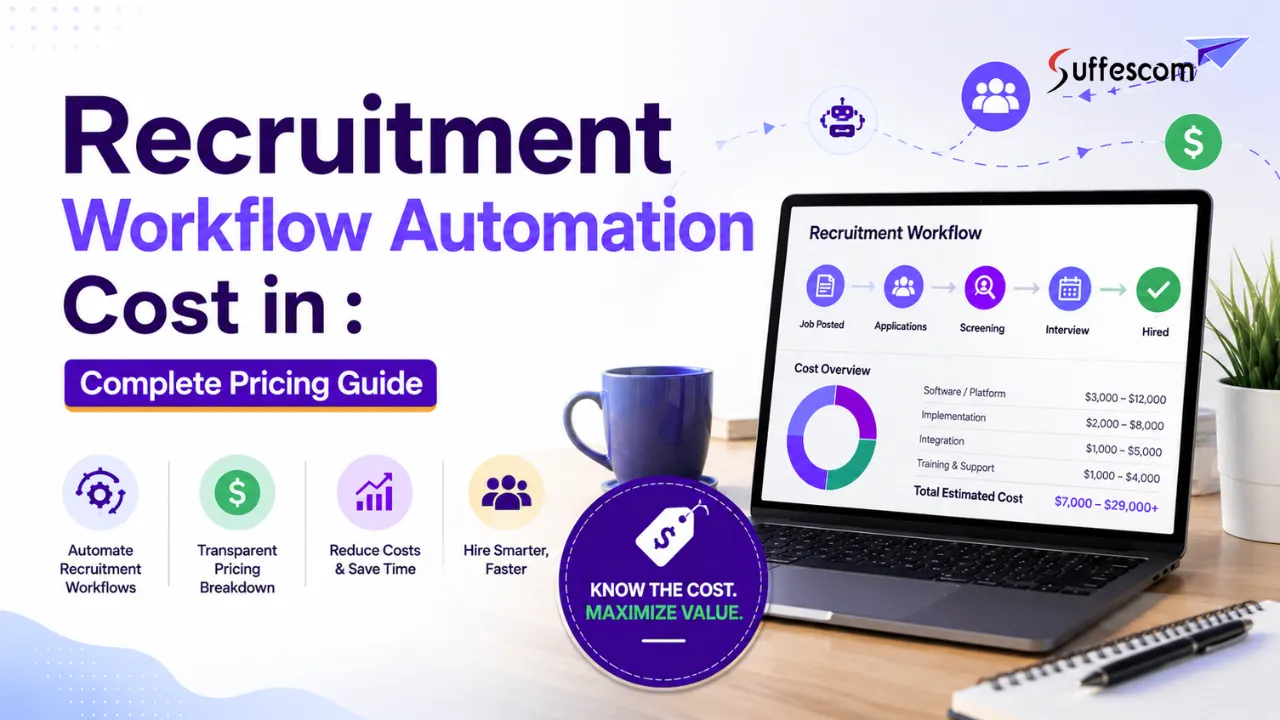
The cost of recruitment automation processes in Australia usually falls within the range of AUD 100 to AUD 15,000+ per month depending on company size, recruiting scale, number of integrations, AI functionality, and workflow complexity. Smaller companies prefer basic software solutions with applicant tracking system functionality and automated scheduling, whereas larger firms usually require complex recruitment workflows that offer AI screening and analytics features.
The total cost of investment also consists of one-time implementation costs, including costs for installation, integration, workflow customization, data migration, and employee training. Both costs should be considered by businesses prior to choosing a recruitment automation solution.
Average Recruitment Automation Costs in Australia
Startups and small companies in Australia usually pay between AUD 100-500 per month for recruitment automation with basic ATS and scheduling functionalities. Mid-sized companies in Australia usually pay around AUD 500-2,500 per month for recruitment automation. Enterprise companies with complex AI recruiting solutions and custom recruitment workflows may pay up to AUD 15,000+ per month for recruitment automation.
| Business Size | Estimated Monthly Cost | Typical Features |
| Small Business | AUD 100–500 | Basic ATS, scheduling |
| Mid-Sized Business | AUD 500–2,500 | Workflow automation, integrations |
| Enterprise | AUD 2,500–15,000+ | AI tools, analytics, custom workflows |
One-Time Implementation Costs
Setup Fees: A lot of recruiters might levy setup charges to configure the recruiting tool and enable key functionalities.
Workflow Configuration: Setting up custom hiring processes, approval levels, and automation settings might incur further setup charges.
Integration Costs: The integration process with other applications like HRIS, payroll, CRM, or communication platforms may be costlier to implement.
Data Migration: Migration of applicant databases, recruiter details, and prior hiring information may incur extra service charges.
Training Sessions: Companies will require training sessions to integrate and deploy the recruiting software properly.
Subscription-Based Pricing Models
Per Recruiter Pricing: Companies are charged depending on the number of recruiters and HR users who use the software every month.
Per Employee Pricing: In some instances, the pricing is dependent on the number of employees in the firm.
Per Job Posting Pricing: Under this type of pricing structure, firms are charged depending on the number of job listings.
Usage-Based Pricing: AI-based recruitment software can employ usage-based pricing where pricing depends on the number of candidates.
Custom Enterprise Pricing
Typically, enterprise recruitment software vendors structure their pricing based on the level of workflow complexity, the number of new hires being made, and the amount of integration that you will require. In Australia, large companies could pay between AU 5,000 and AU 15,000 (or often higher) per month for recruitment automation tools, with API support for ongoing integration into their existing systems (e.g. HRMS), AI-based analytics (e.g. using machine learning), compliance management tools, and reporting dashboards that support hiring across multiple countries.
In addition, many companies with significant regulatory requirements—including those in industries such as health care, finance, and government—may also require additional types of security (e.g. verification of employee identity) or record-keeping (document storage), which will also impact both the total cost of ownership associated with selecting, implementing, and subscribing to an enterprise recruitment automation tool.
Real Recruitment Automation Cost Scenarios in Australia
Scenario 1: Small Australian Startup Hiring 5–10 Employees Per Year
Due to their limited need for employee hiring, small Australian businesses are known for using Applicant Tracking Systems (ATS), Interview Scheduling Software, and types of automated communication with applicants. The majority of smaller businesses that are starting prefer to use cloud-based SaaS platforms because they provide a good price, are simple to use, and do not require much technical assistance.
The average monthly cost charged out to small businesses typically ranges between AUD 100 and AUD 500, depending on a number of variables including recruiter access, job posting volume and automation. Because of their low hiring volume, implementation costs are usually lower than for larger organisations.
The return on investment (ROI) for many startups can be achieved within 3-6 months, due to automation reducing manual screening time, increasing the effectiveness of communication with candidates, and decreasing the number of tasks taken up by a founder or HR department on a repeated basis in relation to the hiring process.
Scenario 2: Mid-Sized Company Scaling Across Multiple Australian Cities
The hiring needs of mid-size organisations differ greatly from different locations included in this analysis (Sydney, Melbourne, Brisbane and Perth) and typically require the use of more sophisticated recruitment automation workflows. Mid-size companies are generally looking to invest in ATS and integrate their ATS with HRIS, communication tools, onboarding systems, and reporting dashboards.
Monthly recurring costs associated with recruitment automation for mid-size companies generally range from AUD 500 to AUD 2,500, while implementation and integration costs vary based on the complexity of an organisation’s recruitment automation workflow and the number of systems to which the ATS will be connected.
A major benefit of recruiting automation for an organisation is savings through an internal recruiting resource. By automating some of the administrative functions associated with coordinating interviews, HR professionals will realise increased efficiencies during the recruitment process, allowing for the continued growth of primary HR team resources without the requirement for significant additional headcount.
Scenario 3: Enterprise Recruitment Team Managing High-Volume Hiring
High-volume recruitment is typically done by large companies that need a sophisticated AI powered system to manage applications effectively across departments and locations. Many of these businesses invest in recruiting tools such as AI resume screening, predictive analytics (using ‘what-if’ scenarios), recruitment CRM platforms (customer relationship management), compliance automation, and enterprise-level reporting.
The cost of enterprise recruitment automation services in Australia may vary between AUD 5,000–15,000+ monthly, with additional fees for implementation such as API integration, customization, migration, and compliance management across locations.
Recruitment automation is essential for enterprises since it helps in optimizing the recruitment process to be scalable, compliant, less burdensome for recruiters, and ensures consistency in the candidate experience.
Start Automating Your Hiring Process in Under 7 Days
Explore quick-deployment recruitment automation solutions for small and mid-sized teams.
Factors That Affect Recruitment Automation Costs
There are several key determinants behind the overall cost of recruitment process automation in Australia. While some companies only need basic functions provided by ATS, others may be in need of a complex system with AI integration, various integrations, workflow customization, and dedicated recruitment systems focused on compliance requirements.
Company Size and Hiring Volume
One of the key factors that has an effect on the cost of recruitment automation is the size of the business and the volume of its annual hiring. The majority of small businesses that hire employees on occasion do not require any special automation functions. Large enterprises that conduct mass recruitment campaigns require more sophisticated solutions.
The seasonality of hiring is another factor that increases the cost of automation. Companies working in sectors like retail, hospitality, and logistics require automation of their recruitment processes because of seasonal fluctuations in demand. Businesses that work with many cities in Australia require automation of their recruitment processes in all locations.
Number of Integrations Required
The more integrated the recruitment automation process is with other enterprise solutions, the lower the cost of manual effort for managing staff. The number of integrations involved increases the cost of implementation and maintenance.
Payroll solutions, HRIS solutions, CRMs, communication channels, and onboarding software represent some typical solutions that may need to be integrated with the recruitment automation solution.
AI and Advanced Automation Features
However, high-end AI-based recruitment capabilities will certainly drive prices up, although they make the recruitment process easier and reduce workload for the recruiters. A number of Australian companies have started using intelligent automation solutions to automate candidate assessment and improve their recruitment processes.
Common AI and advanced automation features include:
- AI Candidate Matching: Automatically identifies the most relevant candidates based on skills, experience, and job requirements.
- Predictive Analytics: Uses hiring data and trends to improve recruitment planning and decision-making.
- Automated Assessments: Assists businesses in assessing and evaluating candidates’ skills through skill assessments, behavioural assessments, and candidate screening questionnaires.
- Recruitment Chatbots: Automate the communication required from a candidate for both interview reminders and status updates on their application.
AI Recruiting Systems that are of an enterprise-level generally are more costly than other recruitment systems due to their advanced analytical capabilities, automated workflow capabilities and greater processing resources.
Local Compliance Requirements in Australia
Businesses in Australia are required to follow certain laws concerning recruitment, privacy and records when recruiting employees. Those companies that operate within regulated industries usually need more security features, as well as those relating to document management and compliance automation.
Recruitment software solutions also have to offer functionality aimed at promoting fairness in hiring processes and managing information on candidates securely. Such compliance-related capabilities will result in higher expenses for implementation and subscriptions.
Hidden Costs Businesses Often Overlook
When creating budgets for recruitment automation projects, numerous businesses in Australia will typically only factor in software subscription costs; however, there are many other expenses associated with the implementation process. While developing a budget, businesses should take into consideration developments or changes they may need such as integration, technical support, training, and future upgrades, when developing their budgets. Including this additional expense in your budget will prevent businesses from exceeding their budget and creating difficulty in future functional operations.
Employee Training and Change Management
Recruitment automation platforms may necessitate both recruiter training and company-wide onboarding to facilitate a successful integration into an organisation. Recruiting personnel will largely be resistant to changing from a manual recruitment process to an automated one due to the major workflow change necessitated by this different method of recruitment.
Onboarding sessions, training materials, and documentation of available HR processes may be developed specifically for this purpose by the organisation to ensure successful implementation of the new recruitment system by recruiters.
Workflow Customisation Expenses
Many businesses need a custom recruitment workflow to match their internal hiring process. Customisations can add time to the implementation and costs to the development of a recruitment solution.
Typical cost items for customisation include:
- Custom recruiter views/dashboards
- Advanced analytics and reporting needs
- Approval chains for enterprise hiring workflows
Ongoing Technical Support
Technical support varies widely by vendor support model and complexity of the recruitment platform used. Depending on their support plan, some vendors might offer basic support in their subscription; while premium support levels will require additional monthly fees.
Large organisations often have an internal IT resource to handle integration, troubleshoot, and perform maintenance of ongoing workflow performance.
Software Upgrade Costs
Growth of a business may require extra modules and enhanced capabilities, leading to increased expenses for the entire system over time.
Typical cost factors during upgrades include:
- Extra automation modules
- High-end third-party integrations
- Access to API and advanced connectivity options
| Hidden Cost Area | Potential Expense |
| Staff Training | Medium |
| Integrations | Medium to High |
| Customisation | High |
| Data Migration | Medium |
| Premium Support | Medium |
Recruitment Automation ROI: Is It Worth the Cost?
A majority of Australian businesses can benefit from the long-term value provided by automating recruitment workflows, through decreasing delays and improving recruiter efficiency and reducing the total cost of recruitment. The initial cost may seem like a large amount; however, automation provides measurable “ROI” (return on investment), by reducing the time it takes to hire candidates, reducing the amount of manual work involved, and providing better candidate management.
Time Savings for Recruiters
One of the major benefits of using an automated recruitment process is that it saves significant time for recruiters and their HR teams. Automation of administrative processes will significantly reduce repetitive tasks, allowing recruiters to spend more time on engaging with candidates and making better strategic hiring decisions.
Major advantages that can save time for companies include:
- Decreasing repetitive and manual processes
- Faster shortlisting process of resumes
- Automation of communication process with candidates
Reduced Cost-Per-Hire
By automating the recruitment process, companies will be able to cut down their costs in relation to hiring since they become more efficient internally and require less support from external recruiters.
Businesses can lower cost-per-hire through:
- Companies can lower cost-per-hire by:
- Minimizing outsourcing cost
- Speed up the hiring process
Better Candidate Experience
Improved Candidate Experience: Modern candidates demand constant and timely feedback from their recruiting counterparts. Moreover, delays in interviewing and hiring processes have always been known to cause loss of leads due to the dropping off of prospective candidates during the recruitment process.
Automated recruiting improves candidate experience through:
- Faster responses and feedback
- Speedy processing of applications
- Enhanced image of the company
Long-Term Hiring Efficiency
Long-term Benefits for Recruitment Process: Besides short-term gains, automated recruiting makes long-term improvement of the recruitment process easier by making it easier to set up a scalable and analytics-enabled recruitment process. Furthermore, automation of reporting and analytical functions enables HR to make better recruitment-related decisions in the future.
Long-term benefits include:
- Better analytical tools for recruiting
- Ability to scale the recruitment process
- Improved management of the talent pipeline
| Metric | Before Automation | After Automation |
| Time-to-Hire | 45 Days | 25 Days |
| Manual Admin Hours | 30 hrs/week | 10 hrs/week |
| Candidate Response Time | 3 Days | Same Day |
| Cost-per-Hire | High | Reduced |
Recruitment Automation Pricing by Business Type in Australia
Prices for recruitment automation tools in Australia will vary widely based on the size of your business, how complex it is to hire people, and what type of workflow you need or want.
For example, while small businesses will typically seek out low-cost applicant tracking systems (ATS) or recruitment automation systems that offer basic technology automation capabilities, large corporations would be willing to pay for more advanced AI-based recruitment systems that have the capability to integrate with multiple tools or platforms, as well as provide advanced reporting and analytics.
Small Businesses and Startups
A variety of recruitment automation tools are available to small businesses and startups, including simple ATS systems, interview scheduling systems, and automated email communication systems. In most cases, these companies will only use an ATS system to help them fill one position at a time.
On average, small businesses can expect to pay between AUD 100 and AUD 500 a month for ATS system services, depending on how many different recruiters have access to the system, the number of job postings they plan to post in a given month, and what features are included in the system. In addition, there will be very few startup costs associated with having the ATS system installed and operating because the hiring processes for small businesses are generally not very complicated and therefore require less effort to implement and maintain overall compared to those of larger companies.
Mid-Sized Australian Companies
To meet their growing demand from multiple locations and/or departments for an advanced recruiting workflow, mid-sized organisations frequently deploy ATS solutions that integrate with HRIS solutions, onboarding systems, reporting dashboards and enable collaborative hiring.
On average, mid-sized companies can expect to spend AUD 500 to AUD 2,500/month on automation of recruitment. There are often additional costs associated with customising workflows for your organisation, integrating systems, training users, as well as advanced reporting functionality.
Enterprise Organisations
Large corporations, which manage many recruitment activities or have offices in multiple locations, typically will need a highly customized recruitment automation system. These systems usually include AI candidate screening, predictive analytics, compliance processing, enterprise reporting and workflow integration capabilities within existing HR systems.
The cost of enterprise recruitment automation in Australia ranges from AUD 2,500 – AUD 15,000+ per month, based on several factors; the volume of hiring being conducted, complexity of the workflow(s) being automated, security levels required and the implementation scope. Many large public companies may incur significant setup and integration expenses in deploying their enterprise recruitment automation solution.
Upgrade from Manual Hiring to AI-Powered Recruitment
See how automation can reduce time-to-hire by up to 50% for your business.
How to Choose the Right Recruitment Automation Solution
On the other hand, in selecting the best recruitment automation software, one is expected to do better than select software on the basis of its low price alone. There will be many factors that Australian companies would have to consider such as their hiring requirements and future plans.
Define Your Hiring Challenges First
Before investing in recruitment automation, businesses should identify the biggest problems affecting their hiring process. This helps in selecting software features that directly solve operational inefficiencies.
Some hiring issues experienced by organizations include:
- Late hiring and screening
- Poor candidate communication
- Administrative inefficiencies
Insight into these hiring issues can aid in choosing an ATS and other automation capabilities.
Compare Pricing Transparently
Pricing schemes for recruitment software may differ widely from one software provider to another. Companies should be careful in comparing their pricing schemes to make sure they know what is included in their subscription package.
Some key pricing considerations that companies need to evaluate include:
- Contract period and lock-ins
- Extra charges for features
- Limits on the number of users
Transparency will help the company to avoid hidden costs down the line when needs change.
Prioritise Scalability
Organizations must consider systems that have scalability in the event of future recruitment requirements. What is efficient now for the current recruitment volume may prove ineffective in future when more recruiting will be required.
Some factors that contribute to scalability are:
- Future growth and recruitment requirements
- Ability to recruit from different locations
- Workflow scalability for long-term use
Scalable platforms reduce the need for costly system migrations later.
Evaluate Vendor Support and Local Expertise
The presence of reliable support from the vendor organization is crucial to ensuring successful implementation and management of the technology. Organizations in Australia need to ensure that the software vendor provides adequate local support and implementation assistance.
Some critical aspects of vendor support are:
- Customer support within Australia
- Implementation assistance
- Training material for recruiters
Strong vendor support can significantly reduce implementation challenges and improve long-term platform adoption.
Should Australian Businesses Build or Buy Recruitment Automation Software?
The decision about purchasing either a pre-existing SaaS recruitment platform or creating an automated recruitment solution specific to the organisation’s recruitment processes is a major decision faced by organisations in Australia when considering investing in recruitment technology. The options available will depend on the complexity of the hiring procedure, available budget, the requirements of scalability, compliance issues as well as long-term operational business goals.
When Off-the-Shelf Software Makes Sense
Businesses that require a quicker time to implement a recruitment automation solution; have lower upfront capital costs; or do not wish to incur ongoing maintenance costs of software will find that off-the-shelf recruitment automation solutions are appropriate for their needs. Start-up and small-to-medium-sized businesses are most likely to use SaaS ATS and recruitment automation solutions as they allow them to gain critical functionality required for hiring without having to spend a large amount developing or managing their technical requirements.
Typically the features provided by these recruitment automation systems include but are not limited to resume screening, interview scheduling, workflow automation, reporting dashboards, candidate communications and these are accessed through a monthly subscription. By using a subscription model the vendor is responsible for hosting, maintaining, upgrading, and providing technical support which allows organisations to implement the solution quickly with very little internal information technology support.
When Custom Recruitment Automation Is Worth Considering
Customized recruitment automation software is generally considered a better choice for corporations or companies that have unique hiring processes. Companies functioning in sectors where there are many compliance issues like health care, financial services, or government will need customized recruitment processes, along with integration and reporting options that generic software may fail to provide.
Even though the upfront investment for custom development is larger and the development time more lengthy, it provides far more flexibility, scalability and control over workflows. Automation features can be built specifically around a business’s exact hiring needs, internal processes and structure.
| Factor | Off-the-Shelf Software | Custom Solution |
| Initial Cost | Lower | Higher |
| Deployment Speed | Fast | Slow |
| Flexibility | Moderate | High |
| Maintenance | Vendor-managed | Internal responsibility |
| Scalability | Depends on vendor | Fully custom |
Best Practices to Reduce Recruitment Automation Costs
Start With Core Features
The first step businesses should take in order to ensure that they invest in an automated recruitment system is to concentrate their efforts on core functions of automation rather than investing in all aspects of automation at once. For example, implementing ATS capabilities (such as tracking candidates through the application process), scheduling interviews, and communicating with candidates will help to minimize the first significant drop out of upfront capital costs while allowing businesses to expand slowly as their hiring needs continue to increase.
Automate High-Volume Tasks First
Automating processes with a large volume of repetitive work and a small amount of time and effort results in a significant return on investment and an immediate improvement in operational efficiency. Businesses should focus their efforts on automating tasks that are repetitive and time-consuming (e.g., screening resumes, scheduling interviews, following-up with prospective candidates) and will account for a large portion of the Recruiter’s time to complete a candidate’s application.
Use Existing Integrations
Utilising a recruitment platform that integrates with an existing human resources management system (HRMS), payroll system, customer relationship management (CRM) system, and communication system will significantly reduce implementation and development costs. Further, businesses can avoid implementing duplicate systems, manually entering data and completing unnecessary work.
Monitor ROI Regularly
The continuous measurement of recruitment performance allows companies to assess their investment in automation efforts and learn how they can be improved. Key performance indicators in this respect comprise recruitment KPIs, recruiter effectiveness, time-to-hire, and even candidate experience indicators.
Future Trends in Recruitment Workflow Automation in Australia
AI-Driven Recruitment
The adoption of AI in recruiting is now gaining popularity in Australia among recruitment teams in various companies, as they seek ways to streamline their recruitment process. Such capabilities include predicting candidates, using smart resume screening, and rating the potential of the candidates during the recruiting process.
Increased Use of Conversational Automation
Conversational automation is a tool that a lot of organizations are implementing for candidate engagement throughout the recruitment process. Recruitment chatbots and automated messaging systems enable organizations to respond to candidate questions, schedule interviews, share important updates, and enable a more timely candidate engagement.
Data-Driven Hiring Decisions
Hiring strategies in Australia continue to be optimized with recruitment analytics and workforce data by Australian businesses. Automated reporting dashboards, workforces and hiring data along with forecasting applications and recruitment performance indicators enable businesses to become better at hiring decisions and strategic workforce planning for the future.
Greater Compliance Automation
While regulations and data privacy legislation concerning recruitment continue to change; Australian organizations are utilizing automated recruitment solutions that focus on compliance. Fully automated workflow management with auditable records and candidates records maintained securely will enable companies to stay compliant while reducing recruitment risk.
Conclusion
Recruitment workflow automation is now available not just for big companies, but smaller companies are using these systems as well to increase their recruitment efficiency, reduce the administrative burden associated with recruiting, and speed up the process of filling positions. With the proper strategy and scalable technologies in place, recruitment automation can provide long-term operational and financial advantages to growing businesses.
The price of recruitment workflow automation solutions may differ significantly based on many factors related to an organisation’s business and technical needs. For example, an organisation with simple hiring processes may only require access to basic ATS platforms while larger organisations typically invest in AI-based systems that provide custom workflows and integration points.
The main contributors that determine the cost of recruitment automation solutions are:
- Size of the organisation and volume of hiring
- Integration needs
- AI-based functionality and advanced automation functionality
- Complexity of implementing and customising a workflow
Final Recommendation for Australian Businesses
Australian businesses must take into consideration their return on investment when choosing recruitment software instead of selecting one purely based on the initial cost. An appropriate automation software solution would increase recruiter efficiency, cut down hiring time and help organizations grow.
It is important to consider scalable recruiting automation software, which will enable companies to first automate tasks where the maximum amount of time is saved for recruiters. These would include resume screening, interviewing scheduling and candidate communication among others.
Get a Free 30-Minute Recruitment Automation Consultation
Get a tailored roadmap to reduce time-to-hire and recruitment costs in your organization.
Frequently Asked Questions
1. How much does recruitment workflow automation cost in Australia?
Recruitment automation costs vary greatly across Australia but generally start at around AUD 100 – AUD 500 per month for small businesses and can exceed AUD 15,000 per month for enterprise organizations needing advanced AI features, customized workflows, and multiple integrations.
2. Is recruitment automation affordable for small businesses?
Yes! Recruitment automation offers start-up companies many excellent entry-level recruitment platforms that provide low-cost basic applicant tracking software for scheduling, communication, etc.
3. What is included in recruitment automation software pricing?
Most recruitment automation platforms provide a variety of features in their software price, including applicant tracking, resume screening, scheduling interviews, corresponding with candidates, working through recruitment workflows through automation, generating reporting dashboards, and supporting new employees. Additional features available under advanced plans might include AI tools and analytics capabilities.
4. Are there hidden costs with recruitment automation platforms?
Yes, there can be additional costs associated with the set-up and implementation of recruitment automation platforms. Examples of these include data migration costs, costs for training employees to use the new system, workflow customization for each company, additional support, and additional costs for access to certain APIs depending on the specific platform and complexity of the implementation.
5. How long does implementation take?
For implementation of basic recruitment automation software, typically only a few days – weeks are required; however, for enterprise-level solutions that require customized workflows and integrated systems, implementation can take several months.
6. What ROI can Australian businesses expect?
Organisations typically receive an ROI on their recruitment process by experiencing reduced time-to-hire, reduced administrative burden associated with recruitment, faster candidate screening compared to their current processes, improved productivity levels of recruiters, and more positive candidate experiences throughout the hiring process. Many companies will find that they are able to track measurable increases in efficiency within the first few months of implementing recruitment automation.
7. Can recruitment automation integrate with existing HR software?
Most of today’s recruitment software solutions offer some sort of integration capability with existing HRIS solutions, payroll processing systems, onboarding tools, CRM systems and communications tools to help streamline workforce management and eliminate manual data entry.
8. Is AI recruitment automation expensive?
Costs can vary significantly from low-end feature-rich solutions to high-end enterprise solutions. Smaller companies will typically use low-end SaaS solutions, which provide basic screening capabilities, while larger companies tend to invest heavily into predictive analytics and intelligent automation for recruitment purposes.
9. What is the difference between an ATS and recruitment automation software?
The primary function of recruiting software applications (ATS) is to assist in managing and tracking candidates who apply for positions. Recruitment automation software goes beyond this by automating many of the day-to-day activities involved in recruiting, including, but not limited to, screening candidates, communicating with candidates, scheduling interviews, conducting onboarding, and reporting.
10. Which industries benefit the most from recruitment automation in Australia?
Sectors that have a high volume and/or high frequency of recruiting requirements like healthcare, technology, logistics, retail, hospitality, construction, financial services will most benefit from recruiting automation software.
11. Can recruitment automation reduce recruiter workload?
Yes, recruiting automation tools take the load off from repetitive administration functions enabling recruiters to concentrate on higher value recruitment activities.
12. Is cloud-based recruitment software better for Australian businesses?
Yes, cloud based recruitment software solutions generally have the advantage of quick implementation, scalability, remote accessibility, automatic upgrades, cost-effectiveness etc.
13. Do recruitment automation tools support remote hiring?
Many recruitment automation platforms include functions that allow you to conduct remote hiring including video interviewing functions, electronic onboarding, automatic communication between candidate and employer and online candidate assessments.
14. Should businesses choose custom or off-the-shelf recruitment automation software?
Off-the-shelf recruitment automation solutions are a better fit for start-up and SMEs due to lower costs, but for enterprise companies with complex hiring processes that require compliance or large-scale hires, custom recruitment automation may be better suited.
Need Help With
Development?