Get a quick blog summary with:

One of the biggest business decisions an organization makes when developing a digital product is which mobile app development framework to choose. By 2026 organizations are not judging app technology by the speed of development. Instead the decision will be based on the level of performance and return on investment that each option will bring. This shift comes as the global mobile application market continues to expand rapidly, with industry estimates projecting it to surpass USD 626.39 billion by 2030.
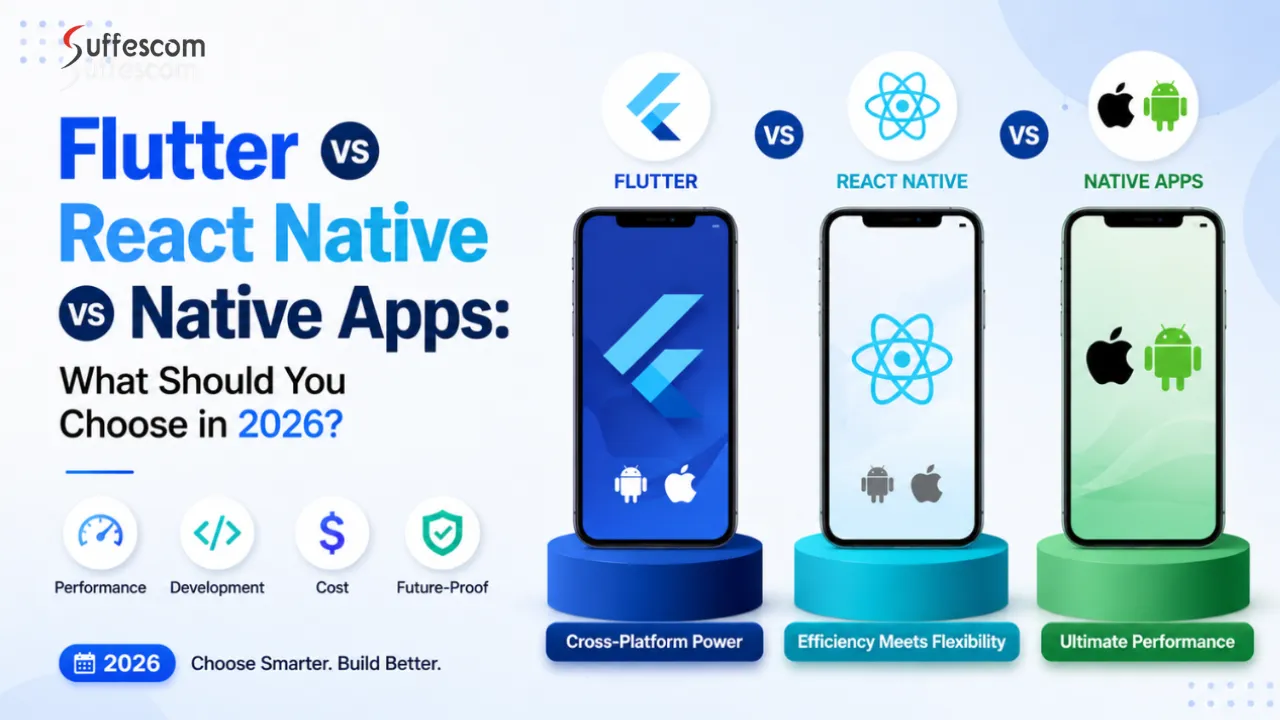
As each development framework has their strengths and weaknesses the argument between Flutter, React Native and Native apps continues. Flutter developed by Google will allow an organisation to develop a cross platform app using a single code base and render a consistent user experience across different platforms. React Native developed by Meta allows development teams to use the languages they are familiar with such as JavaScript to utilise code reuse and expedite the development of mobile applications. Finally, Native Development is known to give an organisation direct access to all of the platform specific features and provides the best level of performance.
Mobile-first strategies have become essential for companies and choosing the right framework will not only save you time and project cost but also affect the quality of the application and scalability of the future. While startup companies need to take their application to the market quickly at an affordable price, enterprises require high security, compliance, performance under load and so on.
In this ultimate Flutter vs React Native vs Native Apps comparison, we will analyse the pros and cons, costs, performance of each approach, and best scenarios to use them. From an MVP project or the scaling of a business application to a performance-critical enterprise solution, this guide will help you make the right choice regarding which mobile development framework to use in 2026.
Key Takeaways
- Flutter-Startup or MVPs are likely to choose Flutter for its rapid development capabilities, affordability and uniform UX across iOS and Android with a single codebase.
- React Native-Best suited for companies that already have in-house JavaScript skills-reuse the expertise and cut development time, with near-native experience.
- The top performance and security offered makes native development the first choice for enterprise, fintech, healthcare, hardware intensive apps.
- Generally, Flutter provides better UI consistency due to using its own UI rendering engine whereas React Native uses nativeUI components.
- The benefit to using React Native is that it already has an established developer community behind it, therefore allowing you to build applications which have the advantage of an exponentially higher amount of resources.
- On the other hand, native mobile applications have the benefit of giving full access to all device functions.
Flutter vs React Native vs Native Apps: Quick Comparison
There are various factors that one needs to analyse before choosing the appropriate mobile app development framework. While Flutter, React Native and Native apps are the prominent choices, each of them are suited for different business goals and technical constraints. A summary of their differences is presented in the table below.
| Factor | Flutter | React Native | Native Apps |
| Developer | Meta | Apple/Google | |
| Language | Dart | JavaScript | Swift/Kotlin |
| Platforms | iOS + Android | iOS + Android | Platform specific |
| Performance | High | High | Highest |
| Cost | Lower | Lower | Higher |
| UI Control | Excellent | Good | Complete |
| Best Use | Startups | Business apps | Enterprise apps |
What Is Flutter?
Flutter is an open source UI software development framework developed by Google to create multi-platform applications with one single code-base. Since then, Flutter has become the most widely adopted framework in mobile app development, enabling businesses to build applications on both iOS and Android platforms and create similar user experiences.
Different from typical native development where there is separate codebase for different platforms, Flutter provides a way that developer writes the code once, runs on cross-platform, which saves development time, decreases maintenance cost and speeds up the product release.
Currently Flutter is being used to develop all kinds of applications such as startup MVP, E-commerce app, Fintech app, health apps, SaaS products, enterprise software and so on.
Flutter Architecture Explained
Flutter’s architectural design ensures efficiency and performance on the screen. This framework does not depend too much on UI elements offered by native apps but creates its own rendering system and draws everything on the screen directly.
Key components of Flutter architecture include:
Dart Programming Language
The flutter apps are constructed using Dart programming language that belongs to Google. Dart programming language is designed to support responsive UI creation and can be compiled via JIT and AOT approaches. Hot reload feature enables the programmers to see any code changes immediately, which facilitates app development and debugging considerably.
Widget-Based UI System
With widgets you can implement everything in Flutter – simple buttons, text inputs, elaborate layouts, navigational systems etc. The power of Flutter lies in how it enables you to build complex and interactive user interfaces with consistent design by chaining and customising widgets together, allowing for the creation of a unique app branding and user experience.
Flutter Rendering Engine
A distinguishing feature of Flutter is its rendering engine that paints each pixel on the screen directly. The Skia graphics engine in Flutter is used to draw user interfaces without native UI controls. The approach of rendering independently of the platform provides for fluid animation and a predictable look and feel of the interface across different platforms.
Single Codebase Development
It allows developers to use one codebase on Android and IOS. This is a great development and can save on the need to maintain and build two projects for both systems. Businesses also save on development costs as bug fixes and feature additions only need to be completed once.
Flutter Advantages
So for companies searching for the most time and cost effective solutions for developing mobile applications, Flutter is the framework of choice.
- Faster Development Cycles: The ability for developers to see the changes they make to the app live within the environment thanks to Flutter’s hot-reload functionality.
- Consistent User Interface: The unique rendering system of Flutter ensures that Flutter applications will have the same look and feel on all devices and platforms, ensuring that businesses provide the experience that their users are accustomed to.
- Good cross-platform support: as a developer will be able to build both Android and iOS applications from one code, and thus it would consume less resources on building and maintaining an application.
- Reduced Maintenance Cost: Instead of having to manage numerous projects across different platforms, bug fixing, testing, and upgrading a single application over many years will result in significant savings.
Flutter Limitations
Although Flutter offers many benefits, it may not be the ideal solution for every project.
- Larger Application Size: Flutter apps tend to have a larger size of installation as compared to some native apps as the framework and rendering engine gets packaged along with the app.
- Native Dependencies for Advanced Features: Though Flutter offers access to most device features, it does not offer full functionality of some advanced, platform specific features and we have to access it through some native code or external plugins.
- Smaller Ecosystem Than Native Development: Although the Flutter ecosystem is growing at a very rapid pace, native development platforms have been there for quite a long time, hence they offer a wider collection of mature plugins, tools and resources that are platform specific.
What Is React Native?
React Native is an open-source framework to develop mobile applications established by Meta. It permits developers to develop multi-platform mobile applications by using Javascript and React, in that way a large amount of source code can be shared by iOS and Android platforms.
Since the release, it has turned out to be one of the best frameworks of multi-platform development, because of the plasticity, large community and use of Web experience. Companies select React Native for their development if they need to reduce cost and time for development, and if they need to have the same experience for both platforms.
Today React Native is the technology of many applications like social networks, eCommerce applications, business applications, content applications, enterprise mobility, etc. Thanks to its ecosystem and huge adoption, it’s a valid tool for companies that want to quickly develop products on the market.
React Native Architecture Explained
React Native is a framework that bridges JavaScript and native application development, where applications will almost match native applications with native performance, and provide the benefits of sharing a codebase. The framework’s structure connects the JavaScript code to the native device function.
JavaScript-Based Development
React Native applications are mainly built on JavaScript-an all-time world popular programming language. This allows the companies that are already equipped with web development teams to readily use their existing abilities to construct mobile applications. The developer can make reusable code with the use of React component systems.
Native Components
Instead of some cross-platform frameworks that render their own UIs, React Native uses native platform elements in creating UIs. Thus buttons, nav components and any UI components in the apps are rendered with native Android and iOS components making your app appear to the users to be more native.
Bridge and Modern Architecture
Previously, React Native had a JavaScript bridge, allowing the communication between JavaScript code and the native functionalities of the devices. Although the bridge worked, in certain cases it generated some performance bottlenecks when building heavy applications. The latest React Native versions have implemented the New Architecture, composed of libraries like Fabric or TurboModules, improving the communication efficiency between JS and native code, and reducing the overall application’s latency.
React Native Advantages
React Native can be quite a business boon for companies looking to develop cost-effective and scalable mobile applications.
- Big ecosystem – There is one of the most robust developer communities existing in the mobile industry. Thousands of libraries, plugins, development tools, as well as community resources are at the disposal of any business to make projects delivery faster and at less effort.
- Faster delivery of features – The framework lets developers deliver features faster by sharing them across platforms. Shortened development time helps businesses deliver updates faster, respond quickly to users feedback, and reduce their release cycles.
- Reusable components – React Native adopts a component based development model. It lets developers share the User Interface (UI) elements and business logic across their application.
React Native Limitations
The React Native framework has its merits, however, it may not be the suitable solution for all kinds of mobile applications.
- Dependency Management Challenges: React Native applications are usually packed with numerous third-party libraries and plugins to achieve certain functionalities in applications. Maintaining the dependencies along with compatibility across frameworks and keeping them updated could increase the development complexity over a period of time.
- Native Modules for Advanced Features: Applications that would need to harness specific hardware features, highly interactive animations, or need complex animations with real time processing capabilities or platform specific unique features, necessitate the usage of native modules.
- Platform-Specific Maintenance Requirements: Although React Native apps are heavily dependent on shared code, the platform specific code needs to be maintained; thus, testing and unique modifications for the respective platforms need to be done accordingly.
Not Sure Which Mobile App Framework Is Right for Your Business?
Get expert guidance to choose between Flutter, React Native, and Native development based on your goals and budget.
What Are Native Apps?
Native mobile apps-These are mobile applications written specifically for a particular operating system using native languages, frameworks, and SDKs for a certain OS. This means you have to develop and maintain two separate apps, one for iOS and one for Android as opposed to using cross platform frameworks like Flutter and React Native.
Since native mobile apps have been made just for their specific platform it allows you to access the device’s operating system, hardware and platform specific design patterns, to offer a better performance, security and overall reliability.
The typical areas for native development are enterprise software, fintech apps, healthcare solutions, gaming applications, and similar areas where performance, security, and device-level access are core business needs.
Native iOS Apps
A Native iOS app is an app specifically made for the Apple ecosystem and its operating systems using either Objective-C or Swift as the app development language and its related official framework. The app will run only on the specific type of Apple device, the iPhone, the iPad, the iWatch, etc.
Swift Programming Language
Swift-is Apple’s modern programming language, used for developing applications in the iOS platform. It has been engineered to be fast, secure, and developer friendly while also providing good performance and reliability. Through the robust type safety and the modern syntax of Swift, developers are guided toward stable applications.
SwiftUI Framework
SwiftUI-is Apple’s declarative framework for user interfaces, which makes the creation of beautiful and responsive applications easier than ever before. It can generate adaptable interfaces which adjust smoothly between Apple devices as well as staying consistent with Apple’s design.
Deep Integration with the Apple Ecosystem
Native iOS apps have easy integration to the Apple ecosystem such as face ID, touch ID, Apple Pay, Siri, HealthKit, Apple Watch and iCloud. Businesses benefit through excellent optimisation to offer the best experience possible while fully utilising all features provided by Apple hardware and software.
Native Android Apps
Native Android applications are written exclusively for the Android platform using Google’s provided frameworks and development tools. This gives developers full access to the operating system’s functions allowing an application to be completely optimised for the platform.
Kotlin Programming Language
Kotlin has now turned to be the favorite language of Google for application development for Android platforms. It offers better features like conciseness, safety and efficiency compared to the past programming languages which were used for Android development.
Android SDK and Development Tools
In Android, applications can be developed using the Android Software Development Kit (SDK), Android Studio and other Google development frameworks. These tools provide native access to the Android operating system functionalities, device hardware, APIs and deep customisation which is possibly inaccessible via cross-platform tools.
Extensive Device and Platform Support
In Android app development, the apps will run optimally on a range of smartphones, tablets, smartwatches, foldable devices, etc running on the Android platform. This gives a developer fine control to optimise apps on a range of screen sizes, device features and operating systems.
Native App Advantages
Native development is the option that is still best for businesses who care about performance, security, scalability and sophisticated platform features.
Best Performance
Native applications work directly on the underlying OS, with the underlying hardware; no extra intermediate layer that hinders the speed and deteriorates the performance of a native application as in most cross platform applications. Native applications usually run faster, with much smoother animations, better responsiveness and the best performance.
Better Security
The ability to exploit all the features of the platform: security, encryption standards, strong authentication and operating system’s own security mechanisms. Thus, Native applications are best suited for sensitive industries such as finance, government, health, enterprise software.
Full Access to Device Capabilities
The ability to interact directly with the device hardware and OS services. Devices’ hardware includes: cameras, biometric devices, GPS, Bluetooth, NFC, various sensors, system services, background tasks, device APIs. Native development allows developers to create more customised applications and integrate them closely with the device.
Long-Term Scalability and Reliability
The more native the development the more room for optimisation and customising the architecture and scaling for enterprise wide large scale usage by millions of users, the longer-term planning and further development of features makes it a best choice for organisations with an investment plan.
Flutter vs React Native vs Native Apps: Performance Comparison
Performance is among the key aspects to consider when selecting a mobile app development platform. Selecting a mobile app development platform will be dependent on the needs of your application. When it comes to business apps, Flutter and React Native provide outstanding performance. Nonetheless, for applications that require graphical and real-time computing power, native app development is ideal.
Performance Comparison Overview
| Performance Area | Winner |
| Speed | Native Apps |
| UI Animation | Flutter / Native Apps |
| Heavy Processing | Native Apps |
| General Business Apps | Flutter / React Native |
| Gaming Applications | Native Apps |
Flutter vs React Native vs Native Apps: Cost Comparison in 2026
One of the main considerations when choosing a development framework for your mobile application may be the cost involved. The mobile app development cost will vary greatly depending on a number of factors, including technology, complexity of the project, and functionality required.
Flutter App Development Cost
Flutter is considered the most economical framework for developing mobile apps, as only one code can run on the two operating systems. In the country of Australia, the pricing of flutter apps lies between AUD $25,000 and $150,000+, according to complexity and customizations required.
A simple MVP would cost anywhere from AUD $25,000 to $50,000 while the software of mid-level businesses would cost anything between AUD $50,000 to $120,000. Conversely, flutter applications that offer high-end features for enterprises would cost much more than AUD $150,000.
React Native App Development Cost
Cost wise the price range of the React Native development is quite similar to Flutter and the only major difference might be when additional third party integrations and native module needs are involved. In most cases, for the development of an average React Native application the project cost varies between AUD $30,000 to $160,000+.
The cost of development for a small MVP or startup type application may be AUD $30,000- $60,000. Cost wise an advanced business feature rich application would vary between AUD $60,000-$130,000, an enterprise solution would be around AUD $160,000+ with required high security integration.
Native App Development Cost
Native application development represents the costliest method because two different applications have to be developed for both iOS and Android operating systems. This requires that businesses allocate specific resources for developing these two applications, which leads to more costs being incurred during the process.
As for the price of developing a native app in 2026, it is estimated to be within AUD $50,000-$300,000+. Smaller native apps would likely cost between AUD $50,000-$100,000, but larger business systems like enterprise applications, fintech software, health care applications, and performance-based applications
Flutter vs React Native vs Native Apps Cost Overview
Here are the estimated mobile application development costs in Australia for the year 2026. Keep in mind that this may change based on various application design complexity and technological factors.
| Development Approach | Average Cost Range (AUD) | Cost Level |
| Flutter App Development | $25,000 – $150,000+ | Low–Medium |
| React Native App Development | $30,000 – $160,000+ | Low–Medium |
| Native App Development | $50,000 – $300,000+ | Medium–High |
Why Flutter and React Native Can Reduce Costs
One reason for the rise in popularity of cross-platform frameworks is that they allow businesses to bring their product to market quickly and in a cost-effective way.
Shared Codebase
The two most obvious cost-saving advantages of using Flutter and React Native is having just one codebase instead of two different ones, which will have to be maintained and developed for both Android and iOS.
Faster Development Cycles
Being able to write code only once, for many different platforms means speed of development is dramatically increased. Developing faster results in fewer billable hours and quicker time to market which allows for faster validation of business hypotheses, critical to startups and rapidly scaling businesses.
Lower Testing Effort
Having much of the application logic in common can simplify testing. Quality Assurance can test core functionality against platforms with reduced redundant testing and lower test costs while keeping application quality high.
Easier Updates and Maintenance
Single codebase makes bug fixes, feature improvements, and new releases a breeze. The maintenance costs for businesses are reduced, since improvements only need to be made and deployed on both platforms at the same time, reducing ownership costs over the life span of the application.
When Native Costs More but Makes Sense
Native application development is often a bigger undertaking, but there are cases when the extra investment is more than worth it in the long run.
High-Security Applications
Applications in the banking and fintech sector, health care, insurance, government etc typically require a high level of security and need to comply with the security norms of regulators and have to manage data securely. Native development allows a greater degree of access to platform security functions, thus enabling it to be chosen over hybrid development.
Advanced Hardware Integration
Applications with heavy reliance on device hardware such as biometric, NFC, Bluetooth, IoT, camera processing and unique sensors can also take advantage of native development. Direct use of platform APIs ensure more reliable applications and better function usage.
Complex Animations and Graphics
The performance of apps that necessitate extensive and tailored animation, advanced visual effects, augmented reality features or graphically-intense interactions benefit most from being native applications. Native applications give a finer control of the system’s resources and rendering process.
High-Performance Applications
For complex enterprise applications, instant communication systems, trading programs, video manipulation and gaming environments where performance is critical and low latency is expected, native applications can indeed be worthwhile despite the cost due to superior performance, scaling capability and better end user experience.
Flutter vs React Native vs Native Apps: Which Is Best for Startups?
Selecting the correct mobile app development framework for a startup differs in significant ways to that of a larger corporation. Start-up businesses must consider the limited finances, speed of time-to-market and a desire for product validation rather than high performance at this early stage. Quickly getting a product to market and receiving real feedback is sometimes more important than top level performance.
This is why many start-ups appraise the different development options of Flutter, React Native and Native app development differently. Getting a Minimum Viable Product to market and gaining real validation/investment/users is the goal, and so quickly testing a concept and then iterating it based on feedback, will often be the priority.
MVP Development
Starting with an MVP development instead of full functionality application is the standard approach for most startups. With MVP the entrepreneurs can test the concept of the product with the real users at the minimal costs.
Flutter and React Native are good frameworks for the MVP development, as it is possible to build the android and iOS application out of a single codebase, which does reduce considerably the effort of building mobile applications in the native platform where two separate applications need to be built.
It will likely be much easier and faster to get on the market with cross platform technologies, in the event where startups need to get quick validation and shorten the product launching.
Faster Product Launch
Speed plays an important role in today’s competitive world. The sooner the start-up firm will be able to deliver its application, the quicker it will gain users’ feedback and start earning money. Flutter comes with the possibility to use hot reload and an extensive set of widgets; React Native provides reusability of components and lots of open-source third-party libraries.
This means that using either framework will allow for quicker application development than using native programming, so a start-up will be able to deliver the product to the market weeks or months before other firms.
Better Budget Control
Startup companies usually start out with minimal resources, and therefore need to extract maximum value from all investments made towards application development. Flutter and React Native save money in that only one development team is required to develop and support applications for multiple operating systems.
The company is therefore able to focus on enhancing features of its products, advertising, and gaining new customers rather than separately developing different apps for Android and iOS. This means there will be minimal risk associated with the cost of app development. Cross-platform app development is therefore more effective for founders who work with tight budgets.
Startup Recommendation
Overall, Flutter usually provides the best option for the majority of startups in 2026. The framework combines the fast development, efficient cost, adequate performance, cross-platform and rich user experience at its best and can give start-ups a strong competitive advantage.
React Native will be a great second choice for firms that have knowledge of working with JavaScript. Native development should be left for specialised cases where high performance, security, and hardware demands exist.
Recommended Choice for Most Startups: Flutter
Turn Your App Idea Into a Successful Product
From MVP development to enterprise applications, we help businesses launch faster and scale efficiently.
Which Technology Is Best for Enterprise Applications?
It should be noted that Enterprise applications have entirely different demands as compared to the startup MVPs and small business applications. The organizations at a larger scale need to ensure scalability, security, compliance, system integration, performance on high load and long term maintainability when choosing a mobile development framework.
Though Flutter and React Native have come a long way and have started to gain adoption at enterprise level too, native development will continue to remain a top choice in case of large scale enterprise apps where performance, security and platform specific features are utmost critical.
The right technology will always depend on the business needs, technical capabilities, budget and future digital transformation strategy of the organization.
Scalability
Enterprise applications typically deal with millions of users, extensive business logic, large databases and a multiplicity of integrations with external services.
Performance optimization and architectural customization with scalable systems are greatest with Native applications as developers have ultimate control over platform specific features and therefore can tailor to the business need.
The architecture and performance of Flutter make it a great enterprise solution as well; it can create and maintain a single user interface for multiple platforms. While React Native can easily be scaled to many enterprise requirements, bigger applications may need more optimisation and development specifically tailored for each platform.
Security
Security is among the key factors to consider when developing enterprise software especially in sectors like finance, health care, insurance, government, and telecommunications where an organisation has to ensure that any sensitive personal or corporate information is safe and in compliance with strict security guidelines.
In-built security features like those provided in native apps give developers direct access to all security-related aspects such as encryption tools, biometrics, security services, secure storage, and operating system security measures. As a result, enterprises are able to implement a highly customised security environment.
Compliance and Regulatory Requirements
Many enterprise companies operate in environments that involve high levels of regulation, demanding strict compliance with various industry guidelines and laws. These may involve such compliance as GDPR, HIPAA, PCI DSS, ISO certifications, financial compliance, and government security compliance.
Native development becomes easier to comply with as developers can take advantage of specific security capabilities that each platform provides. This might be especially useful for companies dealing with such sensitive data as healthcare documents, finances, or classified information from the government.
Applications developed with Flutter and React Native can comply with regulatory requirements too, although some extra work is needed to reach full compliance.
Long-Term Maintenance
It must be noted that enterprise applications are often supported throughout a considerable period of time, with constant updates, additions, and integration of new features. Thus, maintainability becomes one of the main criteria for the selection of a programming framework.
Flutter has its own advantages in this regard due to the fact that a single codebase can be used for developing applications for two different platforms, namely, Android and iOS. This can increase maintainability and allow developers to provide updates faster.
In addition, React Native can offer some additional benefits related to code sharing and fast update processes. In general, native applications need individual support for each platform, which may result in higher expenses related to the development process. On the other hand, companies have more control when it comes to enhancing their efficiency and implementing new technologies.
Enterprise Recommendation
For businesses building mission-critical applications, which demand ultimate control over functionality, high-performance and stringent levels of security, compliance, and scalability, native app development stands as the best solution for 2026. It gives businesses access to a comprehensive range of device functionality and meets strict enterprise-grade conditions.
However, not all enterprise development projects necessitate native application development; organizations seeking increased efficiency, faster development, and reduced maintenance costs may find Flutter an excellent solution. Many are already using Flutter for enterprise mobility solutions, client-side applications and internal business platforms where consistent user interface across platforms is valued.
- Best for Enterprise-critical Applications: Native Apps
- Best for cost-effective Enterprise mobility solution: Flutter
Real-World App Technology Case Studies
The following are real-world examples of how varying technologies can address varying business problems. The case studies outline actual circumstances wherein Flutter, React Native, and native app development offer different benefits.
Case Study: Flutter App Launch
Challenge
The startup company was growing and needed its marketplace application developed for both Android and iOS platforms as soon as possible, on a limited budget and wanted to test its business model before investing in two different development teams, one for each platform.
The objectives were to limit the development costs, have the quickest possible time-to-market and ensure a uniform experience for the user.
Solution
This choice was made due to the cross-platform nature of Flutter and a unified codebase approach. With the help of Flutter technology, it became possible to develop the product at once for both iOS and Android systems. The abundance of widgets in Flutter was also beneficial. Also, the feature of hot reload positively affected the development process.
Results
- Reduced overall development timeline compared to building separate native applications.
- Achieved a consistent user interface across Android and iOS devices.
- Simplified maintenance through a shared codebase.
- Accelerated feature deployment and product updates.
- Enabled faster market validation while controlling development costs.
Key Takeaway: Flutter was well-suited for developing a quick MVP and launching the product cross-platform.
Case Study: React Native Business Application
Challenge
A medium-sized company was looking to update its customer engagement platform in order to introduce new features on a more frequent basis. Existing resources included an established JavaScript development organisation, which would allow for a reduction of support time, as well as cost savings, through the reuse of already proven resources.
In addition, there was also a desire to implement a solution that supported the company’s goals for continuous improvement and regular product releases.
Solution
Reason for Choosing: It allowed the organisation to leverage the existing javascript development skills and also deploy to both Android and iOS. React Native’s component based approach permitted building UI components which could be reused easily and make implementation faster. The big ecosystem of libraries was another advantage and enabled faster development.
Results
- Faster feature releases and shorter development cycles.
- Improved development efficiency through reusable components.
- Reduced training and hiring requirements by leveraging existing JavaScript skills.
- Simplified code sharing between platforms.
- Increased ability to adapt quickly to customer input and to changes in the market.
Key Takeaway: Overall React Native provided a usable solution to balancing the pace, cost, and continuing evolution of the product.
Case Study: Native Performance Application
Challenge
The requirement was for a mobile application for a Fintech company to process financial transactions, provide high level of controls over money, secure sensitive data, implement biometric authentications and perform complex computations and manipulations of data. Performance, availability and security were identified as critical business requirements. In addition the application also had to have a high level of platform integration.
Solution
The company chose to develop native with Swift for iOS and native for Android with Kotlin. This method enabled access directly to operating system features, to security frameworks, to hardware features and to performance optimising features of the hardware. Using a specific platform means a precise tailoring of the application’s behaviour.
Results
- Superior application performance and responsiveness.
- Enhanced security through direct use of platform-level protections.
- Better integration with biometric authentication and device hardware.
- Improved reliability for real-time financial transactions.
- Greater flexibility for future performance optimisation and scalability.
Key Takeaway: Developing natively was the right decision for a sensitive and performance-critical enterprise application.
Expert Recommendation: How to Choose the Right Framework
We have seen how Flutter, React Native, and Native app development perform against each other on the basis of Performance, Cost, Scalability and business cases, but there’s one thing that applies to all three: there’s no framework that fits all requirements.
Below are the guidelines for making a decision.
Choose Flutter If:
So Flutter would perhaps be the top choice for a company which wishes to reach the market very fast while controlling the development efficiency and costs.
✓ Speed matters
With Flutter’s single-codebase approach and the availability of Hot Reload functionality, development speed will surely increase. Hence the company can release products faster to take the benefit of the market windows, without spending much of the development time.
✓ Budget matters
Development and maintenance costs will probably be lesser than that of native app development because Flutter allows the developer to build apps on both Android and iOS through a single codebase. Thus it is the obvious choice for the startups and growing companies.
✓ You need Android and iOS support
With flutter we can develop an application on Android and IOS at the same time. We can keep the look and feel of an app consistent for both the operating systems.
✓ You are building an MVP or startup application
For those companies that are looking for validation and speed, Flutter could be the perfect combination of performance, speed, and cost-effectiveness.
Choose React Native If:
Cross platform development using existing JavaScript skills would be a suitable choice for organizations, which could make use of React Native.
✓ You already have a JavaScript team
A team with existing React or JavaScript developers will face an easier transition and lower recruitment costs for a React Native project, also speed up the onboarding of a project.
✓ You are building a business-focused application
React Native functions very well for customer portals, booking sites, e-commerce applications, content based applications and other business solutions.
✓ Fast feature releases are a priority
The component based structure and established framework allows for quickly building, testing, and deploying of features enabling fast iteration of your product.
Choose Native Apps If:
Native development-for most important things. The best approach when you are going to develop a performance-critical, secure, platform-specific app.
✓ Maximum performance is required
Native apps interact with device hardware directly. Their highest level of speed, performance, reliability, and interaction capabilities are ensured through communication with the device and the native OS directly.
✓ Security is critical
High security requirements often appear in such industries as finance, medicine, insurance or governmental. Native development is allowing access to the advanced level of device security functions and the ability to comply with the regulatory requirement.
✓ You are building a large-scale enterprise application
Native architecture can provide the highest scalability and allow you to take the most performance optimization.
Future of Flutter, React Native, and Native Apps After 2026
The area of app development keeps changing and advancing at a fast pace due to increasing demands for speed, enhanced user experience, better security, and tighter integration into new technologies. In spite of the current relevance of Flutter, React Native, and Native app development, it can be safely assumed that all three will continue to be significant even after 2026. Each of the technologies is unlikely to replace any other but instead will become more advanced in itself.
AI Integration
The advent of AI is increasingly dominating the structure of new age mobile applications. With businesses adopting technologies and integrating a variety of features like intelligent search, predictive analytics, automated responses, customised recommendations, smart virtual assistant/chatbots and real time decision making capabilities, AI is transforming the nature of mobile apps.
The growth of the libraries, APIs and cloud services in AI will fuel growth of Flutter and React Native as they will ease the implementation of AI across platforms thus developers will be able to integrate smarter technologies within a short period without a need for separate developments for android and iOS.
In parallel, native development will continue to be the only way to access platform-specific AI functions at a deep level-providing organisations with a way to tune on-device machine learning, computer vision, and hardware acceleration
Better Cross-Platform Development Tools
Over the last couple of years we have seen that cross-platform frameworks are growing fast and they will continue to grow in the coming future as well. The current capabilities of Flutter and React Native make it possible for developers to have a near-native application experience in terms of performance, responsiveness, and usability.
Future updates will likely focus on:
- Faster rendering performance.
- Improved development workflows.
- Better platform integration.
- Reduced dependency on native code.
- Better support for new devices and operating systems.
These enhancements, as they develop, may make cross-platform development much more similar to native development for many business applications.
Frameworks Will Become More Mature
Flutter and React Native have both made significant names for themselves as top cross-platform development tools. Further development by Google and Meta is likely to result in an improvement in all three categories.
Future improvements may include:
- More efficient rendering engines.
- Better state management solutions.
- Enhanced security capabilities.
- Improved developer productivity tools.
- Stronger support for enterprise-scale applications.
These frameworks will become more robust and maintainable over time, while business developers gain access to more development tools and third-party solutions.
Future of Native Development
Though cross-platform technologies will advance in the coming years, there is little doubt that native technology will not vanish. Those applications which will need maximum performance, maximum security, tight integration with hardware, and platform optimization will depend on native technologies.
Such industries as fintech, health care, gaming, defense, automobile, and enterprise applications may need functionality which can be achieved only by direct access to system resources and hardware, for which native technology will always be chosen.
Moreover, the emergence of new types of devices like wearables, AR/VR platforms, foldable devices, and more advanced mobile hardware will give rise to use cases which require native technology.
Flutter vs React Native vs Native Apps: Final Verdict
Flutter, React Native, and Native app development all have their strengths but there is no one-size-fits-all solution for selecting a winner; rather, it will depend on what your business wants to accomplish with the application, what your budget is, how the app will perform and how long you plan to be in business.
| Requirement | Best Choice |
| MVP | Flutter |
| Business App | Flutter / React Native |
| Enterprise | Native Apps |
| Performance | Native Apps |
| Cost Efficiency | Flutter |
Conclusion
However, when it comes to selecting the development platform for the creation of a mobile app, you should understand that it may affect the future life cycle of your application in many ways. Though functionality matters in terms of choosing an appropriate technology for building applications, in most cases, you need to make decisions considering your goals and resources.
It is important for businesses to look at other elements besides the prevailing market trends, such as the target audience, feature demands, security considerations, compatibility, and cost of operation. What fits one company might not suit another company in totality.
As mobile app development moves forward, it will continue to bridge the divide between cross-platform and native technologies. However, as of the beginning of any project, there are few choices that will impact efficient development, future scalability and user experience as profoundly as this one, so a little attention given to analysis now will pay dividends.
Schedule a Free 30-Minute Consultation With Our Experts
FAQs
Flutter vs React Native: Which Is Better in 2026?
Neither platform can be described as being better than the other. Flutter, in many circumstances, provides a more unified UX and great performance along with simple cross platform development. React Native, on the other hand, might be a better choice for companies with already existing JavaScript teams or if rapid development is required. It is the business’s own requirements that dictate which is the better choice, considering project cost and the strengths of your development team.
Is Flutter Faster Than React Native?
There are cases where Flutter may perform somewhat better due to the use of a dedicated rendering engine and compiling into native code. Nevertheless, there is hardly going to be any significant difference in the performance of Flutter and React Native in the vast majority of enterprise applications.
Is React Native Still Relevant?
Yep, RN is still very popular in 2026 and will remain as one of the widely used cross-platform development frameworks. It is still being maintained by Meta and the framework also enjoys massive support from a great community, libraries and enterprise.
Are Flutter Apps Close to Native Performance?
Yes, as previously stated, Flutter apps perform close to natively on the majority of use cases, because it is using its own rendering engine to display UIs which allows it to provide amazing animations and quick responses in the application; it has great for e-Commerce, Business, health and productivity apps.
Should Startups Choose Flutter?
Most of the startups select Flutter because of speed of MVP development, cost reduction and multi-platform deployment on Android & iOS. It’s often an easy choice for businesses needing to test their ideas quickly and access the market quickly.
When Should You Choose Native Apps?
Native development is usually preferred where an application must have optimum performance, use advanced hardware features, needs high levels of security and is subject to rigid compliance standards or where high amounts of specific platform features are needed.
Is Flutter Cheaper Than Native Development?
In most situations, yes. Flutter has the tendency to lower the cost of development as one codebase can be used for both android and iOS applications. This is lower on the development, testing and maintenance of the applications than it would be for native projects.
What Affects Mobile App Development Cost?
Some of the main factors that will impact the price of mobile application development, are complexity of application, functionality it is planned to possess, UI/UX design, need of integration of third party components, requirement for the security, support for the specific platforms,backend systems, additional service and support for an application after it is launched.
How Much Does Flutter App Development Cost?
In 2026, a Flutter application’s development would range from AUD $25,000 to $150,000+, depending on the complexity and feature-set requirements.
How Much Does React Native Development Cost?
Development cost for a React Native app can be anywhere between AUD 30,000 to 160,000+. The actual cost may depend upon: Size and type of application. Technological specifications and custom feature list. Long-term maintenance requirements.
Which Is Easier to Maintain?
In general, it is easier to maintain native apps over native apps as the same codebase is used for both platforms. This allows the update, fix or enhancement of applications to be implemented easily and long term maintenance costs are likely to be lower.
Can Flutter Replace Native Apps?
Flutter offers a feasible alternative to native development in many enterprise applications and startups’ products, but for applications with higher performance needs, hardware access, or platform-specific functionalities, native development may be a more appropriate choice.
Which Is Better for Enterprise Apps?
In the context of Enterprise apps which prioritise high levels of security, scalability, compliance and performance, Native development is a better choice. Nevertheless, enterprise mobility solutions are seeing a rising trend in adopting Flutter if there is an emphasis on efficiency and ease of maintenance for both cross-platform mobile applications.
Flutter vs React Native for Long-Term Projects?
Either frameworks are well suited to handle long-term projects. Flutter has robust UI consistency and easy maintenance while React Native takes advantage of the mature JavaScript ecosystem and broad community support. The right decision relies on your team expertise and your business goals.
Which Framework Has Better Future Support?
React Native is still a very important and strategic project for Meta and has a lot of developers to support it. Flutter has a strong backing from Google, and both of these technologies continue to have a high likelihood of success in the future. Native development will always have significant importance to delivering high-performance and enterprise-grade applications because both Apple and Google continue to support it.

Senior Content Strategist
Jonathan Raabe works as a Senior Content Writer at Suffescom Solutions with an experience of 7+ years of writing for the technology and app development industry. He writes quality content about mobile app development, AI solutions, cloud technologies, enterprise software, and new trends in the digital world. Rabby creates content that both educates and contributes to business success. His skill in breaking down complex topics into understandable and relatable narratives has helped companies build their digital presence.

Need Help With
Development?