Get a quick blog summary with:

Key Takeaways
-
- Doctor booking apps like Practo are transforming healthcare access in Australia through telemedicine and digital consultations.
- Features such as online appointments, AI symptom checkers, and e-prescriptions are essential for modern healthcare apps.
- Compliance with Australian healthcare regulations and data security is critical for building a trusted telehealth platform.
- The development cost of a doctor booking app in Australia can range from AUD 30,000 to AUD 150,000+.
- Startups can compete with platforms like Practo by focusing on AI-driven experiences and seamless patient engagement.
In Australia, you can now book a doctor’s visit online just like you would order food or book a cab. With these advancements, the global telehealth market is projected to exceed USD 455.27 billion by 2030, making it the fastest-growing channel for healthcare delivery. Therefore, as the demand for telehealth services increases, businesses are looking to develop solutions that are highly adaptable in this domain, like Practo.
A growing number of patients are looking to quickly schedule appointments, conduct virtual consultations, and receive prescriptions through an application by credentialed health care providers.
Patients living in rural and regional areas of Australia who have not had access to health services will benefit from these solutions, thereby increasing the digitisation trend of health services. Because of this trend, clinics/hospitals and independent practitioners are increasingly utilising digital technology to enhance interaction with patients and manage their businesses.
With the growth of digital healthcare technology (including telehealth), the availability of government funding, and the evolution of patient expectations, Australia is poised to be a large market opportunity in the future for telehealth and doctor discovery platforms.
In this blog, we will explore how to create a doctor booking app like Practo in Australia and its cost, and much more.
What Is a Practo-Like Doctor Booking App?
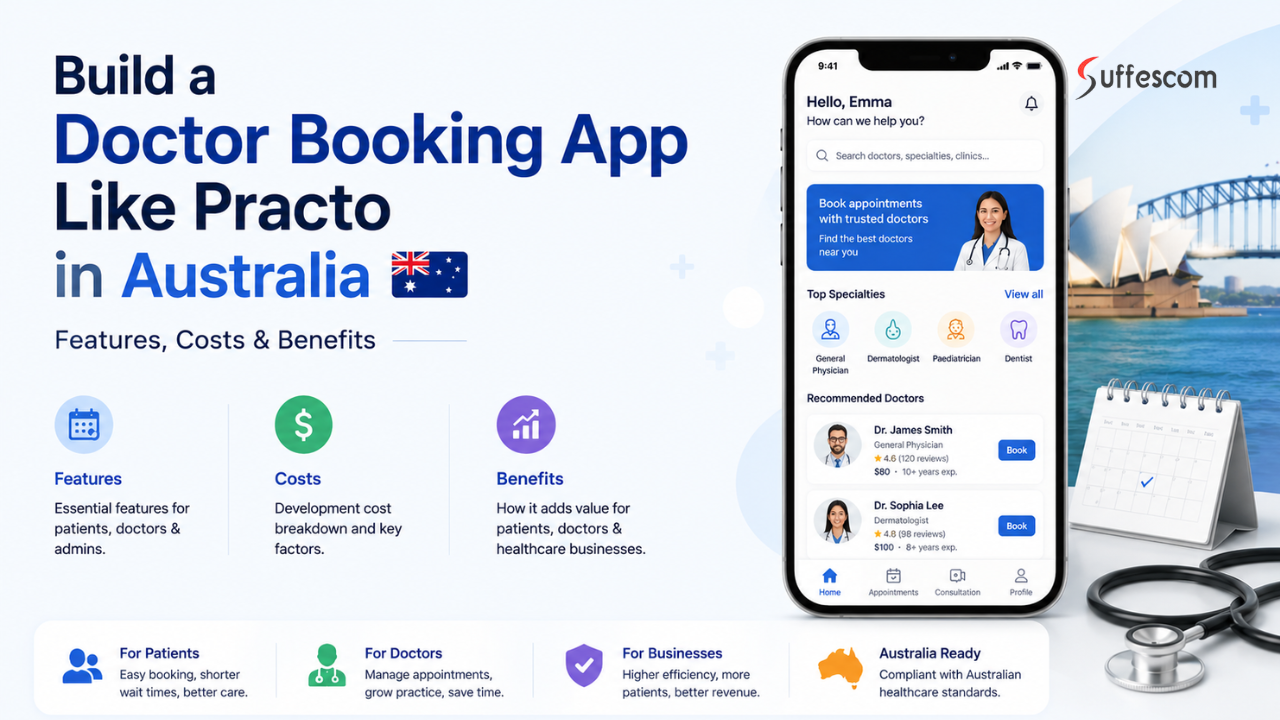
The Practo-like doctor booking app is a healthcare platform that enables connection between patients and doctors and pharmacies using the mobile application. Such apps provide a seamless experience for customers as they enable people to find doctors, review the ratings of these doctors, and make appointments on the same app.
In view of rising interest in telemedicine apps, a lot of healthcare startups are interested in Practo-like doctor booking app development in Australia, as this will improve their customer experience when they access healthcare facilities.
Practo Business Model
Practo is a healthcare platform offering various services to its users. Its revenue streams include appointment booking, consulting with doctors, subscription-based healthcare plans, and healthcare software for managing clinics and hospital services.
The platform primarily earns through:
- Commission per consultation or booking
- Subscription plans for doctors and clinics
- Featured doctor listings and advertisements
- Teleconsultation fees
- SaaS products for healthcare providers
- Partnerships with pharmacies and diagnostic labs
Core Services Offered by Practo
Some of the basic healthcare-related functionalities provided by doctor booking apps like Practo include:
- Online doctor appointment booking
- Telemedicine and video consultations
- Doctor discovery by specialty and location
- Digital prescriptions and health records
- Patient reviews and doctor ratings
- Medicine delivery integration
- Diagnostic test bookings
- Clinic management solutions for healthcare providers
The healthcare application development industry in Australia is incorporating similar functionalities in modern health applications, along with local services like Medicare and other health data security requirements.
How Doctor Discovery Platforms Work
Doctor discovery applications work as digital healthcare marketplaces in which users have accounts, conduct searches according to different parameters like specialty, location, consultation fees, languages, or time slots, and book appointments through the application.
The workflow typically includes:
- User registration and profile setup
- Doctor search and comparison
- Real-time appointment scheduling
- Online payment processing
- Video or in-person consultation
- Prescription and follow-up management
- Ratings and feedback collection
Advanced doctor booking apps also use AI-based recommendation engines to suggest suitable doctors based on symptoms and consultation preferences.
Examples of Successful Telehealth Platforms in Australia
There are many successful telehealth and doctor booking platforms operating currently in the digital healthcare space in Australia.
Some leading examples include:
- HotDoc: For online booking of GPs and clinic management services
- Healthengine: Largest healthcare booking platforms in Australia
- InstantScripts: For online prescription and consultation booking
- Doctor: For online consultations with Australian doctors
- Coviu: For telehealth consultations for healthcare professionals
The above platforms prove the demand for telehealth and medical appointment booking services, thus providing a strong ground to create another Practo-like app in Australia.
| Platform | Core Services | Telehealth Support | Prescription Services | Clinic Management | Target Market |
| Practo | Doctor booking, telemedicine, pharmacy | Yes | Yes | Yes | India & Global |
| HotDoc | Appointment booking | Limited | No | Yes | Australia |
| Healthengine | Doctor discovery & bookings | Yes | Limited | Yes | Australia |
| InstantScripts | Online prescriptions | Yes | Yes | No | Australia |
| Qoctor | Virtual consultations | Yes | Yes | Limited | Australia |
Create Your Healthcare App in Australia
Turn your idea into a scalable doctor booking platform designed for the Australian market.
Why Build a Doctor Booking App in Australia?
The healthcare industry in Australia has started adopting digital healthcare solutions in large numbers. Rising telemedicine adoption, lack of adequate healthcare facilities, and other factors can drive the need for a doctor booking app like Practo in Australia.
Growing Demand in Regional Areas
As per the Australian Institute of Health and Welfare, about 28% of the Australian population lives in regional or remote parts, where specialist health facilities are hard to access. The telemedicine solutions can help patients connect with doctors remotely through online sessions.
Rising Patient Expectations for Digital Healthcare
According to research, about 71% of the global population prefer accessing digital healthcare services such as online booking systems and virtual consultations. Patients now expect an easy experience in mobile healthcare involving such features as online prescription issuance and automatic reminders.
Healthcare Accessibility Challenges in Australia
Many Australians continue experiencing extended wait times when seeking specialist healthcare due to understaffed healthcare centers, especially those in remote areas. Doctor booking apps in such situations boost healthcare accessibility by allowing fast identification of doctors and remote healthcare consultations.
Opportunities for Private Clinics & Hospitals
As Australia’s private healthcare sector is expanding, there is a growing need for digital healthcare solutions. Private clinics and hospitals utilize telemedicine apps to enhance the scheduling of appointments.
Government Support
The Australian government remains committed to providing financial assistance for telehealth and digital healthcare infrastructures. The introduction of Medicare-funded telehealth services and national digital health programs has boosted telehealth apps in Australia.
Key Features of a Doctor Booking App Like Practo
For creating a doctor booking app similar to Practo in Australia, it is important to emphasize features that increase the convenience for patients and facilitate the management of the platform.
Patient Panel Features
It is aimed at providing users with a comprehensive healthcare solution, including finding a doctor, conducting online consultations, and managing their own healthcare.
User Registration & Profile Management
An option for registering an account and managing the personal profile, where patients will be able to enter medical information and store their preferences concerning healthcare.
Smart Doctor Finder with Filtering Options
Finding a doctor based on such parameters as specialty, localization, cost of consultation, feedback, schedule, and preferred language.
Specialty-Based Doctor Discovery
An option for users to find various specialists, such as dermatologists, cardiologists, pediatricians, psychiatrists, etc.
Online Appointments Booking
The option to book a visit to a doctor or conduct consultations in a remote mode.
Slot Availability Feature
Feature to check the schedule of the doctor and available slots for booking appointments.
Video Consultation and Telemedicine
Offers video calls for secure virtual doctor consultations.
Digital Health History
Manages electronic records of patient health histories, medication, and past consultations.
Access to E-Prescriptions
Patients can view and download prescription medications from the application.
In-app Secure Online Payments
Facilitates payment services using safe payment gateways, e.g., Stripe or PayPal.
Digital Payment Receipts
Generates payment receipts for payments and consultations.
Repeat Consultation Booking
Enables patients to book repeat consultations with previous doctors.
Medication Reminder Service
Reminds patients of medicines, appointments, and consultations that require regular attendance.
Push Notifications and Appointment Alerts
Gives instant notifications regarding booking, appointment, or consultation cancellations.
Online Ratings and Reviews
Provides patients with a platform for rating doctors’ services and sharing experiences.
Lab Report Upload and Management
Allows uploading, storing, and managing lab results and reports in the application.
Multi-Language Interface Support
Enhances accessibility by offering multiple languages for multicultural and multilingual communities in Australia.
Emergency Contact Services
Helps patients save contacts for emergency situations and share health details.
Doctor Panel Features
This panel aids healthcare professionals in scheduling and handling appointments, consultations, and patient communications effectively.
Verification of Doctor Profiles
It ensures that only genuine medical practitioners are listed on the application.
Appointment Calendar
Doctors will be able to schedule and monitor appointments and consult timing.
Doctor Availability
Healthcare professionals will be able to change their availability and schedule off in the app.
Medical History of Patients
Doctors will be able to look up the medical history of patients in previous consultations.
Digital Prescriptions
Facilities such as sending digital prescriptions will be available for doctors.
Consultation Dashboard
An integrated dashboard for virtual consultation is provided to doctors.
Automated Scheduling for Follow-Ups
Automatic scheduling for follow-ups and appointments is possible.
Consultation Analytics Dashboard
The dashboard shows information about appointment numbers and consultation analytics.
Consultation Revenue Tracking Dashboard
Doctors will be able to track their earnings from consultations and pay-outs.
Prescription Information Management
Previous prescriptions are stored on the app for future reference.
Encrypted Messaging
A feature where patients’ communications with doctors are secured.
Admin Panel Features
It takes care of the general management and performance of the doctor booking app like Practo.
User & Doctor Management
Administrators will be able to control user accounts, doctor accounts, and access to the website.
Verification of Healthcare Providers
It ensures that doctors and hospitals fulfill all the licensing and compliance requirements.
Revenue & Commission Generation
It helps in tracking income from subscriptions, commissions earned from appointments, and payments.
Analytics Dashboard
It provides analytics for user growth, bookings, consultations, and general platform performance.
Monitoring & Fraud Detection
It detects any fraud or unusual activities by users and doctors on the website.
Complaints Resolution System
Effective system for resolving customer complaints and queries.
Content & CMS Management
It will help in managing blogs, healthcare-related content, banners, and other information about the website.
Subscription Management & Payment Gateway
Managing payment systems and controlling subscriptions in an effective way.
Cybersecurity & Platform Monitoring
Security and monitoring of the platform’s data and cybersecurity issues.
Advanced Features That Can Outshine Practo
To create a booking application like Practo app in Australia, you need to think about advanced healthcare options that could enhance accessibility, personalization, and engagement. AI development and integration could prove useful for start-ups wishing to compete in Australia’s telemedicine space.
AI-Driven Symptom Checker
AI symptom checkers help patients know about possible health conditions before booking consultations. For instance, AI-assisted triaging would help to point patients towards specialists considering their symptoms and the level of urgency.
AI-Driven Recommendations for Suitable Doctors
AI algorithms can recommend suitable doctors based on symptoms and location. Such applications as HealthEngine feature intelligent searching and booking functionalities that could assist patients in finding relevant healthcare providers.
Voice Navigation for Senior Citizens
Voice navigation could facilitate healthcare access for senior citizens. Patients will be able to search for “book a GP near me” using only voice commands.
Integration with Wearable Devices
Integration with wearable devices such as Apple Watch and Samsung Health could provide real-time data regarding heart rate and physical activity.
Clinical Notes Using AI
AI can help physicians to automatically prepare consultation notes when carrying out teleconsultations. For instance, telemedicine providers in Australia using voice-based medical documentation can save a lot of time.
Follow-Up Consultation and Medication Reminders
Medical applications can provide follow-up consultations and medication reminders for patients with a medical history. For instance, diabetics can automatically receive monthly checkup reminders.
Patient Health Risks Predictions Dashboard
AI can be used to analyze the patient’s health risks by detecting any anomalies in hypertension, diabetes, or heart disease. For instance, health risk prediction algorithms can use a patient’s vital signs and consultation history to predict health risks.
Mental Health Features and Services
Applications that have therapy appointment booking and meditation services are important due to the increasing number of people suffering from mental problems in Australia. For instance, mental counseling services can be booked through the application.
Family Health Management Profiles
Family health management services allow users to keep track of medical histories and book consultations for their children or aged parents. For instance, patients can schedule pediatric consultations.
Automated Prescription Refills
AI can enable the automation of prescriptions. For instance, online platforms like InstantScripts offer an efficient way of handling prescriptions for Australians.
Chronic Disease Remote Management Solution
Remote management solutions can assist in chronic illness control, such as asthma and diabetes. For example, users can send blood glucose levels and blood pressure reports to their physicians using an app.
Queue Prediction of Offline Clinics
AI-driven queue predictions minimize wait time at clinics. For example, patients can predict delay time during consultations prior to visiting healthcare centers.
Health Insurance Claiming Platform
An insurance claiming platform can facilitate claim submission and payment tracking. For instance, users can transmit online consultation bills to health insurance companies in Australia.
Build a Healthcare MVP First in 14 days
Validate your healthcare app idea quickly before investing in full-scale development.
Compliance & Regulations in Australia
Understanding Australian Privacy Principles (APPs)
The Australian Privacy Principles (APPs) obligate all healthcare apps to comply with the APPs (under the Privacy Act 1988) when processing patient information. Patient information can only be collected, stored, accessed, and shared as outlined by the APPs. Transparency around data handling and control over the user’s personal health information are two of the principles that govern how healthcare apps in Australia work.
Healthcare Data Security Requirements
Healthcare platforms in Australia are required to meet high standards for information security. This includes creating and maintaining secure credentials, using encrypted databases and incorporating access control systems based on roles.
HIPAA vs Australian Compliance Standards
The U.S. has HIPAA as its healthcare regulatory framework, while Australia has its own privacy and healthcare regulations. The difference between the two approaches is that the Australian compliance model emphasises the APPs and the My Health Record regulations (unique to Australia) and national digital health standards. If a company is developing a solution for Australian users, then compliance with local requirements should be the primary compliance requirement, not U.S.-based HIPAA compliance.
GDPR Considerations for Global Users
If a healthcare app is first targeting customers in Australia or has customers in Europe, then that app is required to follow the U.S. HIPAA and comply with the General Data Protection Regulation (GDPR) as well.
Telehealth Compliance Checklist
Telemedicine platforms in Australia should follow approved telehealth practices, including:
- Secure video consultation systems
- Patient identity verification
- Digital consent collection
- Protected medical record storage
- Secure payment processing
- Licensed healthcare provider verification
Data Encryption
Healthcare apps should use end-to-end encryption and cloud platforms like AWS or Google Cloud with healthcare grade security configurations. Secure cloud storage is very important for safeguarding electronic health records and telemedicine data.
Consent Management for Patients
Australian healthcare apps must obtain clear patient consent before collecting or sharing medical information. Users should be informed about how their data is used, stored, and processed within the platform.
| Compliance Area | Australia Requirement |
| Patient privacy | Australian Privacy Principles (APPs) |
| Data hosting | Secure cloud infrastructure |
| Telehealth standards | Government-approved practices |
| Payments | PCI DSS compliance |
| User consent | Mandatory consent collection |
Technology Stack for Building a Practo-Like App
Choosing the right technology stack is essential when planning to build a doctor booking app like Practo in Australia.
Recommended Tech Stack
| Component | Recommended Technologies |
| Mobile App | Flutter, React Native |
| Web Frontend | React.js, Angular |
| Backend | Node.js, Django, Spring Boot |
| Database | PostgreSQL, MongoDB |
| Video Calling | Twilio, Agora, Vonage |
| Cloud Infrastructure | AWS, Azure, Google Cloud |
| AI Modules | Python, TensorFlow, PyTorch |
| Notifications | Firebase Cloud Messaging, Twilio |
| DevOps & CI/CD | Docker, Kubernetes, Jenkins |
| Payments | Stripe, PayPal |
Step-by-Step For Practo-Like App Development
Practo-like healthcare app development needs an extensive development process centered around scalability, compliance, performance, and UX. A healthcare platform that manages medical information and communicates in real time, both front-end and back-end need to be developed strategically from scratch.
Conduct Market Research
The development process begins with the analysis of the telehealth market and gaps in healthcare availability, and competitor apps such as HotDoc and HealthEngine. Businesses will have to assess their compliance capabilities under Australian Privacy Principles (APPs).
Define Product Scope & Development Roadmap
Following this step, businesses will finalize their product scope by determining necessary functions, roles, workflows, and other components of the healthcare app. They can either develop a full-scale application or opt for MVP development to validate their market position quickly.
Wireframes & UI/UX
The UI/UX phase focuses on designing intuitive healthcare workflows for patients, doctors, and administrators. Since healthcare apps are used by people across different age groups, the interface must remain simple and responsive.
- Appointment booking workflows
- Dashboard layout
- Video consultation interface
Build Frontend Applications
Front-end development is the creation of Android, iOS, and web interfaces using a framework, such as Flutter or React Native. App developers work on reusable UI components, integrate APIs, and optimize real-time interactions with users.
Key frontend components include:
- Patient and doctor dashboards
- Appointment booking interfaces
- Video consultation screens
- Search and filtering systems
- Real-time notification modules
Develop Backend Architecture
Back-end development of a Practo-like app will power the core of the healthcare platform’s functionality, such as authentication, appointment scheduling, telemedicine infrastructure, notifications, healthcare data processing, and payment management.
Most doctor booking apps will use scalable technologies to develop the back-end architecture, including:
- Node.js or Django for backend development
- PostgreSQL or MongoDB for database management
- RESTful APIs or GraphQL APIs
- Redis caching for performance optimization
- Cloud infrastructure like AWS or Azure
Integrate APIs
APIs are integrated into third-party applications for various purposes such as accelerating the development of telemedicine applications and improving the scalability of applications through an API that allows for video consultation, cloud storage, notifications, analytics, and secure payment integrations. Here are some common third-party integrations:
Common integrations include:
- Twilio or Agora for video consultations
- Stripe or PayPal for payment processing
- Firebase for push notifications
- Google Maps for location services
- AWS S3 for cloud storage
Perform Security Testing
Security testing is an important step in healthcare app development. Given the nature of the application and the confidential nature of patient and medical record data the platform handles, security testing is of utmost importance during app development.
Healthcare applications undergo numerous security tests throughout the SDLC process, including API security testing, penetration testing, authentication validation, encryption validation, load testing, and database security audits. In addition, most modern healthcare applications incorporate end-to-end encryption, multi-factor authentication, audit logs, and secure cloud storage when developing a healthcare application to comply with Australian regulations.
Deploy to App Stores
Upon completion of security testing, the healthcare application will be ready to deploy to production servers and be submitted to the Google Play Store and Apple App Store. Most modern healthcare applications implement CI/CD and Kubernetes for infrastructure management and faster deployment.
The deployment process generally includes:
- Production server configuration
- CI/CD pipeline setup
- Docker and Kubernetes deployment
- Monitoring and logging integration
- App Store and Play Store publishing
Launch & Marketing Strategy
Once deployed, companies are primarily focused on onboarding healthcare providers, obtaining users and expanding the visibility of their platform through SEO (Search Engine Optimization), ASO (App Store Optimization), referral programs, partnerships with the healthcare community and paid advertising campaigns.
Continuous Product Optimization
Healthcare app development does not end with the launch. The development team will continue to optimise the product based on analytics and feedback received from users. The development team may continually work on:
Post launch optimization commonly involves:
- Feature enhancements and AI integrations
- Database and infrastructure optimization
- Performance monitoring and analytics
- Security patch updates
- User experience improvements
Cost to Build a Doctor Booking App Like Practo in Australia
In Australia, the cost to build a doctor booking app will vary depending on numerous technical and operational factors. Building a healthcare platform entails multiple technical and operational aspects.
Estimated App Development Cost in Australia
| Development Stage | Estimated Cost |
| MVP App | AUD 30,000 – AUD 60,000 |
| Mid-Level App | AUD 60,000 – AUD 120,000 |
| Advanced AI-Powered App | AUD 150,000+ |
Factors Affecting Development Cost
Feature Complexity
The complexity of your app’s development directly correlates to how many different systems will need to be created and how they will be interconnected. For instance, if your app is only designed to allow users to make doctor appointments by viewing a list of doctors and using a dentist’s appointment as an example, your app will have a limited amount of backend logic associated with it.
However, if you expand your platform’s features to include adding digital prescriptions, scheduling follow-ups with your doctor, synchronizing availability with real-time or adding patient history, you are exponentially adding to the number of interdependencies in your platform, making it more complex and therefore costing more to create.
Platform Selection
Depending on which platform you choose, the amount of engineering effort required and how that will be allocated will also affect your overall development cost.
For instance, if you created your app using different code for both iOS and Android, you would have two completely separate apps with two different codebases and they would have different UI/UX designs, thus increasing cost, which can be reduced by creating a single cross-platform architecture.
UI/UX Design Requirements
Healthcare apps require highly accessible and user-friendly interfaces for diverse user groups, which increases Practo-like app development cost.
Example: Designing a simplified booking flow (search → select slot → confirm → pay) requires multiple iterations of user testing and UI refinements, which increases design and frontend development cost due to higher complexity.
Telemedicine & Video Consultation Infrastructure
Real-time communication systems/facilities need to have secure communication for streaming services, orchestrated by backend services to allow for optimized data usage by infrastructure.
Example: The process of creating video consultations and streaming with encryption, session management, failover systems, and supporting recording will add more backend processes, increase the infrastructure required to support additional system complexity and utilization, and thus cause higher development and operational costs.
Backend Architecture & Scalability
Backend systems must have the ability to handle a large number of concurrent data requests, process securely, and update instantly.
Example: If you want a system to handle thousands of appointments being booked at any given time with load balancing, having cached information and distributed database systems will increase backend infrastructure complexity, thereby increasing development costs.
Compliance & Security Requirements
Healthcare applications must meet rigorous data protection standards to protect the security of patient records.
Example: If you add encrypted medical records with role-based access control, audit logs, and secure login processes, this will significantly increase the level of effort to create the software and develop additional security for these records, thereby increasing total development costs.
Upgrade Your Clinic Digitally
Help your clinic or hospital move to a modern online booking and telehealth system.
Timeline to Develop the App
The timeline for developing a doctor booking app like Practo in Australia will require a defined structure with defined stages, phases, and an estimated timeframe depending on how complex the system is, how many features are available, how deep the integration is and what type of compliance is needed. A typical end-to-end build may take anywhere from several months for a simple system that is functional to much longer, for a fully scalable healthcare platform with advanced features.
Estimated Development Timeline
| Phase | Duration |
| Research & Planning | 2–4 weeks |
| UI/UX Design | 3–5 weeks |
| MVP Development | 8–14 weeks |
| Testing & QA | 2–4 weeks |
| Full Launch | 4–6 months |
Revenue Models for a Practo-Like App
A doctor booking platform in Australia would typically not utilize just one revenue stream. Rather, it utilizes multiple revenue streams through a tiered structure based on transaction volume and service usage. Let’s discuss some of the main revenue strategies for a Practo-like app in Australia.
Subscription Plans for Doctors
In this type of doctor subscription model, the physicians and clinics pay a monthly fee to access the platform.
Example: If there is a small clinic in Sydney that utilizes this subscription model, the clinic could pay a monthly fee to manage its patient bookings online to reduce the need to call patients to schedule appointments. One of the monthly subscription levels provides the ability for the clinic to be displayed above others in search results.
Commission Per Appointment
This is the simplest form of generating income. A service fee is charged by the platform every time an appointment is booked through the platform. This applies to both face-to-face appointments and telehealth appointments.
Example: A patient schedules a consultation with their physician for $120. A service fee is deducted from the total paid for the service that was booked on the platform. With thousands of consultations booked through this platform on a daily basis, this represents a significant source of income.
Featured Listings
Doctors and clinics will pay to be featured at the top of search results. This is similar to digital advertising, but it is driven by the demand from patients for health services.
Example: A physiotherapist clinic in Melbourne pays to be featured at the top of the search results when someone searches for “back pain treatment.” As a result, the clinic receives an increase in patient inquiries, which will generate consistent revenue for the platform.
Teleconsultation Charges
Whenever a video consultation is conducted, there is a substantial infrastructure cost associated with the technology used. The platform charges a service fee to enable the service.
Example: A patient chooses to conduct their appointment via video rather than in person. In addition to the consultation fee, the platform will collect a service fee to cover the infrastructure and technology required for secure video consultations.
Pharmacy Partnerships
This model connects prescriptions to medicine fulfillment. After a consultation, patients can order medicines directly through partner pharmacies integrated into the platform.
Example: A physician will write a prescription for a patient after the consultation. The patient will use their app to order the prescribed medication. The pharmacy will pay a referral commission for the patient that the platform referred to them.
Diagnostic Lab Partnerships
The platform will also be used to connect users with clinical diagnostic labs. This expands the platform from just consultations into preventative health care. Revenue is generated through booking commissions and referral fees.
Example: A physician will recommend that a patient needs a blood test. The patient will use the app to make an appointment for their blood test. The clinical diagnostic lab will pay a booking fee for the patient made through the platform.
In-App Advertisements
This model generates revenue through advertisements associated with the health care industry. Ads are typically related to user behavior, search intent, or location.
Unlike the general advertising platforms, where click-through rates are important, this model is more about relativity and thus allows for only ads that relate to health care products and/or services.
Example: When a user searches for a dermatologist, they may see ads for skin clinics or health insurance plans on the app. Advertisers will pay a set fee for all impressions.
Challenges in Building a Healthcare App
There are many challenges when building a doctor appointment application or a telemedicine application in Australia. The technical, regulatory and operational challenges are complex. The application will be handling sensitive patient information that requires a high level of privacy and security. As such, the entire application (from the infrastructure to the experience of the user) must be designed with great care and detail and be able to support an array of different healthcare interactions in real time.
Data Privacy & Security Risks
Healthcare applications contain a high volume of sensitive data, including medical records, prescriptions, consultation records, and payment information, which makes them susceptible to unauthorized access and attacks from the outside. Therefore, a healthcare application should have the utmost security features, including but not limited to: Strong encryption, secure API communication, role-based access control, and continuous monitoring.
For example, if encryption is not applied consistently across the databases and communications, then patient medical records can be intercepted while being transmitted or obtained from an unsecured database. Such occurrences will have serious implications for compliance and trust.
Doctor Verification Challenges
A doctor registration and verification process is required so that only qualified doctors can use the system. The verification process requires checking that the doctor holds a valid registration number, verifying a doctor’s credentials and verifying their identity.
For example, if verification relies only on uploaded documents, without being cross-referenced against the official doctor register, then unqualified doctors can potentially access the system. The safety of the patients and the credibility of the platform will be affected.
Managing Real-Time Availability
Availability of healthcare professionals varies by multiple factors, such as consultations with patients, emergencies during the day or adjustments to their schedules (which include all forms of healthcare). Therefore, the system must provide accurate and timely updates of available times (slots) across all forms and functions in order to ensure that they do not have conflicting appointments with patients.
For example, if a physician has a calendar updated every 15 minutes and the appointment is reserved for that time, however the patient books the appointment, there may be two patients trying to book the same appointment at the same time, which will result in a double booking and damage to the practice.
Handling High Video Consultation Traffic
Telemedicine relies upon a real-time video infrastructure; therefore, the real-time video infrastructure must be capable of remaining stable despite the varying network environments and the availability of other users using video for their healthcare consultation. This requires managing bandwidth, latency, and continuous video connectivity.
For example, if a video to a patient is dropped and the quality of that video is inconsistent, it may result in call quality issues, including poor quality video or delays in audio or response times to patients.
Compliance Complexity
Healthcare applications need to comply with many regulatory requirements in Australia; these include regulations regarding the privacy of data, the management of consent, and how telehealth can operate. All of these regulations impact how the system is designed, how data is processed (the flow of data), and how the data is retained.
For example, if a patient’s consent is not appropriately recorded prior to the retention of their medical data (including but not limited to the start of a consultation), then that healthcare application may not be compliant with regulatory requirements, irrespective of whether all the software features of the application function correctly.
Scalability Challenges
With the growth of the healthcare platform, the number of users, the number of appointments, and the amount of real-time transactional data that the platform has to process each day is considerable. The growth of the platform will require an appropriate scalable architecture, caching technology, and distributed infrastructure.
For example, if the backend technology does not have the appropriate load balancing and scaling practices in place, then the sudden spike in the volume of new appointment bookings can cause the response time for the application to slow down and ultimately affect a patient’s ability to book an appointment or access a consultation.
How to Make Your App Better Than Practo
To be competitive in the Australian healthcare market, a doctor appointment booking app should provide far more than just making appointment bookings. The primary focus should be local healthcare gaps/needs; build trust in the platform; and provide faster and more individually tailored healthcare experiences to the consumer/patient through technology-driven solutions.
Focus on Australian Healthcare Needs
The app’s platform must be designed to meet all of the workflows that operate within Australia’s unique healthcare system in regard to referrals, local clinic structure, and telehealth regulation, and also be designed to meet the access requirements of both urban and rural healthcare delivery systems.
Build AI-Driven Personalization
AI personalisation is a great solution for increasing the relevance of any potential doctor recommendation by using symptom patterns, the patient’s history, and past doctor visits. Not only does this make doctor recommendations more relevant, but it also greatly reduces the amount of time the patient will need to spend searching for a suitable doctor.
Offer Faster Consultation Matching
It should also be very easy for end users to see that the doctor they are being recommended to is verified with the appropriate regulatory body, thereby providing the end-user confidence that they are seeing a truly verified healthcare professional.
Improve Doctor Verification Transparency
The doctor review system should have structured and verifiable reviews of all healthcare professionals, therefore ensuring that patients would have a more reliable method of determining which doctor they should go to.
Create a Better Review Authenticity System
The majority of reviews are incorrectly structured or non-verified, resulting in fraudulent and/or incorrect feedback. As a result of this, consumers will have greater confidence in their decision to select a healthcare provider by increasing the reliability of the data available.
Improve Rural Telehealth Accessibility
The platform must ensure that customers will be able to use the tele-health services regardless of where they live, including areas with poor or limited access to broadband internet. Video performance and bandwidth will need to be optimized for remote locations.
Build Accessibility Features for Seniors
Senior citizens must have access to a simplistic interface with large UI components, voice command applications, and simplified navigation flows.
AI & Future Trends in Telehealth Apps
Telehealth Platforms in Australia are being revolutionized through AI and new technologies. Telehealth platforms have changed from simple booking applications to complete intelligent systems, including features such as assisting with early diagnoses, automating clinical tasks & supporting long-term monitoring of patients outside hospital settings.
AI Chatbots in Healthcare
Chatbots powered by AI are beginning to be utilized by healthcare providers to address issues for patients, including checking symptoms, scheduling appointments, and guiding patients. This results in a decrease in work for support staff while improving response time for patients needing immediate assistance.
An example of this is when a patient who is suffering from flu-like symptoms has an interaction with a chatbot that will ask a specific series of questions and will make a recommendation for the patient on whether or not they should visit a GP or if they can manage their care with home care.
Predictive Healthcare Analytics
A predictive analytical model uses both the past history of patients as well as their behavior to identify the potential for future health risks prior to them becoming problematic. This assists physicians in making proactive interventions with patients in order to increase positive long-term outcomes.
In an example of this, if a patient repeatedly has high blood pressure readings at each visit, the system would flag this patient as high risk and the system would recommend that the patient return for follow-up visits, preventing complications.
Generative AI for Clinical Documentation
Generative A.I. assists health care providers in lessening their administrative burden by automatically generating documentation such as templates for consultation notes, summary reports, and draft prescriptions based on patient-provider conversations.
For example, during a telehealth visit, A.I. could convert verbal conversation notes into formalized clinical documentation, eliminating the need for the provider to manually enter any information into their electronic health record (EHR)
Voice-Based Telemedicine
Voice-activated platforms give patients access to health care services through the use of their voice, enabling older adults or patients with limited technology skills to use telehealth services.
For example, a patient could use their voice to schedule an appointment, describe their symptoms, or request a refill for their medications without having to navigate different menus in an AI based technology platform.
Blockchain in Health Records
The use of blockchain technology can enable secure storage and management of health care records with assurance of the integrity of the data and controlled access to it between providers.
For example, if a patient has their medical record stored on a secure blockchain, then they and various specialists who may have treated the patient could securely exchange health information without putting the patient at risk.
Personalized Preventive Healthcare
AI-driven personalization helps create tailored health recommendations based on individual habits, medical history, and risk factors.
A user with a sedentary lifestyle and family history of heart disease will receive recommendations from the system on how to achieve this by incorporating routine check-ups, exercise, and diet changes into their lives to reduce their risk in the future.
Final Thoughts
Developing a booking application for doctors, such as Practo, provides a large market opportunity in Australia. However, due to the highly regulated nature of this type of service and its reliance on a high level of trust between patients and healthcare providers, it will require a combination of real-time reliable systems, solid compliance, and smooth user experience for both patients and physicians to be successful. In addition, the increasing demand for telehealth and access to medical services from rural areas will support the longevity of digital healthcare providers.
For entrepreneurs looking to develop successful booking applications, the objective is not just to create carbon copies of currently successful applications; instead, they should focus on solving basic challenges within the healthcare system, including appointment confirmation and verification of health providers, as well as secure management of patient information (i.e. data privacy and security) Related to the above-mentioned issues, platforms that demonstrate excellence in execution of these core tenets of the user experience will likely develop long-lasting relationships with their users because of the trust established.
The future of telehealth will be towards an integrated system whereby each element of an individual’s healthcare is part of a coordinated system, including initial consultation, diagnostic procedures, prescription fulfillment, and remote monitoring of chronic illnesses (or other health issues). AI will add to the development of these systems by improving personalization and automation at every step in the healthcare journey.
Selecting the proper healthcare app development company is also essential, as your application’s system design, compliance, and ability to scale will be highly influenced by your choice of development partner. Choosing an experienced development partner will help you create secure, scalable, and future-proofed healthcare applications.
Book a Free 30 Minute Consultation
Discuss your healthcare app idea with specialists and plan your next steps.
FAQs
1. What are the estimated costs associated with developing a doctor booking app similar to Practo platform in Australia?
The overall cost of developing an MVP (minimum viable product) is likely to be approximately AUS$ 30,000 for a basic healthcare application. However, if you want a more advanced application with Artificial Intelligence and other advanced technologies then you should expect to pay at least AUS $150,000 for development.
2. What are the must-have features in a telemedicine app?
Core features of a telemedicine app include doctor search, appointment booking, video consultations, digital prescriptions, secure payments, user profiles, and real-time notifications.
3. How long do I need to develop a Healthcare app?
Development of a basic version of a health care app will take approximately 3-4 months. A complete healthcare platform (such as a full-fledged appointment scheduling, video consultation and telehealth) will take longer, up to and over 4-6 months.
4. Is Telemedicine Legal In Australia?
Yes, Telemedicine is legal in Australia as long as it follows federal healthcare laws like the patient’s informed consent, patient data privacy and confidentiality laws, and the patient’s consent to receive
5. What are the security measures for health apps?
Health applications require several key security measures, including encrypted data; the establishment of secure API connections and data transfers; role-based access control; logs recording activity performed by any component within the application’s system.
6. Is there any impact of using an AI doctor booking app?
AI integration helps to enhance a doctor’s matching function, symptom checking capability, appointment scheduling process and clinical documentation/cataloging ability, thus creating a more efficient and easier-to-use platform on which to interact.
7. How can startups compete with Practo in Australia?
Startups can compete by focusing on local healthcare needs, improving telehealth accessibility, offering better user experience, and building stronger doctor verification systems.
8. How Can Healthcare Apps Improve Rural Healthcare Access?
By providing users access to teleconsults, low-data video systems, remote patient monitoring systems and connecting patients from rural areas to specialists in urban centers.
9. Why do some users stop using doctor booking apps?
Users often stop due to poor trust, inaccurate appointment scheduling, weak support systems, slow app performance, or inconsistent doctor availability.

Senior Content Strategist
Jonathan Raabe works as a Senior Content Writer at Suffescom Solutions with an experience of 7+ years of writing for the technology and app development industry. He writes quality content about mobile app development, AI solutions, cloud technologies, enterprise software, and new trends in the digital world. Rabby creates content that both educates and contributes to business success. His skill in breaking down complex topics into understandable and relatable narratives has helped companies build their digital presence.

Need Help With
Development?